Process for producing proteoglycan
a technology of proteoglycan and process, applied in the direction of immunoglobulins, peptides, drug compositions, etc., can solve the problems of difficult extraction of proteoglycan without any change, high cost involved in extraction and purification, and cannot be said that conventional methods like them are at the level of commercial application, so as to reduce the cost of proteoglycan production, and reduce the volume of industrial waste
- Summary
- Abstract
- Description
- Claims
- Application Information
AI Technical Summary
Benefits of technology
Problems solved by technology
Method used
Image

Examples
example 1
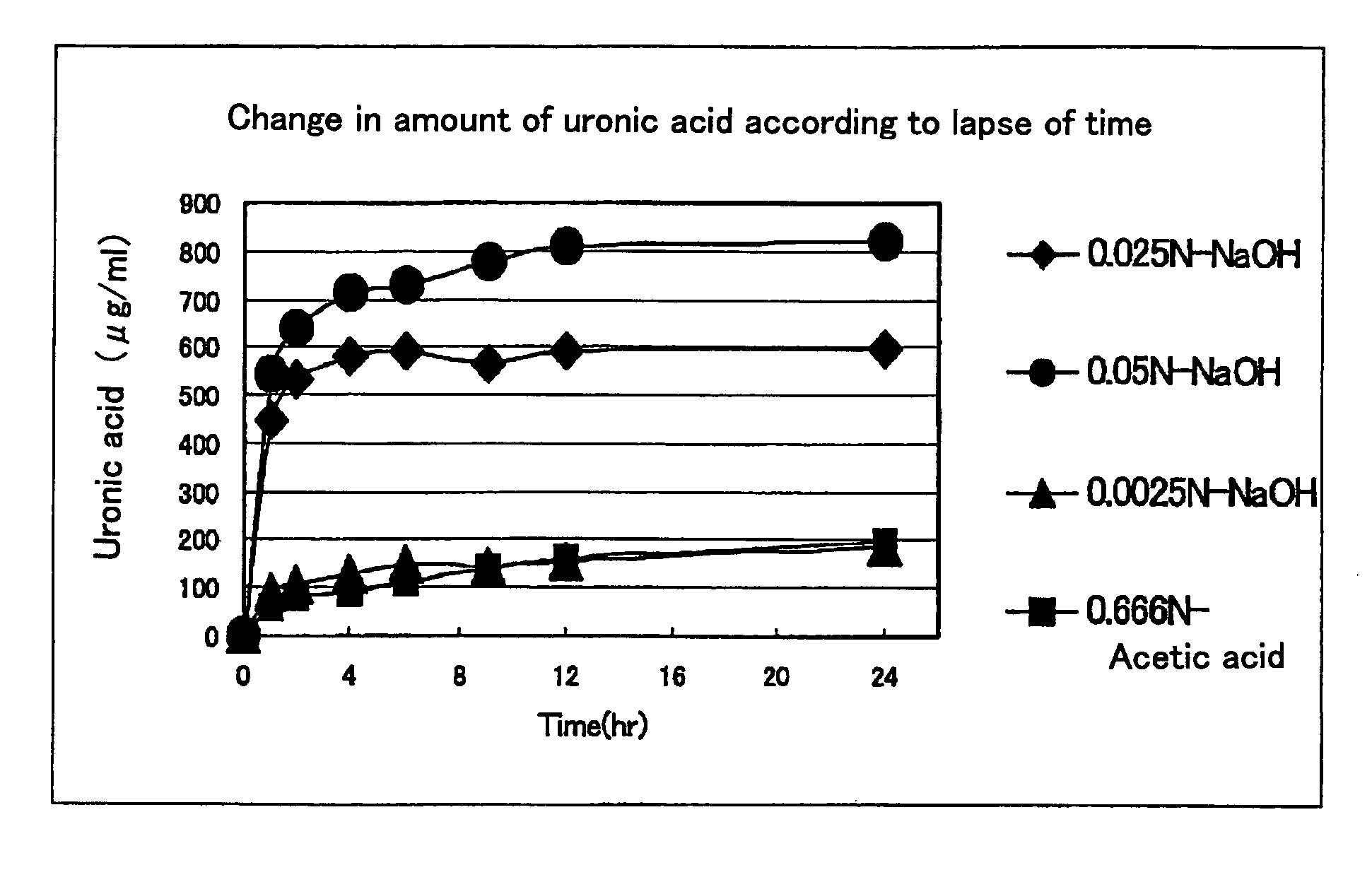
[0035]Nasal cartilage removed from a head part of Oncorhynchus keta salmon that had been frozen and stored at −40° C. was chopped using an electric meat chopper into tiny pieces in minced shape. 200.00 g of such minced pieces were used as a starting material. To a 5 liter extraction vessel, 2397.60 g of distilled water that had been previously chilled to 0° C. was added and 2.40 g of solid sodium hydroxide was further added thereto to prepare 2400.00 g in total of an aqueous solution of sodium hydroxide (0.025 N). To this extraction vessel, the above-described starting material (200.00 g) was added and immersed for 9 hours while stirring the contents with a stirrer.
[0036]Upon completion of the immersion, the contents were transferred to another vessel over which a stainless steel filter (1 mm) was placed so that an extract including proteoglycan can be recovered.
[0037]The extract was subjected to centrifugation for 20 minutes at 3500 rpm by using a centrifuge (IWAKI CFS-400 type). A...
example 2
[0044]Nasal cartilage removed from a head part of Oncorhynchus keta salmon that had been frozen and stored at −40° C. was chopped using an electric meat chopper into tiny pieces in minced shape and immersed in acetone, and the nasal cartilage was dehydrated and defatted. 24.00 g of the treated nasal cartilage, after air drying or drying under reduced pressure, were used as a starting material. To a 5 liter extraction vessel, 2997.75 g of distilled water that had been previously chilled to 5° C. was added and 2.25 g of solid sodium hydroxide was further added thereto to prepare 3000.00 g in total of an aqueous solution of sodium hydroxide (0.02 N). To this extraction vessel, the above-described starting material (24.00 g) was added and immersed for 9 hours while stirring the contents with a stirrer.
[0045]Upon completion of the immersion, the contents were transferred to another vessel over which a stainless steel filter (1 mm) was placed so that the nasal cartilage is removed and an ...
example 3
[0051]Nasal cartilage removed from a head part of Oncorhynchus keta salmon that had been frozen and stored at −40° C. was chopped using an electric meat chopper into tiny pieces in minced shape and immersed in acetone, and the nose cartilage was dehydrated and defatted. 17.90 g of the treated nasal cartilage, after air drying or drying under reduced pressure, were used as a starting material. To a 5 liter extraction vessel, 2322.67 g of distilled water that had been previously chilled to 5° C. was added and 2.33 g of solid potassium hydroxide was further added thereto to prepare 2325 g in total of an aqueous solution of potassium hydroxide (0.018 N). To this extraction vessel, the above-described starting material (17.90 g) was added and immersed for 9 hours while stirring the contents with a stirrer.
[0052]Upon completion of the immersion, the contents were transferred to another vessel over which a stainless steel filter (1 mm) was placed so that the nasal cartilage is removed and ...
PUM
| Property | Measurement | Unit |
|---|---|---|
| molecular weight | aaaaa | aaaaa |
| temperature | aaaaa | aaaaa |
| temperature | aaaaa | aaaaa |
Abstract
Description
Claims
Application Information
 Login to View More
 - R&D
- Intellectual Property
- Life Sciences
- Materials
- Tech Scout
- Unparalleled Data Quality
- Higher Quality Content
- 60% Fewer Hallucinations
Browse by: Latest US Patents, China's latest patents, Technical Efficacy Thesaurus, Application Domain, Technology Topic, Popular Technical Reports.
© 2025 PatSnap. All rights reserved.Legal|Privacy policy|Modern Slavery Act Transparency Statement|Sitemap|About US| Contact US: help@patsnap.com