
Oral solid preparation containing ambroxol hydrochloride and guaifenesin active components
A technology of guaiacol glycerol ether and ambroxol hydrochloride, which is applied in the directions of ether/acetal active ingredients, pill delivery, respiratory system diseases, etc., can solve the problems of high production cost, inconvenient portability, easy precipitation and the like , to achieve the effect of low production cost, easy portability and simple process
- Summary
- Abstract
- Description
- Claims
- Application Information
AI Technical Summary
Problems solved by technology
Method used
Image

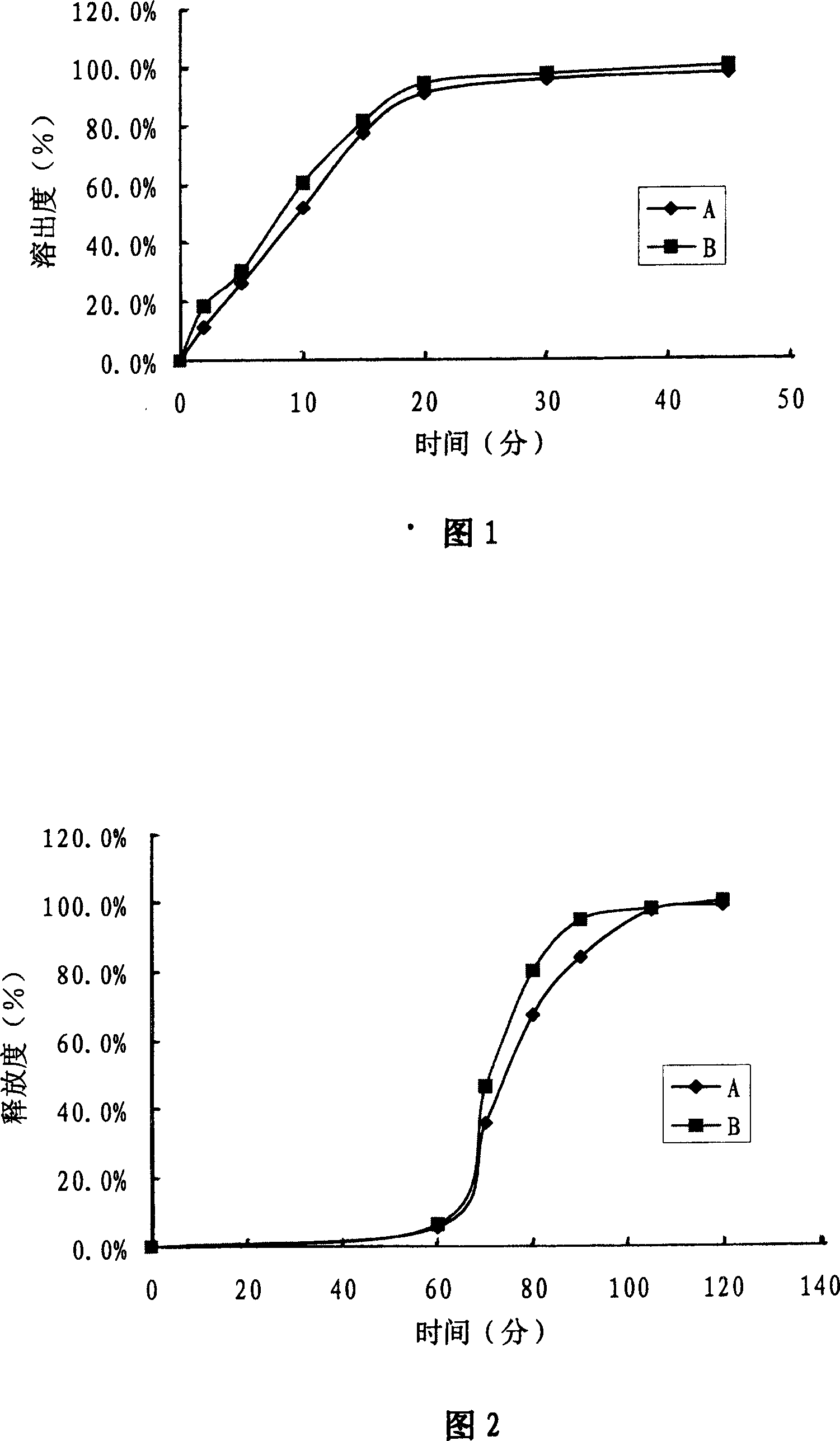
Examples
example 1
[0025] Example 1: (tablet) (quantity of 100 tablets)
[0026] Ambroxol Hydrochloride 3g
[0027] Guaifenesin 10g
[0028] Lactose 10g
[0029] Starch 2.0g
[0030] Polymicroketone 1.0g
[0031] Sodium carboxymethyl starch 1.0g
[0035] Pass the main drug and auxiliary materials through a 100-mesh sieve respectively, fully mix, then weigh the prescription amount of auxiliary materials and fully mix with the main drug. Then add 8% starch slurry to make soft material, granulate with 20 mesh sieve, dry at 55°C, and granulate with 18 mesh sieve. Finally, add the lubricant and mix evenly for tableting.
example 2
[0036] Example 2 (dispersible tablets) (100 tablets)
[0037] Ambroxol Hydrochloride 1.5g
[0038] Guaifenesin 10g
[0039] Lactose 10g
[0040] Microcrystalline Cellulose 3.0g
[0041] Carboxymethyl Starch Sodium Add 0.5g plus 1.0g
[0042] Aspartame 0.1g
[0043] Orange flavor 0.1g
[0044] 2% hypromellose qs
[0045] Silica qs
[0046] Pass the main drug and auxiliary materials through a 100-mesh sieve respectively, fully mix, then weigh the prescription amount of auxiliary materials and fully mix with the main drug. Then add binder to make soft material, granulate with 20-mesh sieve, dry at 55°C, and granulate with 18-mesh sieve. Add lubricant and remaining carboxymethyl starch sodium at last and mix and compress evenly.
example 3
[0047] Example 3: (orally disintegrating tablet) (quantity of 100 tablets)
[0048] Ambroxol Hydrochloride 1.5g
[0049] Guaifenesin 5.0g
[0050] Mannitol 10.0g
[0051] Microcrystalline Cellulose 2.0g
[0052] Croscarmellose Sodium, 1.0g
[0054] Silica qs
[0055] Pass the main ingredient and auxiliary materials through a 100-mesh sieve, mix thoroughly, press the cake with a roller press, pass through a 18-mesh sieve with a granulator for granulation, and finally add a lubricant and mix evenly for tableting.
PUM
 Login to View More
 Abstract
Description
Claims
Application Information
 Login to View More