Unlock instant, AI-driven research and patent intelligence for your innovation.

Polyethylene glycol monomethyl ether-polycaprolactone-polyphosphate triblock copolymer and siRNA medicament carrier prepared thereby

A technology of polyethylene glycol monomethyl ether and polycaprolactone, which is applied in the field of siRNA drug carriers, can solve the problems of difficult process amplification and poor repeatability, and achieve good stability, high repeatability and good application prospects Effect

Inactive Publication Date: 2009-07-08
UNIV OF SCI & TECH OF CHINA
View PDF0 Cites 20 Cited by
  • Summary
  • Abstract
  • Description
  • Claims
  • Application Information

AI Technical Summary

Problems solved by technology

The traditional methods use water-soluble cationic polymers to mix these carrier molecules with siRNA to obtain complexes or nanoparticles of the two, so as to achieve the purpose of delivering siRNA. The obvious disadvantage of this method is that the process is difficult to scale up and can be repeated. Poor sex

Method used

the structure of the environmentally friendly knitted fabric provided by the present invention; figure 2 Flow chart of the yarn wrapping machine for environmentally friendly knitted fabrics and storage devices; image 3 Is the parameter map of the yarn covering machine
View more

Image

Smart Image Click on the blue labels to locate them in the text.
Viewing Examples
Smart Image
  • Polyethylene glycol monomethyl ether-polycaprolactone-polyphosphate triblock copolymer and siRNA medicament carrier prepared thereby
  • Polyethylene glycol monomethyl ether-polycaprolactone-polyphosphate triblock copolymer and siRNA medicament carrier prepared thereby
  • Polyethylene glycol monomethyl ether-polycaprolactone-polyphosphate triblock copolymer and siRNA medicament carrier prepared thereby

Examples

Experimental program
Comparison scheme
Effect test

Embodiment 1

[0063] Synthesis and characterization of embodiment 1, mPEG-PCL-PPEEA

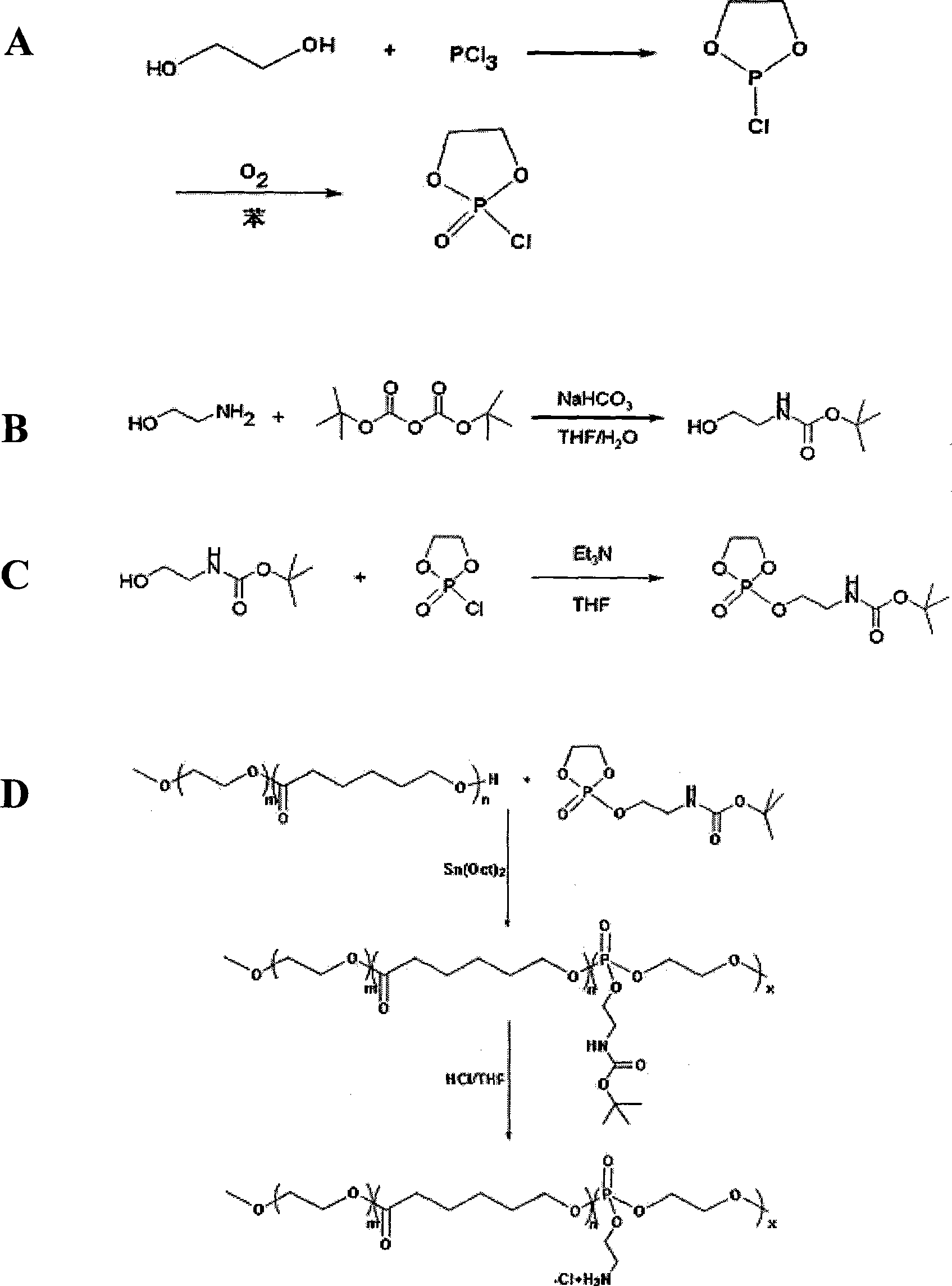
[0064] 1. Synthesis and characterization of 2-(N-tert-butoxycarbonylamino)ethoxy-2-oxo-1,3,2-dioxaphospholane (PEEABoc) cyclic phosphate monomer

[0065] (1) Synthesis of 2-chloro-2-oxo-1,3,2-dioxaphospholane (COP)

[0066] COP synthesis route such as figure 1 (A) shown. The specific steps for synthesizing COP are: slowly add 301 mL of 3.25 mol / L ethylene glycol in dichloromethane to 300 mL of 3.26 mol / L phosphorus trichloride in dichloromethane. After the drop was completed, the reaction was continued for 0.5 hour, and the solvent was evaporated under reduced pressure. After distilling off the product under reduced pressure for two consecutive times, it was dissolved in benzene and passed through 3 days. 2 Until the reaction is complete, distill under reduced pressure (20Pa), collect the distillate at 72°C to obtain COP.

[0067] (2) Synthesis and characterization of N-tert-butoxycarbonylaminoethanol...

Embodiment 2

[0109] Embodiment 2, prepare nanoparticle with mPEG-PCL-PPEEA copolymer

[0110] 1. Preparation of nanoparticles

[0111] Amphiphilic block copolymers have hydrophobic interactions between hydrophobic blocks in aqueous solution, and nanoparticles can be formed as long as the copolymer concentration is higher than the critical aggregation concentration.

[0112] There are many ways to prepare nanoparticles, the most simple and common one is the solvent evaporation method, the specific method is: dissolve 10mg mPEG-PCL-PPEEA triblock copolymer in 1mL tetrahydrofuran, stir at room temperature for 1 hour, and then 10 mL of ultrapure water was added dropwise at a rate of 60 mL / h, and after stirring for two hours, the organic solvent was removed under reduced pressure, and the volume was adjusted to 10 mL to obtain a 1 mg / mL nanoparticle solution.

[0113] Prepare 1 mg / mL of mPEG separately by the above method 45 -PCL 45 -PPEEA 7 Nanoparticle solution and 1 mg / mL of mPEG 45 -PC...

Embodiment 3

[0130] Embodiment 3, the application of mPEG-PCL-PPEEA nanoparticle as siRNA carrier

[0131] siRNA is a double-stranded small molecule RNA composed of more than twenty nucleotides, with a negative charge, and can form a stable complex with positively charged mPEG-PCL-PPEEA nanoparticles through the interaction of positive and negative charges.

[0132] N / P refers to the ratio of the positive charge of the amine group of the nanoparticle to the negative charge of the siRNA phosphate group.

[0133] 1. Characterization of complexes of nanoparticles and siRNA

[0134] It is the mPEG of 5mg / mL that the method for preparing concentration according to embodiment 2 45 -PCL 45 -PEEP 7 Nanoparticle solution. Green fluorescent protein GFP siRNA, whose sequence is GCAAGCTGACCCTGAAGTTCAT, was purchased from Shanghai Gemma Pharmaceutical Technology Co., Ltd., 10D GFP siRNA was dissolved in 150 μL DEPC-treated water to obtain a 20 μM siRNA solution. The above-mentioned nanoparticles w...

the structure of the environmentally friendly knitted fabric provided by the present invention; figure 2 Flow chart of the yarn wrapping machine for environmentally friendly knitted fabrics and storage devices; image 3 Is the parameter map of the yarn covering machine
Login to View More

PUM

PropertyMeasurementUnit
diameteraaaaaaaaaa
particle diameteraaaaaaaaaa
Login to View More

Abstract

The invention discloses a siRNA drug carrier. An active component of the siRNA drug carrier is a nano-particle with positive charge formed by polymer which can be polyethylene glycol monomethyl ether-polycaprolactone-polyphosphate ester tri-block copolymer concretely. The invention also provides a polyethylene glycol monomethyl ether-polycaprolactone-polyphosphate ester copolymer and a method for synthesizing the copolymer. The biocompatible tri-block copolymer provided by the invention forms the nano-particles by self-assembly in aqueous solution and has good stability, simple preparation method and high repeatability. The polymer nano-particle is used as a carrier which can protect siRNA from degrading and can also combine with the self size effect of the nano-particle. Nano-micelle has good biocompatibility, and macromolecular micelle has the characteristics of very good stability, convenient preparation and the like, thereby ensuring the biodegradable nano-micelle has good application prospect in siRNA delivery and disease treatment based on RNA interference.

Description

technical field [0001] The invention relates to a polyethylene glycol monomethyl ether-polycaprolactone-polyphosphate triblock copolymer and the prepared siRNA drug carrier. Background technique [0002] RNA interference is a gene silencing technology mediated by double-stranded small interfering RNA (siRNA) consisting of about twenty nucleotides. It is sequence-specific and occurs after the transcription of genetic information. Due to the ability of RNA interference technology to specifically inhibit the expression of disease-causing genes and its high efficiency and diverse characteristics, people are constantly exploring the potential of siRNA in the treatment of human diseases. So far, a large number of animal experiments have been carried out for disease treatment and even Clinical trials, including cancer therapy targeting genes expressing various genes such as vascular endothelial growth factor (VEGF), P-glycoprotein, and telomerase, targeting HIV-1, hepatitis B and C...

Claims

the structure of the environmentally friendly knitted fabric provided by the present invention; figure 2 Flow chart of the yarn wrapping machine for environmentally friendly knitted fabrics and storage devices; image 3 Is the parameter map of the yarn covering machine
Login to View More

Application Information

Patent Timeline
no application Login to View More
Patent Type & Authority Applications(China)
IPC IPC(8): A61K47/34C08G79/04C08G63/08C08G63/85
Inventor 王均杜金志孙天盟
Owner UNIV OF SCI & TECH OF CHINA
Features
  • R&D
  • Intellectual Property
  • Life Sciences
  • Materials
  • Tech Scout
Why Patsnap Eureka
  • Unparalleled Data Quality
  • Higher Quality Content
  • 60% Fewer Hallucinations
Social media
Patsnap Eureka Blog
Learn More