
Novel rare-earth/L type zeolite luminescent material and preparation method thereof
A luminescent material and zeolite technology, applied in luminescent materials, chemical instruments and methods, etc., can solve the problems of high preparation temperature, complex process, high energy consumption, etc., and achieve strong stability, strong application value, luminous intensity and stability. Enhanced effect
- Summary
- Abstract
- Description
- Claims
- Application Information
AI Technical Summary
Problems solved by technology
Method used
Image

Examples
Embodiment 1
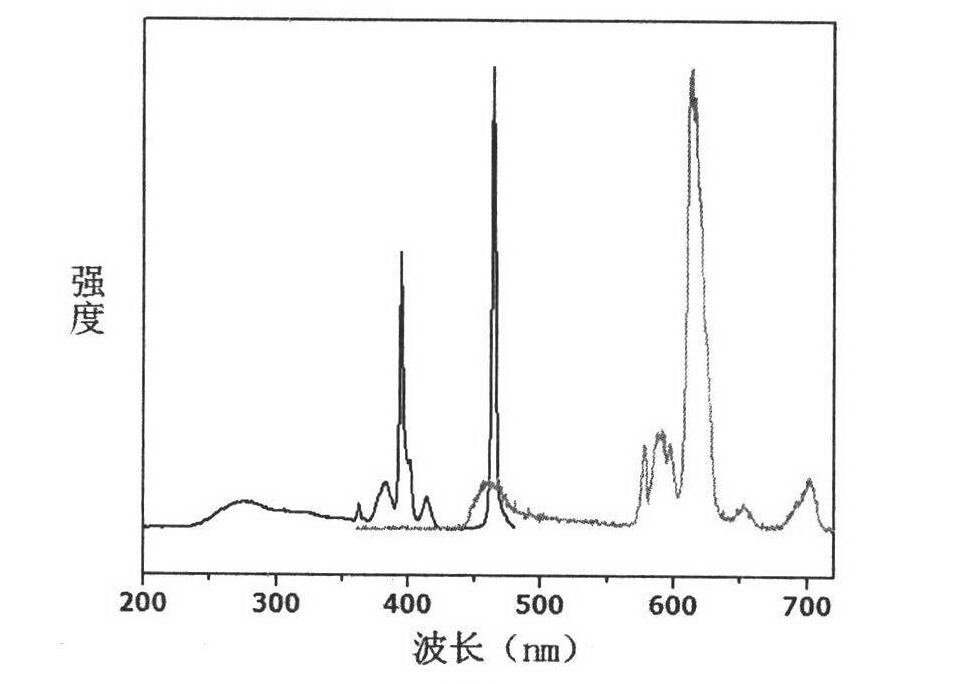
[0032] 1. be that the concentration nitric acid of 65%-68% is diluted into the dilute nitric acid of 2mol / L, dissolve bismuth nitrate pentahydrate crystal with it, be mixed with the Bi(NO of 0.04mol / L 3 ) 3 .5H 2 O solution.
[0033] 2. According to the volume ratio of 9:1, 0.1mol / L EuCl 3 .6H 2 O solution 2.25mL and 0.04mol / LBi(NO 3 ) 3 .5H 2 O solution 0.25mL and mix well.
[0034] 3. Weigh 100 mg of 64T (that is, 0.225 mmol of rare earth ions / 100 mg of zeolite), place it in the mixed solution, and perform ion exchange at a temperature of 80° C. Reflux for 24 hours.
[0035] 4. After the reaction, wash the product of step 3 three times with deionized water. After centrifugation, put it in an oven at 80°C to dry and set aside.
[0036] 5. Take out the dried product of Step 4, grind it, and place it in a tube-type resistance furnace for roasting. The heating rate was 2°C / min, raised to 700°C, and then kept for 1.5h. That is, a rare earth / L-type zeolite luminescent ...
Embodiment 2
[0042] Change the volume ratio of the second step in Example 1 to 8:2, that is, add 0.1mol / L of EuCl 3 .6H 2 O solution 2mL, 0.04mol / L Bi(NO 3 ) 3 .5H 2 O solution 0.5mL (ie 0.2mmol rare earth ion / 100mg zeolite). All the other processes are the same as in Example 1. Finally, a rare earth / L-type zeolite luminescent material (99.1 mg) was obtained.
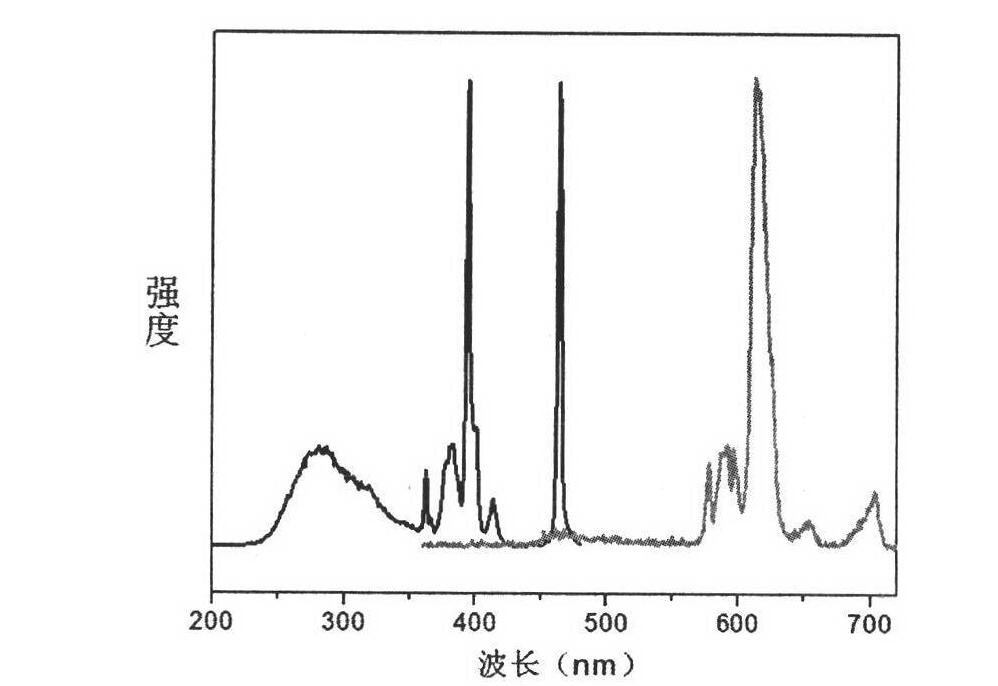
[0043] Utilize fluorescence spectrum to carry out fluorescence monitoring to embodiment 2, monitor collection of illustrations such as figure 2 Shown:
[0044] Excitation spectrum (detection wavelength: 612nm): 200-480nm
[0045]Emission spectrum (excitation spectrum: 395nm): 611nm, 576nm, 591nm, 653nm, 703nm
[0046] Lifetime: 1.29ms
Embodiment 3
[0048] Change the volume ratio of the second step in Example 1 to 7:3, that is, add 0.1mol / L EuCl 3 .6H 2 O solution 1.75mL, 0.04mol / L Bi(NO 3 ) 3 .5H 2 O solution 0.75mL (ie 0.175mmol rare earth ion / 100mg zeolite). All the other processes are the same as in Example 1. Finally, a rare earth / L-type zeolite luminescent material (99.3 mg) was obtained.
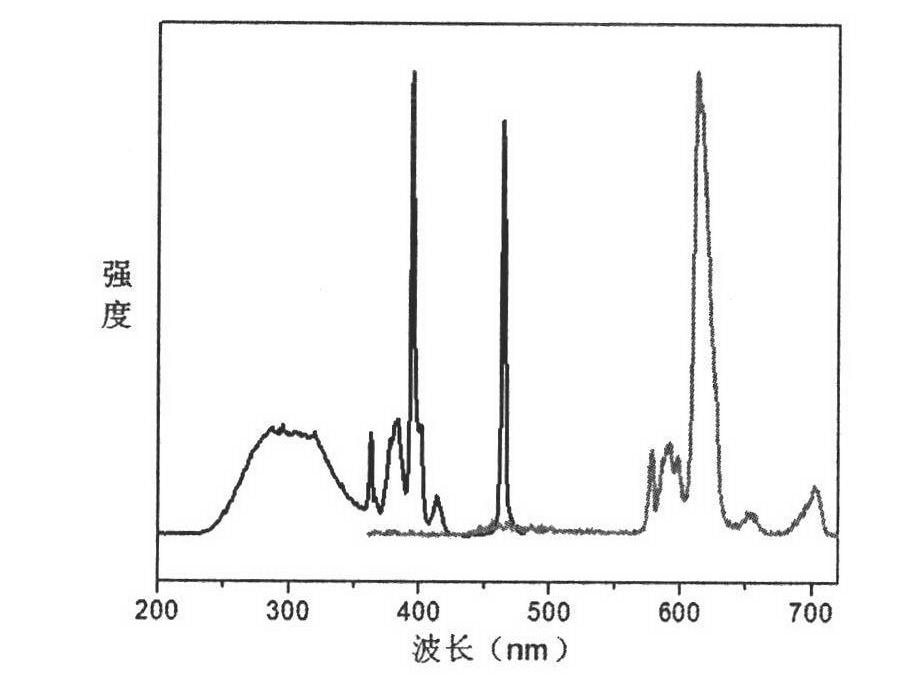
[0049] Utilize fluorescence spectrum to carry out fluorescence monitoring to embodiment 3, monitor collection of illustrations such as image 3 Shown:
[0050] Excitation spectrum (detection wavelength: 612nm): 200-480nm
[0051] Emission spectrum (excitation spectrum: 395nm): 612nm, 578nm, 593nm, 653nm, 702nm
[0052] Lifetime: 1.72ms
[0053] And carried out the detection of scanning electron microscope to embodiment 3, wherein Figure 4a It is a scanning electron micrograph of a rare earth / L-type zeolite luminescent material with a magnification of 20000 times, and b is a scanning electron micrograph of a rare earth / ...
PUM
 Login to View More
 Abstract
Description
Claims
Application Information
 Login to View More