
Adjuvant for improving immunization effect of Edwardsiella vaccine and use method of adjuvant
A technology of immunization and adjuvant, applied in the field of immune prevention and control of Edwardsiella vaccine, to achieve the effect of improving non-specific immune protection, good application prospects and market promotion value, and enhancing immune protection
- Summary
- Abstract
- Description
- Claims
- Application Information
AI Technical Summary
Problems solved by technology
Method used
Image

Examples
Embodiment 1
[0029] Example 1: Determination of the safe dose of β-1,3-glucan for turbot (Scophthatmus maximus) injection
[0030] Healthy turbot (11.4 ± 1.8) g was selected, and after being temporarily raised in a cement pool for 2 weeks before the test, it was placed in a round glass fiber reinforced plastic bucket (water 0.7 m 3 ), running water culture, the water temperature is 18±2°C, the salinity is 28‰±2‰, and the aeration is continuous for 24 hours. During the test period, the compound feed was fed at 3% of the fish body weight, 3 times a day, and the water was changed and cleaned 2 times a day. Turbot was soaked and anesthetized with MS222 (1:9000) before injection.
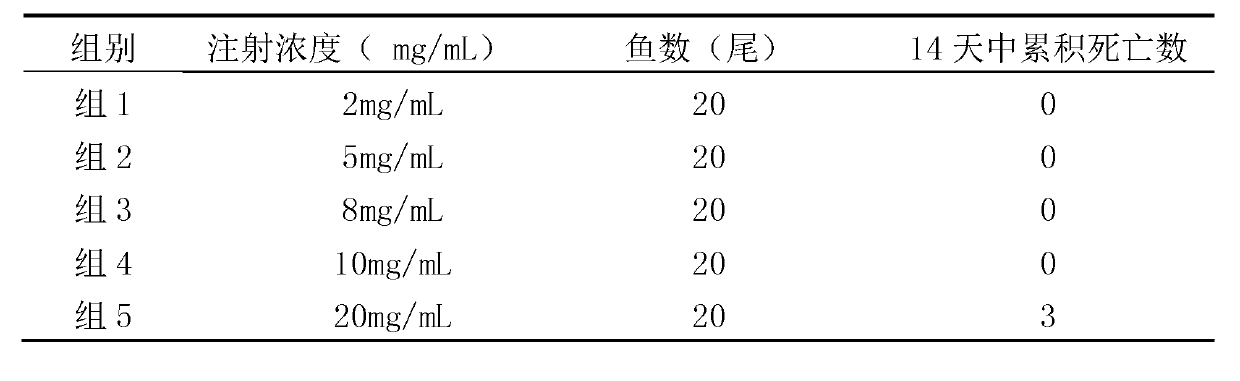
[0031] Twenty turbot were injected intraperitoneally with β-1,3-glucan at concentrations of 2, 5, 8, 10 and 20 mg / mL, respectively, at a dose of 100 μL / tail, and observed for 14 days.
[0032] The mortality of turbot in each experimental group within 14 days is shown in Table 1. From the results, the maximum safe i...
Embodiment 2
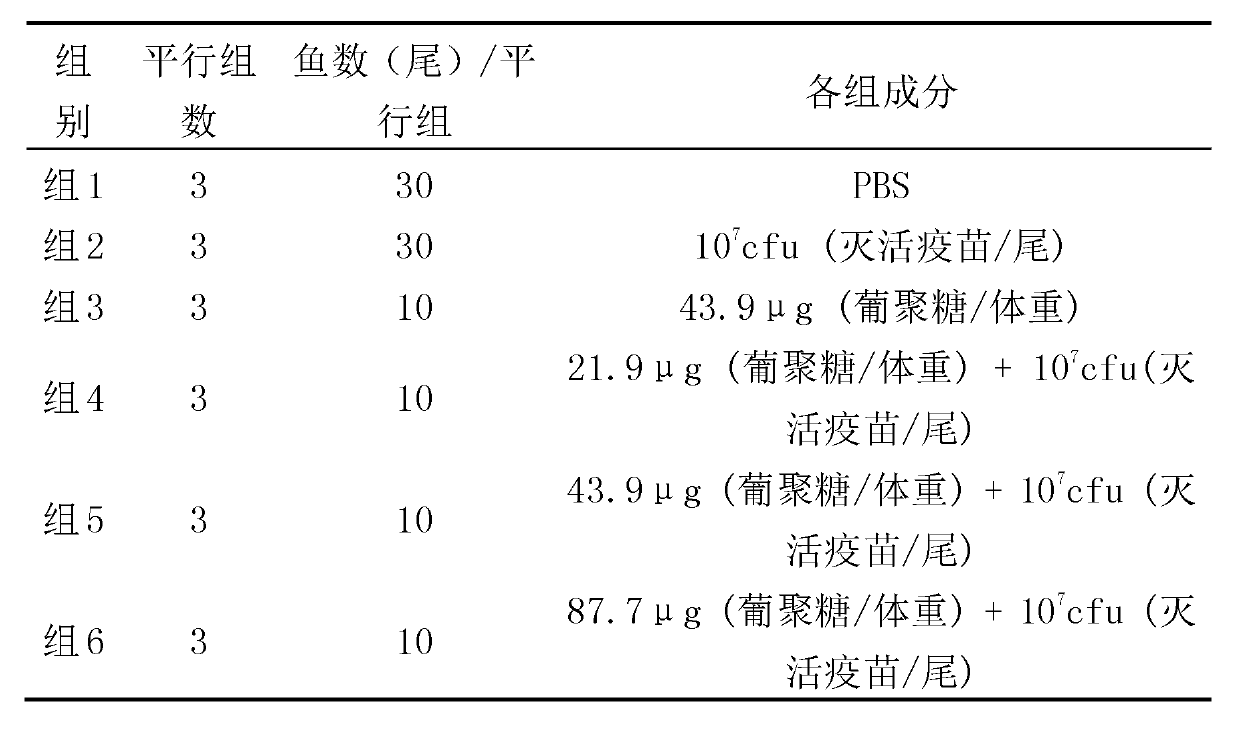
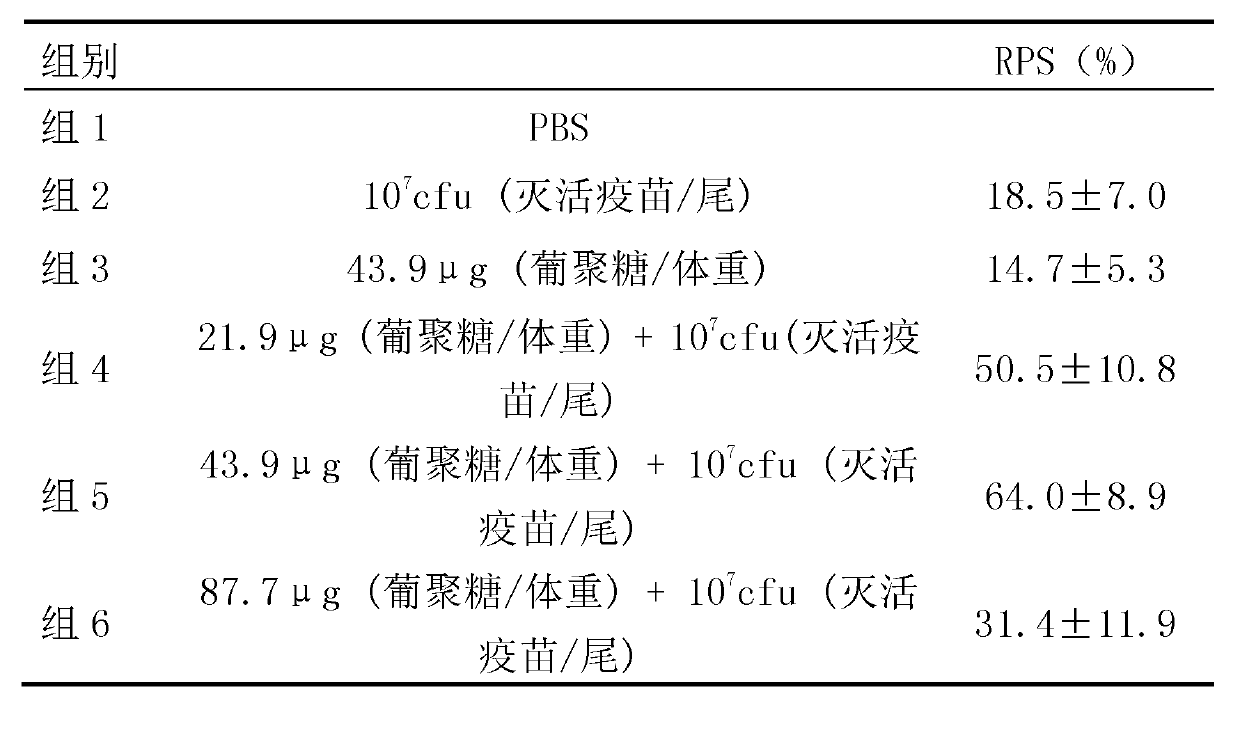
[0035] Example 2: β-1,3-glucan was added to formalin inactivated E. tarda vaccine to immunize turbot (S. maximus).
[0036] Test fish and breeding management are the same as in Example 1.
[0037] Inoculate E. tarda 1101 in Tryptone Soy Broth (TSB), culture with shaking at 28°C overnight, then transfer to fresh TSB at a ratio of 1:100, culture with shaking at 28°C for 5 hours, collect the bacterial liquid, 6000g, 4°C, 10min, wash 3 times with sterile PBS (pH7.2), resuspend in PBS, and spread on Tryptone Soy Agar (TSA) after dilution, the bacterial count adopts the plate counting method to make 1×10 9 CFU / mL bacterial suspension, add formalin (containing 36.5-38% formaldehyde, w / v), adjust its final concentration to 1%, overnight at 4°C to make an inactivated vaccine, wash the bacteria 3 times with PBS ( The method is the same as above), and stored at 4°C. Another 0.2 mL of the inactivated bacterial solution was coated with TSA, and cultured at 28°C for 48 hours to confirm t...
Embodiment 3
[0047] Implementation Example 3: The effect of β-1,3-glucan added to formalin inactivated E. tarda vaccine to immunize turbot on serum antibody titer
[0048] Test fish and breeding management are the same as in Example 1.
[0049] Vaccine preparation preparation and test design (experimental grouping and immunization method) were the same as in Example 2. After 28 days of immunization, 0.1 mL of tail vein blood was extracted from 5 fish in each group, left at room temperature for 2 hours, and then placed at 4 ° C for 12 hours. Serum was collected, mixed with serum from fish in the same group, and stored at -20°C.
[0050] The antibody titer of the serum was determined according to the instructions of the mouse monoclonal antibody against turbot IgM (Aquatic Diagnostic Ltd, UK), and 100 μL of 1.0×10 8 cfu / mL of E. tarda 1101 suspension resuspended in the coating solution was covered and coated with 96-well ELISA plate overnight at 4°C, and then 50 μL of 0.05% (v / v) pentamethy...
PUM
 Login to View More
 Abstract
Description
Claims
Application Information
 Login to View More