Check patentability & draft patents in minutes with Patsnap Eureka AI!

Isotatic polypropylene-b-polyethylene glycol double block copolymer and preparation method thereof

A technology of isotactic polypropylene and polyethylene glycol, applied in the field of polypropylene modification, can solve problems such as difficult industrialization, difficult industrial application, and controllability, and achieve the effect of easy industrial production, easy realization, and simple steps

Inactive Publication Date: 2014-01-15
ZHEJIANG UNIV
View PDF1 Cites 18 Cited by
  • Summary
  • Abstract
  • Description
  • Claims
  • Application Information

AI Technical Summary

Problems solved by technology

Although all the above methods can prepare a two-block copolymer of isotactic polypropylene, there are still various problems: 1) Free radical polymerization cannot achieve controllable molecular weight and structure, and it is difficult to control the properties of block polymers ;2) In controlled free radical polymerization, the ATRP method needs to remove the transition metal complex after the reaction, the preparation process of the dithioester in the RAFT method is complicated and difficult to be applied industrially, and the NMRP method has disadvantages such as a small range of applicable monomers; 3 ) The conditions of anionic polymerization are harsh, and large-scale industrial production cannot be realized; 4) The preparation process of click chemistry is complicated, and there is also the problem of difficulty in subsequent industrialization

Method used

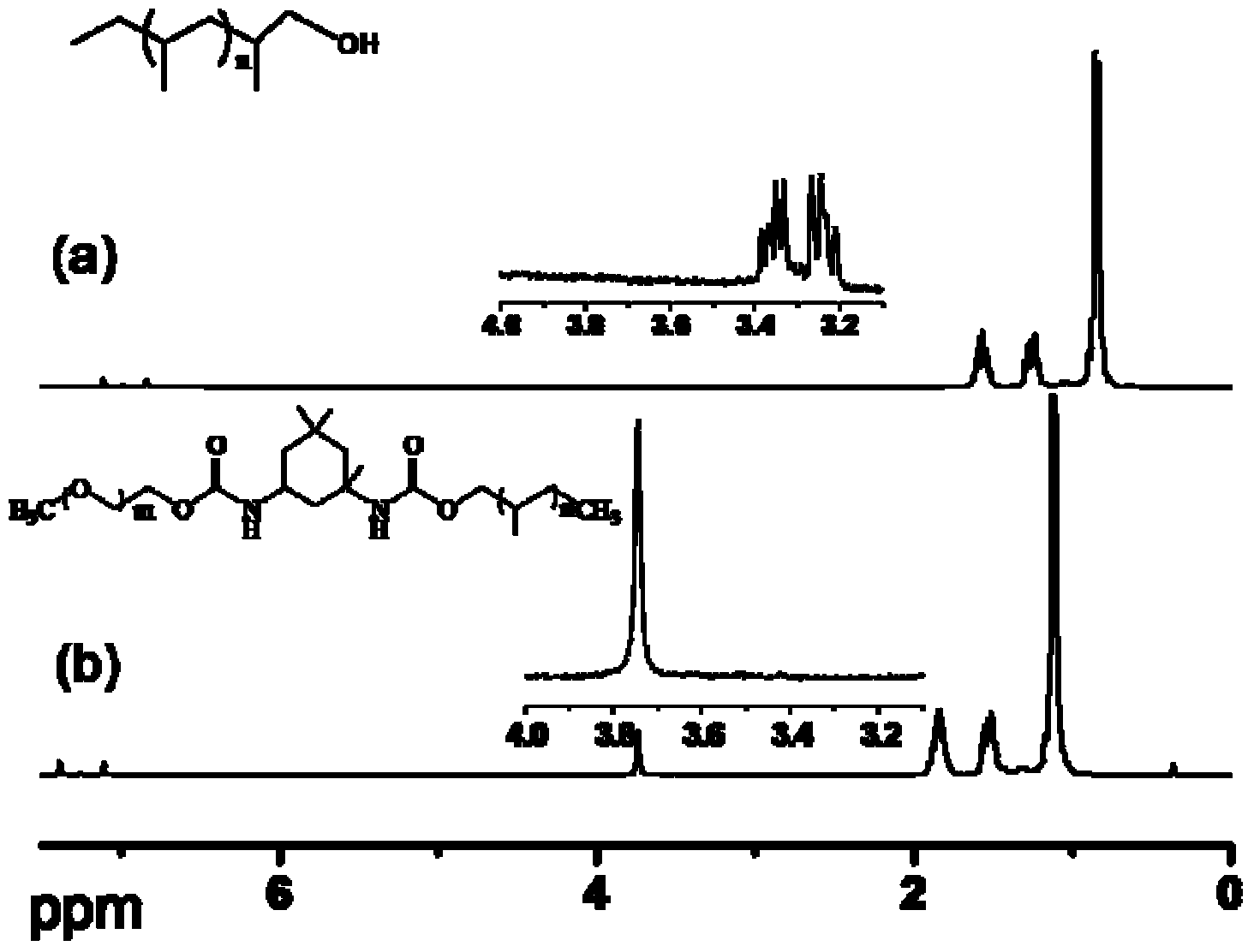
the structure of the environmentally friendly knitted fabric provided by the present invention; figure 2 Flow chart of the yarn wrapping machine for environmentally friendly knitted fabrics and storage devices; image 3 Is the parameter map of the yarn covering machine
View more

Image

Smart Image Click on the blue labels to locate them in the text.
Viewing Examples
Smart Image
  • Isotatic polypropylene-b-polyethylene glycol double block copolymer and preparation method thereof
  • Isotatic polypropylene-b-polyethylene glycol double block copolymer and preparation method thereof
  • Isotatic polypropylene-b-polyethylene glycol double block copolymer and preparation method thereof

Examples

Experimental program
Comparison scheme
Effect test

preparation example Construction

[0025] 1. Preparation of isocyanate-terminated polyethylene glycol

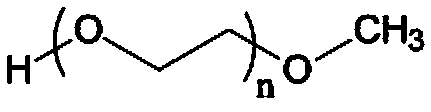
[0026]Methoxy Polyethylene Glycol (Methoxy Polyethylene Glycol, referred to as mPEG) and diisocyanate under the catalysis of dibutyltin dilaurate (abbreviated as DBTDL) undergo nucleophilic addition reaction to prepare isocyanate-terminated polyethylene glycol (the present invention is referred to as mPEG-t-NCO), the chemical formula of the methoxypolyethylene glycol is:

[0027]

[0028] In this formula, n=any integer between 7~120.

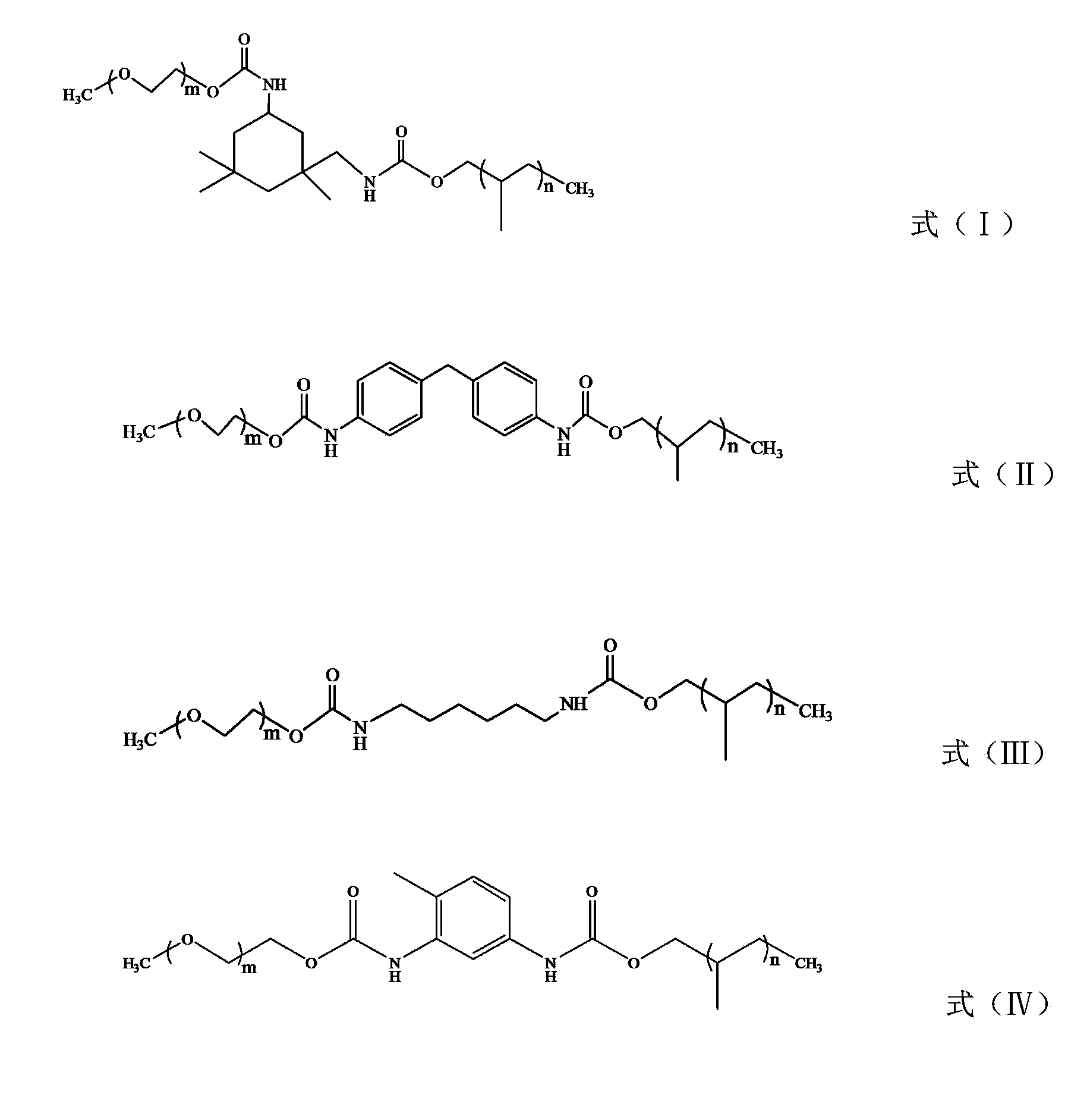
[0029] Used diisocyanate chemical formula is shown in formula (I') or formula (II') or formula (III') or formula (IV'):

[0030]

[0031] The chemical formula of dibutyltin dilaurate used is:

[0032]

[0033] In a Schlenk bottle equipped with a reflux condenser, which was strictly dried and evacuated three times with nitrogen, methoxypolyethylene glycol, diisocyanate, catalyst dibutyltin dilaurate, and solvents (chloroform, tetrachloroethane, etc.) were successively...

Embodiment 1

[0042] 3.5 g (0.01mol) mPEG (M n = 350), 2.5 g (0.1 mol) MDI, 0.06 g dibutyltin dilaurate (1wt.%) and 200 mL chloroform, heated to 25 °C for 8 h, the product was precipitated in a large amount of ether, dissolved in chloroform / ether / After cyclic precipitation three times, vacuum drying was carried out at 40° C. to a constant weight, and 5.5 g of white powder of the intermediate product mPEG-t-NCO was prepared.

Embodiment 2

[0044] Other experimental conditions are with embodiment 1, add 10 g (0.1 mol) (M n = 1000), 12.5g (0.5 mol) MDI, 0.225g dibutyltin dilaurate, and 8.3g white powder of intermediate product mPEG-t-NCO was prepared.

the structure of the environmentally friendly knitted fabric provided by the present invention; figure 2 Flow chart of the yarn wrapping machine for environmentally friendly knitted fabrics and storage devices; image 3 Is the parameter map of the yarn covering machine
Login to View More

PUM

No PUM Login to View More

Abstract

The invention relates to polypropylene modification and aims to provide an isotatic polypropylene-b-polyethylene glycol double block copolymer (iPP-b-mPEG) and a preparation method thereof. According to the preparation method, an isocyanate coupling method is adopted, and the preparation method comprises the following steps: introducing isocyanate into the tail end of methoxy polyethylene glycol; coupling isocyanate-terminated polyethylene glycol with hydroxy-terminated isotatic polypropylene, and preparing the iPP-b-mPEG. Compared with the prior art, the preparation method is simple in steps and easy to implement. The used raw materials are common industrial raw materials and are low in cost and easy for industrial production. Lengths of two chain segments can be adjusted, and the performance of the block copolymer is controlled. (A number-average molecular weight of the iPP is 1,000-15,000 g / mol, and a number-average molecular weight of the mPEG is 300-5,300 g / mol). A high isotatic degree of the iPP chain segment in the prepared iPP-b-mPEG is kept.

Description

technical field [0001] The invention relates to polypropylene modification technology, in particular to an isotactic polypropylene-b-polyethylene glycol diblock and a preparation method thereof. Background technique [0002] Due to its good mechanical properties, stable thermal and chemical properties, good electrical insulation properties and high cost performance, polypropylene has been widely used in packaging, automobiles, construction and even military fields. In 2010, the world's polypropylene demand reached 53,570kt, and the total production capacity reached 60,980kt / a. In recent years, the global demand and production capacity of PP have maintained a steady growth momentum. However, due to the chemical inertness of polypropylene itself, the non-polar and crystalline characteristics of its molecular chain make it have low surface energy and hydrophobic characteristics. The extremely low surface energy leads to poor interfacial compatibility of polypropylene when it i...

Claims

the structure of the environmentally friendly knitted fabric provided by the present invention; figure 2 Flow chart of the yarn wrapping machine for environmentally friendly knitted fabrics and storage devices; image 3 Is the parameter map of the yarn covering machine
Login to View More

Application Information

Patent Timeline
no application Login to View More
IPC IPC(8): C08G81/02C08G65/48
Inventor 傅智盛叶亚楠李培源范志强上官勇刚
Owner ZHEJIANG UNIV
Features
  • R&D
  • Intellectual Property
  • Life Sciences
  • Materials
  • Tech Scout
Why Patsnap Eureka
  • Unparalleled Data Quality
  • Higher Quality Content
  • 60% Fewer Hallucinations
Social media
Patsnap Eureka Blog
Learn More