Copper-zinc-tin sulfide thin film preparation method
What is AI technical title?
AI technical title is built by Patsnap AI team. It summarizes the technical point description of the patent document.
A copper-zinc-tin-sulfur and thin-film technology, which can be used in final product manufacturing, sustainable manufacturing/processing, photovoltaic power generation, etc.
Inactive Publication Date: 2014-12-10
RESEARCH INSTITUTE OF TSINGHUA UNIVERSITY IN SHENZHEN
View PDF4 Cites 2 Cited by
Summary
Abstract
Description
Claims
Application Information
AI Technical Summary
This helps you quickly interpret patents by identifying the three key elements:
Problems solved by technology
Method used
Benefits of technology
Problems solved by technology
However, in this method, during the co-adsorption of cations on the substrate surface, due to Cu 2+ , Sn 2+ , Zn 2+ Ion competition can easily lead to poor control of the ratio of components in the copper-zinc-tin-sulfur film, and impurity phases appear in the copper-zinc-tin-sulfur film
Method used
the structure of the environmentally friendly knitted fabric provided by the present invention; figure 2 Flow chart of the yarn wrapping machine for environmentally friendly knitted fabrics and storage devices; image 3 Is the parameter map of the yarn covering machine
View more
Image
Smart Image Click on the blue labels to locate them in the text.
Viewing Examples
Smart Image
Click on the blue label to locate the original text in one second.
Reading with bidirectional positioning of images and text.
Smart Image
Examples
Experimental program
Comparison scheme
Effect test
preparation example Construction
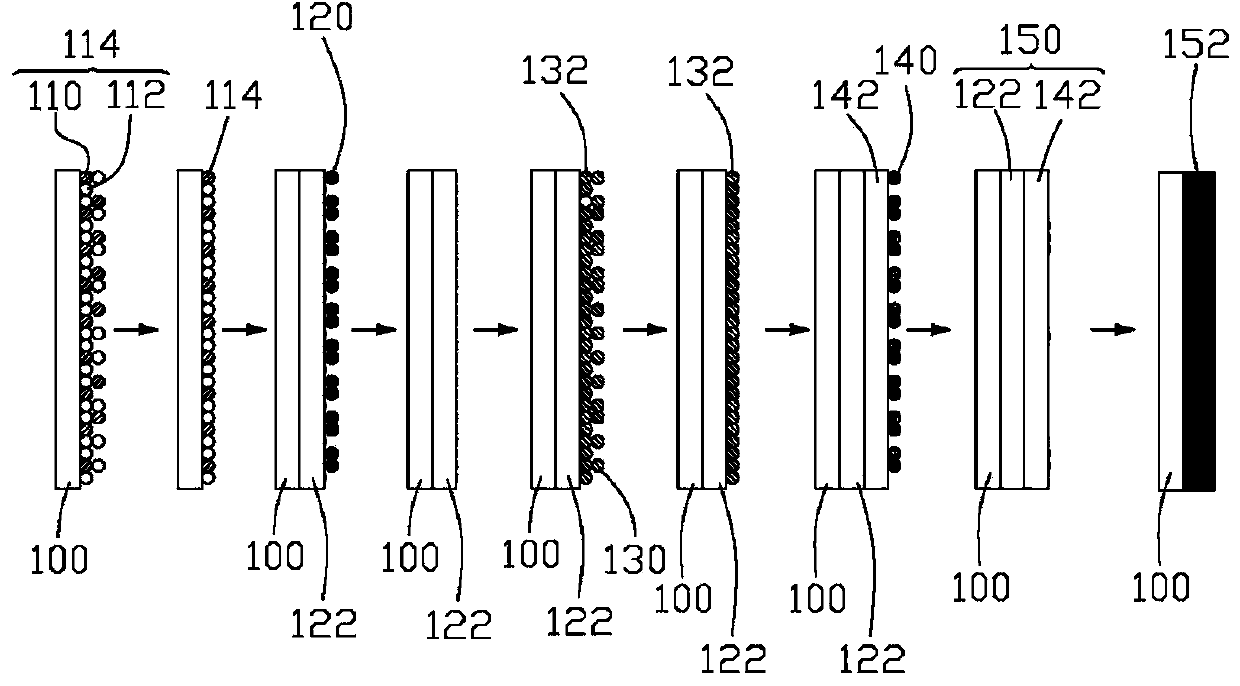
[0026] see figure 1 , the preparation method of the copper-zinc-tin-sulfur thin film 152 provided by the present invention comprises the following steps:
[0027] S10, taking out a substrate 100 after being dipped in a first cationic solution, so that a mixed ion layer 114 of copper ions and tin ions is adsorbed on the surface of the substrate 100;
[0028] S11, cleaning the mixed ion layer 114 of copper ions and tin ions;
[0029] S12, taking out the substrate 100 formed with the mixed ion layer 114 of copper ions and tin ions in a first anion solution, and then taking out the mixed ion layer 114 of copper ions and tin ions to absorb a plurality of first sulfur ions 120, and the plurality of first sulfide ions 120 react with the mixed ion layer 114 of the copper ions and tin ions to form a mixed compound film 122 of copper sulfide and tin sulfide;
[0030] S13, cleaning the copper sulfide and tin sulfide mixed compound film 122;
[0031] S14, taking out the substrate 100 ...
Embodiment 1
[0053] (1), clean the substrate. Soda-lime glass with a length of 70 mm and a width of 30 mm was ultrasonically cleaned with alkaline cleaning solution, acetone, isopropanol and high-purity deionized water for 20 minutes, and dried with nitrogen. Then, use the UV cleaner to clean the soda-lime glass surface ozone for 10 minutes, then put it into a vacuum drying oven for subsequent use.
[0054] (2), solution preparation. Prepare solutions A, B, and C with 99.99% metal salts and high-purity deionized water. A solution is CuSO 4 , SnSO 4 , trisodium citrate and deionized water, in which Cu 2+ The ion concentration is 0.01 mol / L, Sn 2+ The ion concentration is 0.02 mol / L, and the pH of the solution is 5.5. Solution B is ZnSO 4 deionized aqueous solution, where Zn 2+ The ion concentration is 0.5 mol / liter, and the pH of solution B is 5.0. C solution is N 2 Deionized aqueous solution of S salt, wherein, S 2- The ion concentration is 0.05 mol / liter.
[0055] (3), prepari...
the structure of the environmentally friendly knitted fabric provided by the present invention; figure 2 Flow chart of the yarn wrapping machine for environmentally friendly knitted fabrics and storage devices; image 3 Is the parameter map of the yarn covering machine
Login to View More
PUM
Login to View More
Abstract
The invention relates to a copper-zinc-tinsulfide thin film preparation method. The preparation method includes the deposition of a copperion and tinion thin film compound on the surface of a substrate through a successive ion layer adsorption reaction method, the deposition of a zinc ion thin film compound and final high temperature sulfuration treatment for obtaining a zinctinsulfide thin film. According to the preparation method, the problem of uneven film components due to ion competition in a copper ion, tin ion and zinc ion co-adsorption process can be solved, and the proportion of every component in the copper-zinc-tin sulfide thin film can be effectively controlled for the preparation of the single-phase copper-zinc-tin sulfide thin film.
Description
technical field [0001] The invention relates to a method for preparing a semiconductor copper-zinc-tin-sulfur thin film, which belongs to the field of thin-film solar cells. Background technique [0002] The new energy of photovoltaic power generation has developed rapidly in recent years and has attracted worldwide attention. It is expected to become an effective way to solve the energy crisis and environmental crisis. Current solar cells are mainly silicon solar cells. However, the light-absorbing layer that silicon solar cells rely on is monocrystalline silicon or microcrystallinesilicon, which is an indirect bandgap semiconductor material that requires a thicker film thickness to absorb a broad solar spectrum, and the cost of monocrystalline silicon is high. [0003] Quaternary compound copper zinc tin sulfur (Cu 2 ZnSnS 4 , referred to as CZTS) is a direct band gap P-type semiconductor material, the band gap matches the best band gap (1.5eV) value of the solar cell,...
Claims
the structure of the environmentally friendly knitted fabric provided by the present invention; figure 2 Flow chart of the yarn wrapping machine for environmentally friendly knitted fabrics and storage devices; image 3 Is the parameter map of the yarn covering machine
Login to View More
Application Information
Patent Timeline
Application Date:The date an application was filed.
Publication Date:The date a patent or application was officially published.
First Publication Date:The earliest publication date of a patent with the same application number.
Issue Date:Publication date of the patent grant document.
PCT Entry Date:The Entry date of PCT National Phase.
Estimated Expiry Date:The statutory expiry date of a patent right according to the Patent Law, and it is the longest term of protection that the patent right can achieve without the termination of the patent right due to other reasons(Term extension factor has been taken into account ).
Invalid Date:Actual expiry date is based on effective date or publication date of legal transaction data of invalid patent.
Login to View More
Patent Type & AuthorityApplications(China)
IPC IPC(8): H01L31/18H01L31/032
CPCH01L31/0322H01L31/03923Y02E10/541Y02P70/50
Inventor檀满林刘荣跃张维丽李冬霜符冬菊马清叶利强王晓伟陈建军
OwnerRESEARCH INSTITUTE OF TSINGHUA UNIVERSITY IN SHENZHEN


 Login to View More
  Login to View More