Unlock instant, AI-driven research and patent intelligence for your innovation.
Preparation method of carbon nanotube and nickel oxide composite material
What is Al technical title?
Al technical title is built by PatSnap Al team. It summarizes the technical point description of the patent document.
A technology of composite materials and carbon nanotubes, applied in the field of nanomaterials, can solve the problem of small capacitance and achieve the effect of tight combination and wide application prospects
Active Publication Date: 2015-10-28
NORTH CHINA ELECTRIC POWER UNIV (BAODING)
View PDF8 Cites 10 Cited by
Summary
Abstract
Description
Claims
Application Information
AI Technical Summary
This helps you quickly interpret patents by identifying the three key elements:
the structure of the environmentally friendly knitted fabric provided by the present invention; figure 2 Flow chart of the yarn wrapping machine for environmentally friendly knitted fabrics and storage devices; image 3 Is the parameter map of the yarn covering machine
View more
Image
Smart Image Click on the blue labels to locate them in the text.
Viewing Examples
Smart Image
Click on the blue label to locate the original text in one second.
Reading with bidirectional positioning of images and text.
Smart Image
Examples
Experimental program
Comparison scheme
Effect test
Embodiment 1
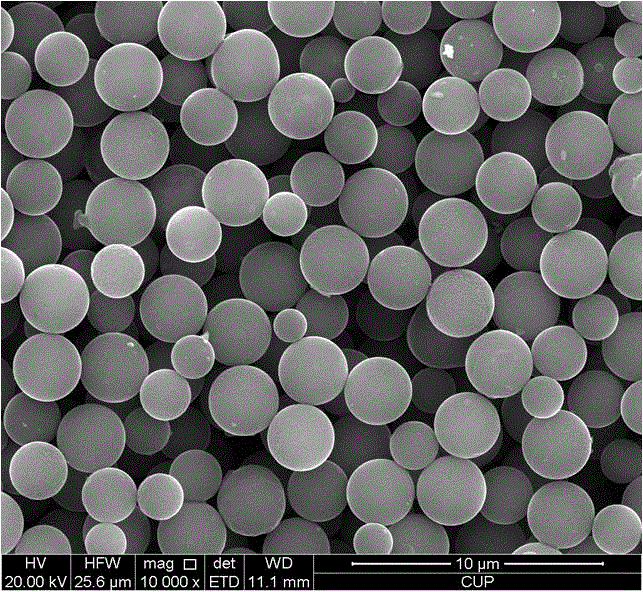
[0025] 1. Add 0.7g Ni(NO3) 2 ·6H 2 O, 0.9g D-glucose and 20 ml deionized water were put into a 50ml beaker, and magnetically stirred for 30 min;
[0027] 3. Wash the obtained solid product with deionized water, suction filter until the filtrate is neutral, and dry at 50°C for 15 hours to obtain nickel hydroxide balls;
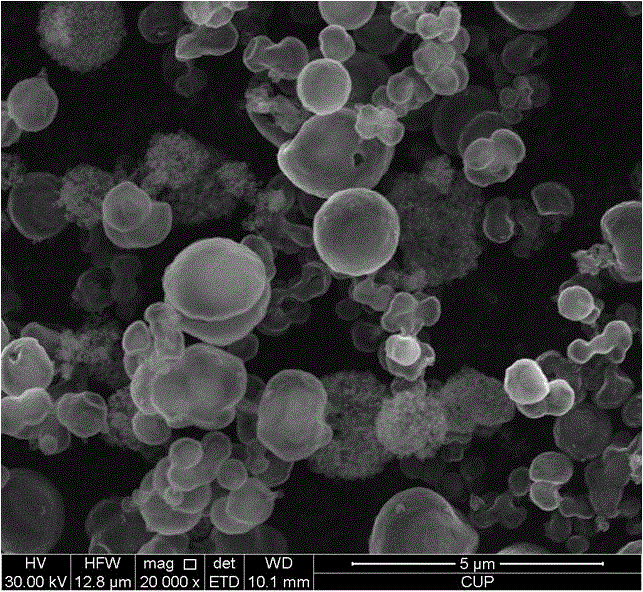
[0028] 4. Sprinkle 0.1 g of the prepared nickel hydroxide balls evenly on the siliconwafer substrate, and then place the sample in the quartz tube. Evacuate while introducing argon. Raise the temperature to 500 degrees and keep it for 3 hours to obtain the nickel oxide ball sample;
[0029] 5. Introduce hydrogen and argon at the same time, and adjust their flow ratio to 1:3. After heating up to 650°C, keep it for 0.5 hours;
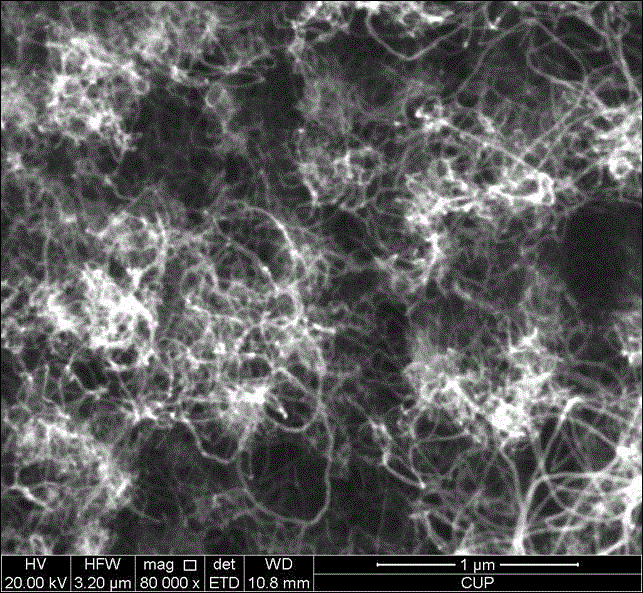
[0030] 6. Raise the temperature to 750°C, introduce methane and keep it for 30 ...
Embodiment 2
[0033] 1. Add 0.9g Ni(NO3) 2 ·6H 2 O, 1.1g of D-glucose and 20 ml of deionized water were put into a 50ml beaker, and magnetically stirred for 30 min;
[0035] 3. The obtained solid product was washed with deionized water, filtered with suction until the filtrate was neutral, and then dried at 70° C. for 24 hours. Then use a muffle furnace to calcinate at 400°C for 5 hours to obtain nano-nickel oxide balls;
[0036] 4. Sprinkle 0.25g of the prepared nickel hydroxide balls evenly on the silicon substrate, and then place the sample in the quartz tube. Vacuumize, introduce hydrogen and argon at the same time, adjust their ratio to 1:8;
[0037] 5. After heating up to 620°C, keep it for 0.5 hours;
[0038] 6. Raise the temperature to 760°C, introduce methane and keep it for 35 minutes. The ratio of the three gas sources is c...
the structure of the environmentally friendly knitted fabric provided by the present invention; figure 2 Flow chart of the yarn wrapping machine for environmentally friendly knitted fabrics and storage devices; image 3 Is the parameter map of the yarn covering machine
Login to View More
PUM
Login to View More
Abstract
The invention discloses a preparation method of a carbon nanotube and nickeloxidecomposite material, and belongs to the technical field of nano-materials. Firstly by a hydrothermal method, a spherical structure is prepared by using a Ni(No3)26H2O and D-glucose mixing solution; the prepared nickelhydroxide of the spherical structure is placed on a silicon-based plate, argon is fed into a chemical vapor depositionsystem, then heating is performed to enable nickelhydroxide to be converted into nickel oxide; then hydrogen is simultaneously fed into the chemical vapor depositionsystem to reduce partial nickel oxide balls to nickel simple substances; and then ethene gas is fed, and carbon nanotubes grow on the surface of the partially reduced nickel oxide balls in an in-situ catalytic manner. By adopting the method, the nickel oxide and carbon nanotubecomposite material can be prepared simply and highly efficiently. Compared with the prior art, by adopting the method, the combination of nickel oxide and carbon tubes is more tighter, the electricityconductivity is better, the composite material is more stable, so that the performance of the composite material is effectively improved. The composite material has a wide application prospect in the field of electrochemistry devices such as a super capacitor and a lithium battery.
Description
technical field [0001] The invention belongs to the technical field of nanometer materials, and in particular relates to a preparation method of a carbon nanotube and nickel oxide composite material, which can be used as a catalyst in electrochemical devices such as supercapacitors and lithium batteries. Background technique [0002] As a new type of nanomaterial, carbon nanotubes have potential value in the fields of composite material reinforcement and catalyst field emission due to their unique hollow structure and nanometer size, as well as their high specific surface area and high electrical conductivity. Due to their high surface area and good electrical conductivity, carbon nanotubes are considered ideal materials for supercapacitors. Although carbon nanotubes have a high surface area and good electrical conductivity, they still have the disadvantage of low capacitance. Combining carbon nanotubes with transition metal oxides can effectively overcome this shortcoming....
Claims
the structure of the environmentally friendly knitted fabric provided by the present invention; figure 2 Flow chart of the yarn wrapping machine for environmentally friendly knitted fabrics and storage devices; image 3 Is the parameter map of the yarn covering machine
Login to View More
Application Information
Patent Timeline
Application Date:The date an application was filed.
Publication Date:The date a patent or application was officially published.
First Publication Date:The earliest publication date of a patent with the same application number.
Issue Date:Publication date of the patent grant document.
PCT Entry Date:The Entry date of PCT National Phase.
Estimated Expiry Date:The statutory expiry date of a patent right according to the Patent Law, and it is the longest term of protection that the patent right can achieve without the termination of the patent right due to other reasons(Term extension factor has been taken into account ).
Invalid Date:Actual expiry date is based on effective date or publication date of legal transaction data of invalid patent.



 Login to View More
  Login to View More