
Activating agent for flotation of copper-nickel sulfide ores
A copper-nickel sulfide ore and activator technology, applied in flotation, solid separation, etc., can solve the problems of lower concentrate grade and lower sorting effect, achieve environmental protection, improve flotation recovery rate, grade, and raw materials Inexpensive and easy to get effects
- Summary
- Abstract
- Description
- Claims
- Application Information
AI Technical Summary
Problems solved by technology
Method used
Image

Examples
Embodiment 1
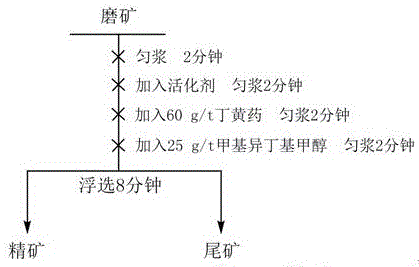
[0028] The experiment adopts open circuit flotation, and the flotation process is as follows: figure 1 shown. The ore used in the experiment is Jinchuan copper-nickel sulfide rich ore; the equipment used is XFD with a volume of 3L Ⅱ Single tank flotation machine.
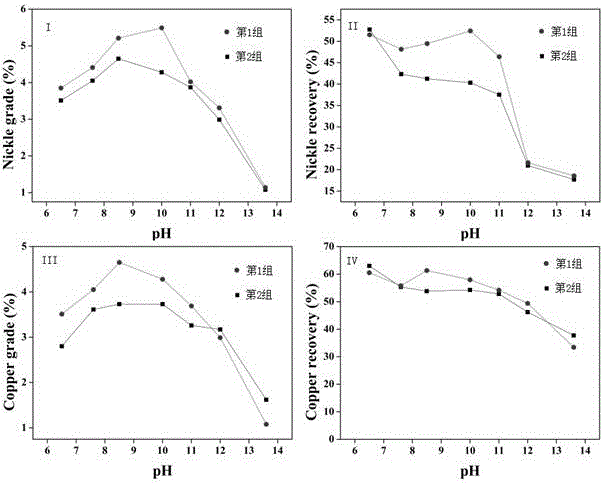
[0029] After grinding 800 grams of ore to 80% -74μm, according to figure 1 The flow shown is dosing and operation, and 90mL of tap water is added per minute during the flotation process to keep the liquid level balanced. The experiment was divided into two groups. The first group used the mixture of copper sulfate and ammonium sulfate (mass ratio: 1:1) as the activator, and the dosage was 60g / t; the second group used copper sulfate as the activator, and the dosage was 30g / t. Flotation effects of two activators at different pH values. Collect concentrates and tailings obtained from flotation, prepare samples and analyze them. For flotation results, see figure 2 , figure 2 (1) is the relationship curve of ni...
PUM
 Login to View More
 Abstract
Description
Claims
Application Information
 Login to View More