
Method for generating supercontinuum from communication band to middle infrared based on silicon nitride waveguide
A production method and technology of silicon nitride, applied in nonlinear optics, instruments, optics, etc., can solve the problems of inconvenient on-chip photon integration, limit the efficiency of nonlinear effects, unstable performance of sulfide waveguides, etc., to overcome nonlinear optical The effect of power consumption
- Summary
- Abstract
- Description
- Claims
- Application Information
AI Technical Summary
Problems solved by technology
Method used
Image

Examples
Embodiment 1
[0034] This embodiment provides a supercontinuum generation method capable of realizing near-infrared to mid-infrared band.
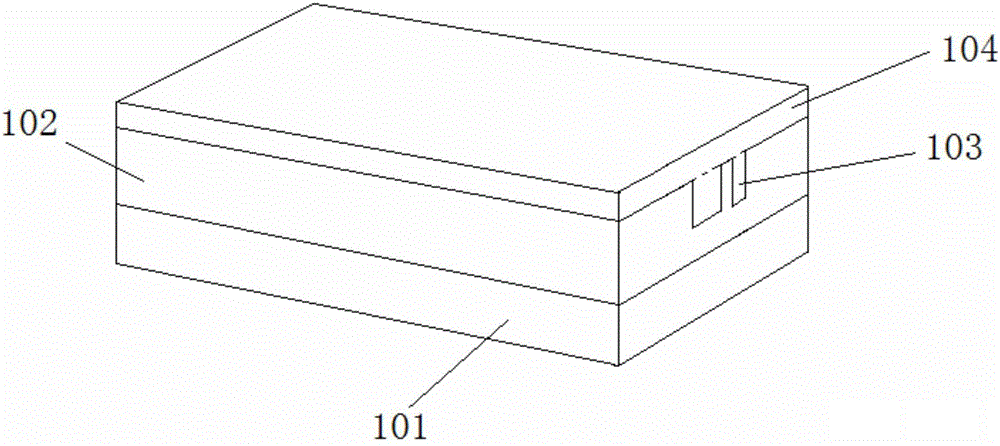
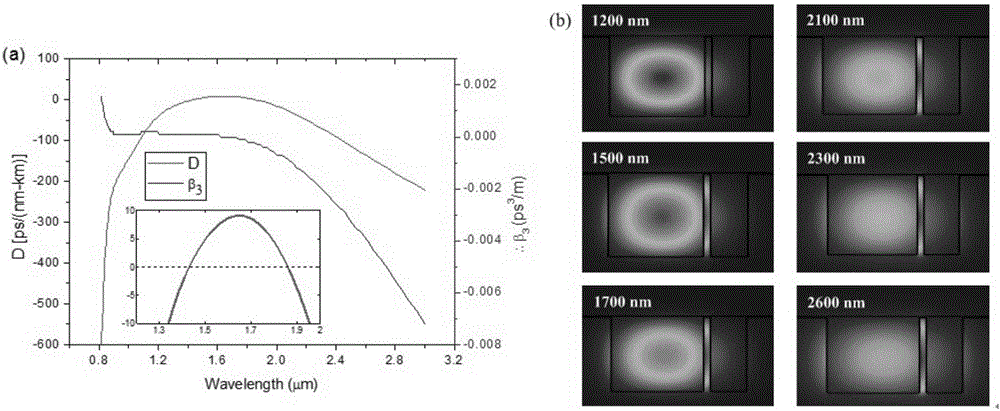
[0035] Such as figure 1 As shown, the silicon nitride waveguide structure in this embodiment includes a silicon dioxide oxide layer 102 disposed on a silicon wafer 101. The silicon dioxide oxide layer 102 is etched on the surface to form a trench 103 containing a single silicon dioxide ridge. The trench 103 on both sides of the ridge silicon dioxide is filled with silicon nitride, and finally a layer of silicon nitride inverted structure 104 is covered on the entire surface of the structure. Its dispersion characteristics and mode field distribution are as follows figure 2 Shown.
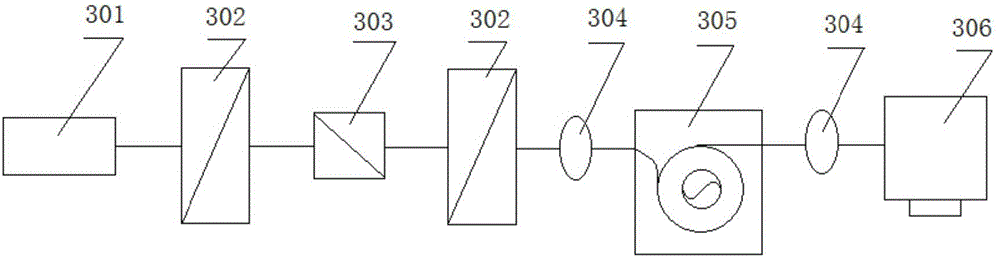
[0036] Reference image 3 In specific implementation, the femtosecond laser 301 emits ultrashort optical pulses with a center wavelength of 1.804 microns, a full width at half maximum and a peak power of 50 femtoseconds and 10 kilowatts, respectively, which are composed of a half-...
Embodiment 2
[0040] Such as Figure 5 Shown, based on the non-linear effect in the dispersion flat high non-linear reverse silicon nitride waveguide to achieve supercontinuum, the input optical power changes on the supercontinuum performance example, the femtosecond laser 301 emits a center wavelength of 1.804 microns, half value Ultrashort optical pulses with full width and peak power of 50 femtoseconds and 10 kilowatts respectively, after passing through the polarization control system composed of half-wave plate 302 and polarization beam splitter 303, they are further coupled and injected into ridges / grooves with flat dispersion through lens 304 Slot hybrid inverted silicon nitride waveguide 305, due to the high peak power of the femtosecond pulse, combined with the large nonlinear coefficient of silicon nitride waveguide 305, self-phase modulation, cross-phase modulation, and four-wave mixing occur inside it A series of non-linear processes such as soliton frequency shift and dispersive ...
PUM
| Property | Measurement | Unit |
|---|---|---|
| wavelength | aaaaa | aaaaa |
| width | aaaaa | aaaaa |
| thickness | aaaaa | aaaaa |
Abstract
Description
Claims
Application Information
 Login to View More