
Method for preparing m-phenylenediamine through catalytic hydrogenation of 2,4-dinitrochlorobenzene
A technology of dinitrochlorobenzene and m-phenylenediamine, which is applied in the field of catalytic hydrogenation of 2,4-dinitrochlorobenzene to prepare m-phenylenediamine, which can solve the problems of excessive three wastes, harsh reaction conditions, and equipment corrosion. To achieve the effect of applying more batches, high conversion rate and yield, and less usage
- Summary
- Abstract
- Description
- Claims
- Application Information
AI Technical Summary
Problems solved by technology
Method used
Image

Examples
Embodiment 1
[0027] A kind of preparation method of m-phenylenediamine, take 2,4-dinitrochlorobenzene as raw material, adopt 3% palladium carbon catalyst, use sodium carbonate as acid-binding agent, carry out catalytic hydrogenation reaction in 5000L hydrogenation reactor At the end of the reaction, an appropriate amount of water is added, the catalyst is separated and recovered, the reducing solution is precipitated, and purified to obtain the target product m-diamine.
[0028] Specific steps:
[0029] (1) Add 3000L of methanol, 1000kg of 2,4-dinitrochlorobenzene, 252kg of sodium carbonate, and 10kg of 5% palladium-carbon catalyst into a 5000L hydrogenation reactor. After three times of nitrogen replacement, three times of hydrogen replacement, and After the oxygen content of the hydrogen gas is detected to be qualified, 0.8Mpa of hydrogen gas is introduced to carry out the catalytic hydrogenation reaction, and the reaction temperature is controlled at 80°C.
[0030] (2) After reacting f...
Embodiment 2
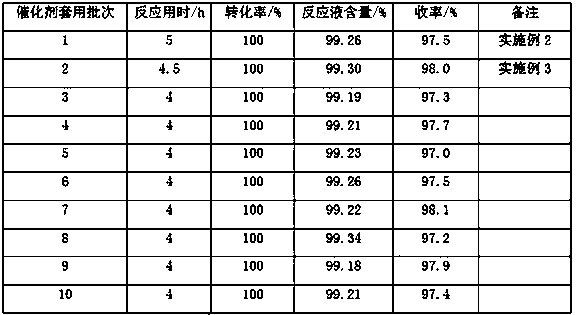
[0033] (1) Add 3000L of methanol, 1000kg of 2,4-dinitrochlorobenzene, 252kg of sodium carbonate, and 10kg of 3% palladium-carbon catalyst into a 5000L hydrogenation reactor, undergo three times of nitrogen replacement, three times of hydrogen replacement, and After detecting that the oxygen content of hydrogen gas is qualified, 1.0Mpa of hydrogen gas is introduced to carry out catalytic hydrogenation reaction, and the reaction temperature is controlled at 90°C.
[0034] (2) After reacting for 5 hours, close the hydrogen valve, and the hydrogen pressure no longer drops. After chromatographic detection, 2,4-dinitrochlorobenzene has been completely converted (the content of 2,4-dinitrochlorobenzene is 0), m-phenylene The crude amine content was 99.26%, so it was judged that the reaction was finished. Under stirring, the temperature of the reaction solution is lowered to below 50°C, 500kg of water is added once, and nitrogen is filled to press the material. The material liquid pas...
Embodiment 3
[0037] (1) Add 3,000L of methanol, 1,000kg of 2,4-dinitrochlorobenzene, 252kg of sodium carbonate, and 1kg of 3% palladium carbon catalyst to a 5,000L hydrogenation reactor. After three times of nitrogen replacement and three times of hydrogen replacement, After the oxygen content of the hydrogen gas is detected to be qualified, 1.0Mpa of hydrogen gas is introduced to carry out the catalytic hydrogenation reaction, and the reaction temperature is controlled at 90°C.
[0038] (2) After reacting for 4 hours, close the hydrogen valve, and the hydrogen pressure no longer drops. After chromatographic detection, 2,4-dinitrochlorobenzene has been completely converted (the content of 2,4-dinitrochlorobenzene is 0), m-phenylene The content of crude amine was 99.3%, so it was judged that the reaction was finished. Under stirring, the temperature of the reaction solution is lowered to below 50°C, 500kg of water is added once, and nitrogen is filled to press the material. The material liq...
PUM
 Login to View More
 Abstract
Description
Claims
Application Information
 Login to View More