
Probiotic solid drink and preparation method therefor
A technology for solid drinks and probiotics, applied to bacteria, lactobacillus, bifidobacteria and other directions used in food preparation, can solve the problems of harsh preservation conditions of probiotics, short shelf life of probiotics, easy death of live bacteria, etc. Gut health, immunity boost, high probiotic survival effect
- Summary
- Abstract
- Description
- Claims
- Application Information
AI Technical Summary
Problems solved by technology
Method used
Image

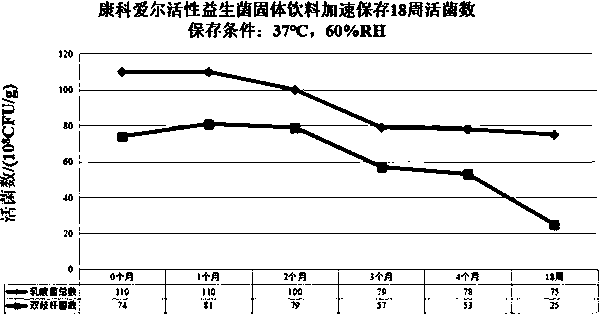
Examples
Embodiment 1
[0016] A probiotic solid beverage, comprising the following components (by mass percentage): inulin: 31.5%, resistant dextrin: 28.0%, fructooligosaccharide: 27.2%, and probiotic composition: 13.3%.
[0017] The probiotic composition contains 3.3% of Lactobacillus acidophilus, 3.3% of Lactobacillus rhamnosus, 3.3% of Lactobacillus reuteri, 2.5% of Bifidobacterium animalis and 0.9% of Bifidobacterium bifidum.
[0018] The unit dose of the probiotic solid drink is 2g.
[0019] The preparation method of above-mentioned probiotic solid beverage is:
[0020] Mix inulin, resistant dextrin, and fructooligosaccharide according to the formula ratio to form a compound prebiotic ingredient.
[0021] Mix the compound prebiotic ingredients and compound probiotics obtained by the above mixing evenly to prepare a solid beverage containing probiotics and prebiotics; each bag of solid beverage of probiotics is 2g.
Embodiment 2
[0023] A probiotic solid beverage, comprising the following components (by mass percentage): inulin: 32.0%, resistant dextrin: 27.3%, fructooligosaccharide: 27.4%, and probiotic composition: 13.3%.
[0024] The probiotic composition contains 3.2% of Lactobacillus acidophilus, 3.2% of Lactobacillus rhamnosus, 3.2% of Lactobacillus reuteri, 2.8% of Bifidobacterium animalis and 0.9% of Bifidobacterium bifidum.
[0025] The unit dose of the probiotic solid drink is 2g.
[0026] The preparation method of the above-mentioned probiotic solid beverage is the same as in Example 1.
Embodiment 3
[0028] A probiotic solid beverage, comprising the following components (by mass percentage): inulin: 33.3%, resistant dextrin: 26.7%, fructooligosaccharide: 26.7%, and probiotic composition: 13.3%.
[0029] The probiotic composition contains 3.2% of Lactobacillus acidophilus, 3.2% of Lactobacillus rhamnosus, 3.2% of Lactobacillus reuteri, 2.8% of Bifidobacterium animalis and 0.9% of Bifidobacterium bifidum.
[0030] The unit dose of the probiotic solid drink is 2g.
PUM
 Login to View More
 Abstract
Description
Claims
Application Information
 Login to View More