Unlock instant, AI-driven research and patent intelligence for your innovation.

Method for recycling vanadium tungsten titanium through secondary oxidation separation with metal oxalic acid solution

A technology of oxalic acid solution and secondary oxidation, which is applied in the fields of non-ferrous metal metallurgy and resource recovery and utilization, can solve the problems of low product purity, difficult control of impurity ions, unusable waste acid solution, etc., and achieves the effect of high-efficiency precipitation

Active Publication Date: 2020-08-25
INST OF PROCESS ENG CHINESE ACAD OF SCI
View PDF11 Cites 0 Cited by
  • Summary
  • Abstract
  • Description
  • Claims
  • Application Information

AI Technical Summary

Problems solved by technology

The developed secondary oxidation precipitation process only uses oxidant oxidation to achieve hydrolysis precipitation. The process is simple, low energy consumption, and can be industrialized. It can also solve the problems of low product purity, difficult control of impurity ions and unusable waste acid in the existing technology. question

Method used

the structure of the environmentally friendly knitted fabric provided by the present invention; figure 2 Flow chart of the yarn wrapping machine for environmentally friendly knitted fabrics and storage devices; image 3 Is the parameter map of the yarn covering machine
View more

Image

Smart Image Click on the blue labels to locate them in the text.
Viewing Examples
Smart Image
  • Method for recycling vanadium tungsten titanium through secondary oxidation separation with metal oxalic acid solution
  • Method for recycling vanadium tungsten titanium through secondary oxidation separation with metal oxalic acid solution
  • Method for recycling vanadium tungsten titanium through secondary oxidation separation with metal oxalic acid solution

Examples

Experimental program
Comparison scheme
Effect test

Embodiment 1

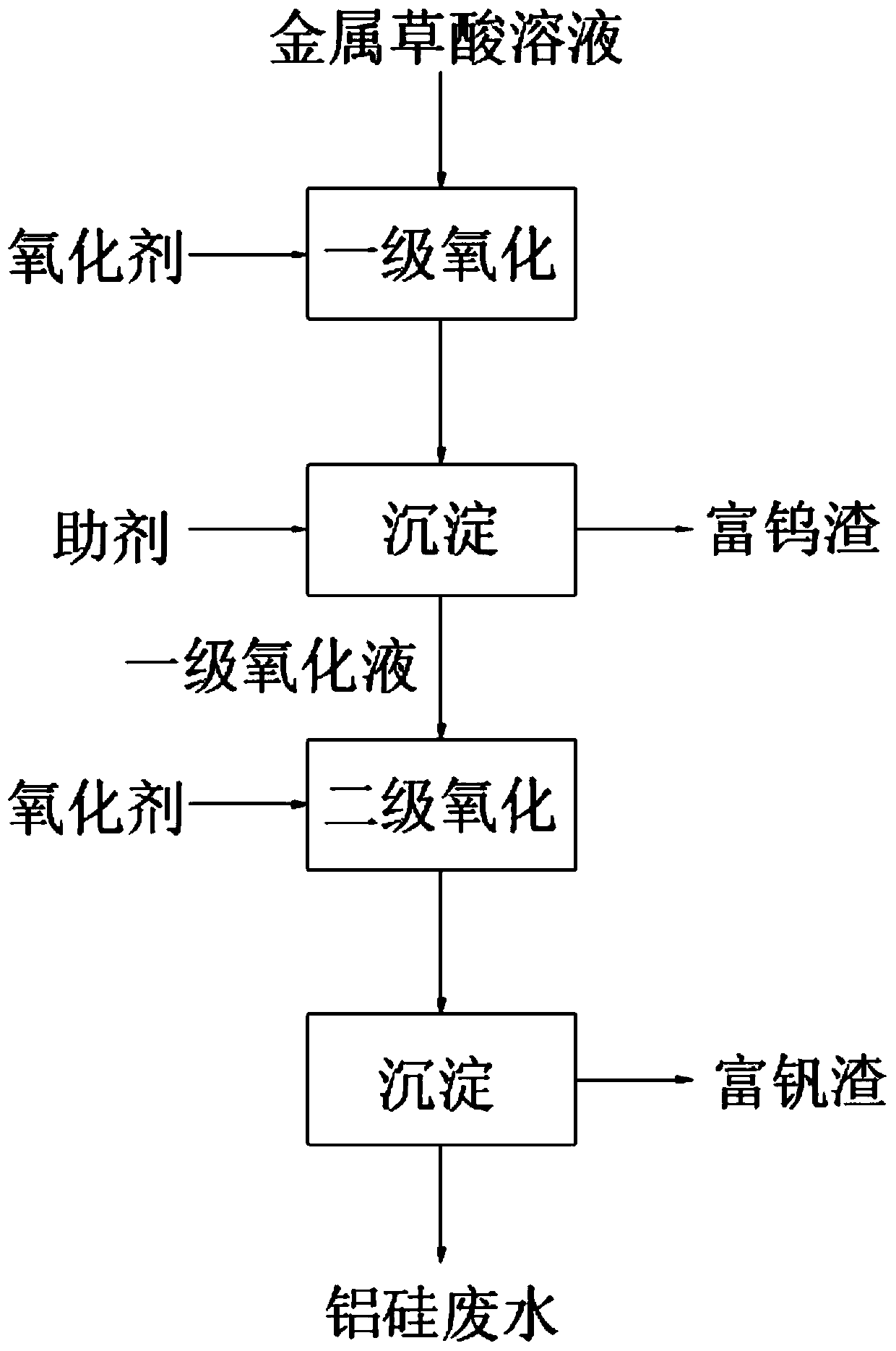
[0093] This embodiment provides a method for the secondary oxidation of metal oxalic acid solution to separate and recover vanadium, tungsten and titanium. The method is as follows: figure 1 Shown:

[0094] (1) After the metal oxalic acid solution is heated to 90°C, oxygen is added for primary oxidation for 240 minutes. The oxalate complex of tungsten and the oxalate complex of titanium are oxidized and decomposed to form metatungstic acid precipitate and titanium dioxide. The molar ratio of oxygen to oxalic acid is 0.9, The flow rate of oxygen is 0.5mL / min;

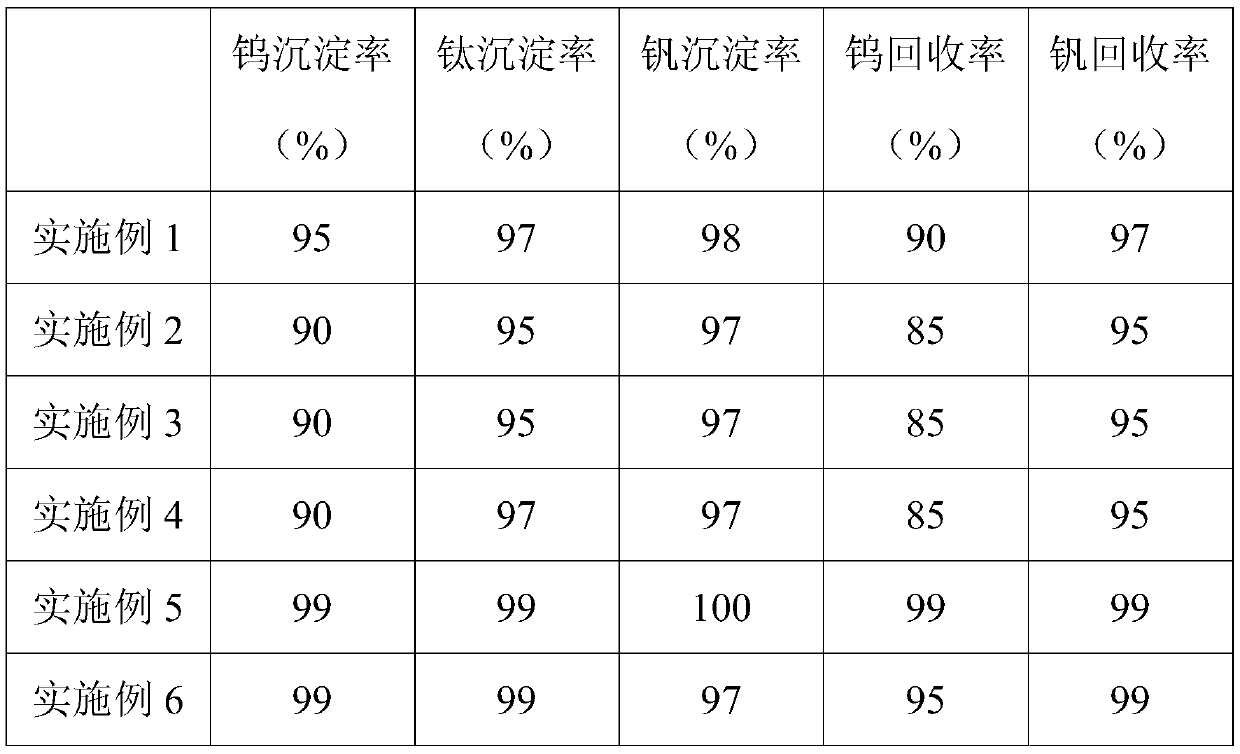
[0095] Add 5mL of ammonium chloride additive to the solution after primary oxidation, and filter for 300 minutes to obtain primary oxidation solution and tungsten-rich slag. The precipitation rates of W and Ti elements are 95% and 97%, respectively, and the rest of the elements precipitate Rates are all lower than 5%;

[0096] Use 2.5mol / L NaOH solution to dissolve tungsten-rich slag to obtain 20g / L sodium tungstate so...

Embodiment 2

[0105] This embodiment provides a method for secondary oxidation of metal oxalic acid solution to separate and recover vanadium, tungsten and titanium. The method is as follows: figure 1 Shown:

[0106] (1) After the metal oxalic acid solution is heated to 80°C, hydrogen peroxide is added for primary oxidation for 300 minutes. The oxalate complex of tungsten and the oxalate complex of titanium are oxidized and decomposed to form metatungstic acid precipitation and titanium dioxide. The molar ratio of hydrogen peroxide and oxalic acid is 0.75. The flow rate of hydrogen peroxide is 1.0mL / min;

[0107] Add 1 mL of urea additive to the solution after primary oxidation, and filter for 360 minutes to obtain primary oxidation solution and tungsten-rich slag. The precipitation rates of W element and Ti element are 90% and 95%, respectively, and the precipitation rates of other elements are uniform. less than 5%;

[0108] Use 1mol / L NaOH solution to dissolve tungsten-rich slag to obt...

Embodiment 3

[0113] This embodiment provides a method for the secondary oxidation of metal oxalic acid solution to separate and recover vanadium, tungsten and titanium. The method is as follows: figure 1 Shown:

[0114] (1) After the metal oxalic acid solution is heated to 120°C, ozone is added for primary oxidation for 180 minutes. The oxalate complex of tungsten and the oxalate complex of titanium are oxidized and decomposed to form metatungstic acid precipitation and titanium dioxide. The molar ratio of ozone to oxalic acid is 1.1, The flow rate of ozone is 0.1mL / min;

[0115] Add 5mL of Sinclair additive to the solution after primary oxidation, and filter for 240min to obtain the primary oxidation solution and tungsten-rich slag. The precipitation rates of W element and Ti element are 90% and 95%, respectively, and the precipitation rates of other elements are uniform. less than 5%;

[0116] Use 5mol / L NaOH solution to dissolve tungsten-rich slag to obtain 60g / L sodium tungstate solu...

the structure of the environmentally friendly knitted fabric provided by the present invention; figure 2 Flow chart of the yarn wrapping machine for environmentally friendly knitted fabrics and storage devices; image 3 Is the parameter map of the yarn covering machine
Login to View More

PUM

No PUM Login to View More

Abstract

The invention provides a method for recycling vanadium tungsten titanium through secondary oxidation separation with a metal oxalic acid solution. The method comprises the steps that the metal oxalicacid solution is subjected to primary oxidation and precipitation separation to obtain a primary oxidation solution and tungsten-rich slag, and the primary oxidation solution continues to be subjectedto secondary oxidation and precipitation separation to obtain vanadium-rich slag. The invention provides the method for separating vanadium tungsten titanium metal in the oxalic acid solution step bystep through secondary oxidation and precipitation. By adding an auxiliary agent, the precipitation rate of tungsten and titanium in the primary precipitation recovery process is greater than 90%. The developed secondary oxidation precipitation process only adopts oxidant oxidation to realize hydrolysis precipitation, the process is simple, the energy consumption is low, industrial production canbe realized, and the problems that in the prior art, the product purity is low, impurity ions are difficult to control and waste acid liquid cannot be utilized can be solved.

Description

technical field [0001] The invention belongs to the field of non-ferrous metal metallurgy and resource recycling, and relates to a method for recovering vanadium, tungsten and titanium from a metal oxalic acid solution, in particular to a method for secondary oxidation, separation and recovery of vanadium, tungsten and titanium from a metal oxalic acid solution. Background technique [0002] At present, oxalic acid, as a commonly used reducing organic acid leaching medium, is used to extract metals from various wastes and mineral resources, such as treating waste SCR denitrification catalysts, stone coal minerals and waste FCC catalysts. During the treatment process, since the oxalic acid solution contains coordination anions, it is easy to form oxalate complexes with various elements and exist stably in the leaching solution, and the final oxalic acid leaching solution often contains a variety of elements. [0003] When the oxalic acid solution is used to treat the waste SC...

Claims

the structure of the environmentally friendly knitted fabric provided by the present invention; figure 2 Flow chart of the yarn wrapping machine for environmentally friendly knitted fabrics and storage devices; image 3 Is the parameter map of the yarn covering machine
Login to View More

Application Information

Patent Timeline
no application Login to View More
IPC IPC(8): C22B34/22C22B34/36C22B3/44C22B34/12
CPCC22B3/44C22B34/1259C22B34/225C22B34/365
Inventor 李会泉武文粉王晨晔王兴瑞
Owner INST OF PROCESS ENG CHINESE ACAD OF SCI