
Anti-aging polymer waterproof coiled material convenient for construction and preparation method thereof
A polymer waterproof and anti-aging technology, applied in chemical instruments and methods, layered products, flat products, etc., can solve the problems of poor polyurea or polyurethane, non-flat surface temperature conditions, dusty and sandy surfaces, etc. Achieve the effect of ensuring moisture absorption performance, reducing weak points, and reducing the occurrence of adhesive surfaces
- Summary
- Abstract
- Description
- Claims
- Application Information
AI Technical Summary
Problems solved by technology
Method used
Image

Examples
Embodiment 1
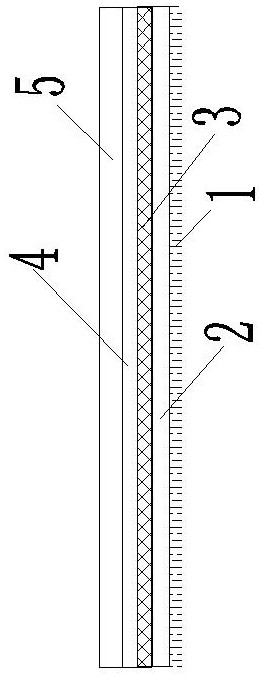
[0061] Example 1. An aging-resistant polymer waterproof membrane that is convenient for construction, characterized in that it includes a base layer, a polyurethane layer 4, and a polyurea layer 5;
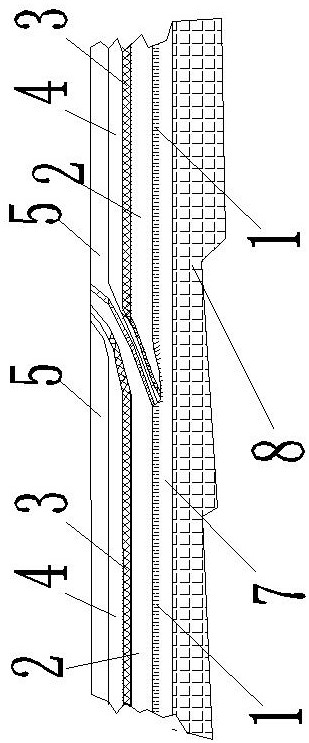
[0062]The base layer includes a 0.5mm polyvinyl chloride soft layer 2, a polypropylene non-woven fabric with a mesh structure 3 compounded on the top surface of the polyvinyl chloride soft layer 2, and a wool-faced polyester compound on the bottom surface of the polyvinyl chloride soft layer 2. Cloth 1; the polyurethane layer 4 is sprayed on the top surface of the polypropylene non-woven fabric 3; the polyurea layer 5 is sprayed on the top surface of the polyurethane layer 4.
[0063] The polypropylene nonwoven fabric 3 is a polypropylene spunbonded nonwoven fabric.
[0064] Described polypropylene fiber non-woven fabric 3 is 40g / m 2 Polypropylene spunbond nonwoven fabric.
[0065] The polyester cloth 1 is a polyester filament hot-rolled non-woven fabric.
[0066] The polyeste...
Embodiment 2
[0091] Example 2. The difference between this embodiment and embodiment 1 is that the polypropylene non-woven fabric 3 is 40g / m 2 Polypropylene spunbond nonwoven fabric. The thickness of the polyvinyl chloride soft layer 2 is 0.8mm.
[0092] The polyester cloth 1 is a polyester filament hot-rolled non-woven fabric.
[0093] The polyester cloth 1 is polyester filament hot-rolled non-woven fabric with a thickness of 70g / m 2 Polyester filament hot-rolled non-woven fabric.
[0094] The raw material of the polyvinyl chloride soft layer 2 includes the following components and parts by weight: 100 parts of polyvinyl chloride resin, 30 parts of diisononyl phthalate, 2 parts of DOTP softening plasticizer, 2 parts of OPE lubricant, 11 parts of dioctyl oxalate, 2 parts of epoxidized soybean oil, 1.5 parts of antimony trioxide, 0.10 parts of sodium pentachlorophenate, 0.05 parts of pentaerythritol β-dodecylthiopropionate, liquid barium-zinc composite stabilizer 1-2 parts of agent, 5 ...
Embodiment 3
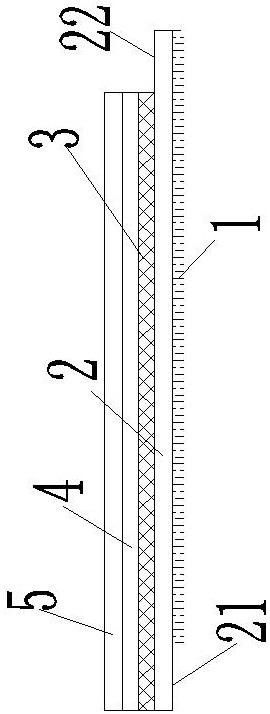
[0116] Example 3. The difference between this embodiment and embodiment 2 is: as Figure 3-5 As shown, the left side of the bottom surface of the polyvinyl chloride soft layer 2 has a lower lap area 21 that is not provided with a polyester cloth 1, and the right side of the top surface of the base layer has an upper layer that is not provided with a polypropylene non-woven fabric 3. Lap area 22. The spraying auxiliary coil material includes a 0.8mm polyvinyl chloride soft layer 2, a polypropylene non-woven fabric 3 with a mesh structure that is hot-pressed and laminated on the top surface of the polyvinyl chloride soft layer 2, and hot-pressed and laminated on the polyvinyl chloride soft layer. 2 The bottom surface of the bottom surface is a polyester cloth 1 with a rough surface.
[0117] Polypropylene non-woven fabric 3 is 50g / m 2 Polypropylene spunbond nonwoven fabric.
[0118] The polyester cloth 1 is a polyester filament hot-rolled non-woven fabric.
[0119] The poly...
PUM
| Property | Measurement | Unit |
|---|---|---|
| thickness | aaaaa | aaaaa |
| thickness | aaaaa | aaaaa |
| freezing point | aaaaa | aaaaa |
Abstract
Description
Claims
Application Information
 Login to View More