
Novel (poly)oxyalkylene block silyl ester copolymer, antifouling coating composition, antifouling coating formed from antifouling coating composition, antifouling method using antifouling coating composition and hull or underwater structure covered with antifouling coating
a technology of oxyalkylene block and silyl ester, which is applied in the direction of biocides, sports equipment, solid balls, etc., can solve the problems of increasing the fuel consumption of the ship, reducing the speed of the ship, and the bottom of the ship is likely to have its appearance and function damaged, so as to reduce the use of solvents, improve the coating cracking resistance and peeling resistance, and improve the antifouling performance.
- Summary
- Abstract
- Description
- Claims
- Application Information
AI Technical Summary
Benefits of technology
Problems solved by technology
Method used
Image


Examples
example 1
[0381] (poly)oxyalkylene Block Silyl Ester Copolymer (BP-1)
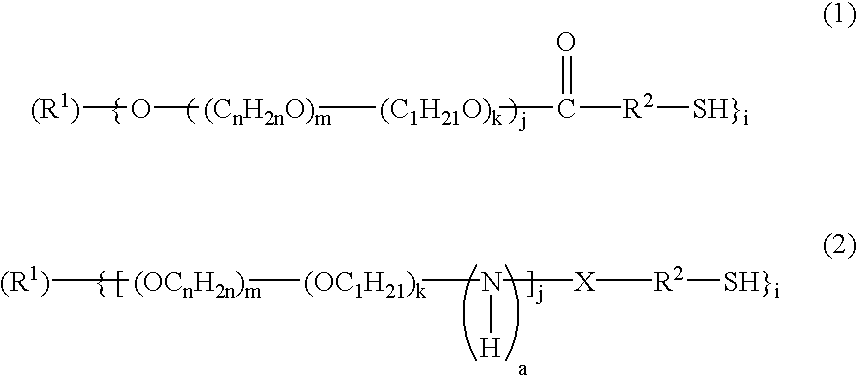
[0382] 100 parts of xylene was charged in a reaction vessel equipped with an stirrer, a condenser, a thermometer, a dropping device, a nitrogen introduction tube and a heating / cooling jacket, and heated under stirring at 85.degree. C. while blowing nitrogen thereinto. A mixture of 40 parts of triisopropylsilyl acrylate, 55 parts of methyl methacrylate, 1.5 parts of mercapto compound M-1 defined below and 1 part of 2,2'-azobisisobutyronitrile as an initiator was dropped through the dropping device into the reaction vessel while maintaining the above temperature over a period of 2 hr. The stirring was continued at the same temperature for 4 hr. Further, 0.4 part of 2,2'-azobisisobutyronitrile was added, and the agitation was continued at the same temperature for 4 hr. Thus, a colorless transparent solution of (poly)oxyalkylene block silyl ester copolymer (BP-1) was obtained.
[0383] The heating residue (residue resulting from dr...
examples 21 to 48
[0401] Preparation of Antifouling Coating Composition
[0402] The components of each of the formulations of Table 2 were charged into a paint shaker packed with glass beads as media, shaken for 2 hr, and filtered through a 100-mesh filter, thereby obtaining the desired antifouling coating compositions.
[0403] With respect to each of the antifouling coating compositions, the storage stability exhibited after storage at room temperature for two months was evaluated.
[0404] The results are also given in Table 2.
[0405] Evaluation of storage stability was made on the basis of an increment of viscosity (Ku value at 25.degree. C. measured by a Stormer viscometer) exhibited by storage at room temperature for two months after the paint production by the following measure.
[0406] (Criterion for Evaluation)
[0407] 5: viscosity increment is less than 10,
[0408] 4: viscosity increment is in the range of 10 to less than 20,
[0409] 3: viscosity increment is in the range of 20 to less than 30,
[0410] 2: vis...
PUM
| Property | Measurement | Unit |
|---|---|---|
| thickness | aaaaa | aaaaa |
| diameter | aaaaa | aaaaa |
| diameter | aaaaa | aaaaa |
Abstract
Description
Claims
Application Information
 Login to View More