[0024] By utilizing a process gas mix having a silicon source gas and which provides a low reaction
activation energy, the silicon source gas decomposes faster and more efficiently to provide silicon atoms.
Thermal chemical vapor deposition processes utilizing process gas mix which provide low reaction activation energies are less
temperature sensitive than are deposition processes which utilize deposition gases having high reaction
activation energy such as process gases utilizing
silane (SiH.sub.4). Because process gas mixes which provides a low reaction activation energy are less sensitive to temperature variation, they can be used to produce extremely uniform thickness films across the surface of the wafer even when the wafer is non-uniformly heated. By utilizing process gas mix which provides a low reaction activation energy, a silicon containing film can be formed by
thermal chemical vapor deposition across the surface of the wafer with a thickness uniformity which is less than 1% and ideally less than 0.5% even when the wafer is heated such that it has a greater than 10.degree. C. temperature variation across its surface during deposition. The use of a process gas mix having a silicon source gas and which provides a low reaction activation energy enables one to form uniform silicon containing films at high deposition rates, between 1000-3000 .ANG. per minute, with excellent wafer to wafer
repeatability. Additionally, by using a process gas mix which provides a low reaction activation energy, uniform films can be formed at relatively lower temperatures than process gas mix with high reaction activation energies. A process gas mix having a silicon source gas and which provides a low reaction activation energy can be used to form a wide variety of silicon containing films, such as but not limited to doped or undoped amorphous and
polycrystalline silicon films, doped or undoped amorphous and
polycrystalline silicon alloy films, such as
silicon germanium (Si.sub.xGe.sub.y),
silicon nitride films,
silicon oxynitride films, and
silicon oxide films.
[0025] Additionally, because process gas mixes which provide low reaction activation energies are less temperature dependent, a single
deposition temperature can be used to deposit each layer of a
composite film stack comprising multiple
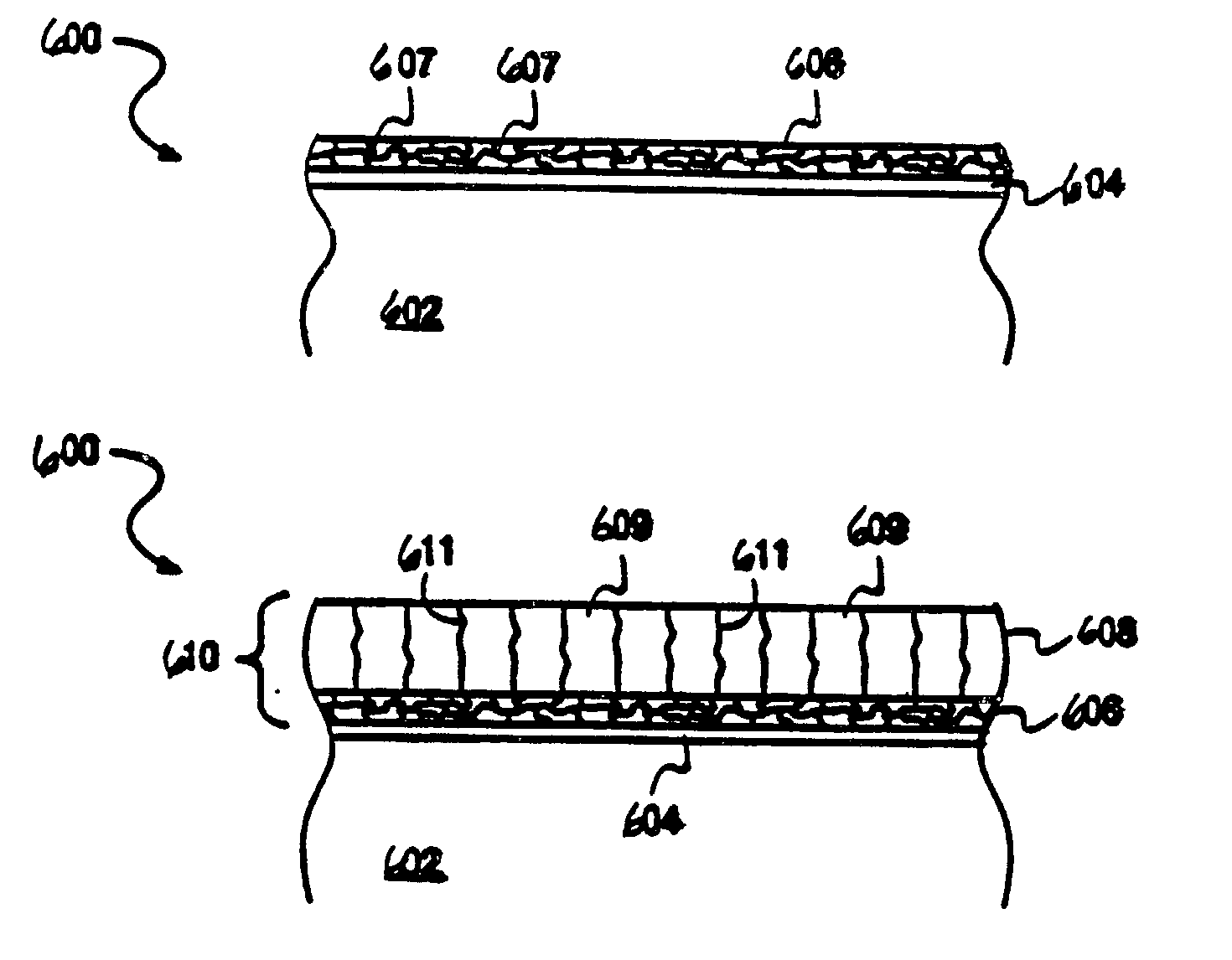
layers of different silicon containing films. For example, in the fabrication of modern gate electrodes, a
composite film stack comprising a lower silicon film, a middle
silicon germanium alloy film, and a top silicon film are sometimes desired. The ability to deposit each film of the stack at the same
deposition temperature dramatically improves wafer
throughput. This is especially useful in cases where the temperature of the wafer is maintained and controlled by means, such as a resistive heater, which cannot reliably
change temperature rapidly (i.e, changes temperatures at a rate of less than 1.degree. C. per second).
[0026] In an embodiment of the present invention, a process gas mix having a silicon source gas and which provides a low reaction activation energy is used to form a
silicon nitride film. By utilizing a process gas mix having a silicon source gas and a low reaction activation energy enables the formation of a silicon
nitride film having precise control over the films composition and properties. For example, by utilizing a process gas mix which provides a low reaction activation energy, the composition of the film can be tuned to produce a wide range of refractive indexes for the film. By being able to produce a silicon
nitride film with varying refractive indexes, the silicon
nitride films can be used as anti-reflective
coating at various steps in an
integrated circuit manufacturing process. This is especially useful when the silicon nitride film is already providing a separate function, such as a
hard mask, in the fabrication of the
integrated circuit. In this way, the silicon nitride film can provide dual functions as a
hard mask as well as an anti-reflective
coating (ARC). This can dramatically decrease
integrated circuit manufacturing complexity, cost and time by removing the need for a separate ARC layer.


 Login to View More