Biotransformation of biologically active compounds made of various classes of chemical substance by means of laccase and manganese peroxidase enzymes

a technology of laccase and manganese peroxidase, which is applied in the direction of biocide, drug composition, antibacterial agents, etc., can solve the problems of losing the biological activity of the starting materials, not being able to be treated with the currently available beta-lactam antibiotics, and keeping pace with the developmen

a technology of laccase and manganese peroxidase, which is applied in the direction of biocide, drug composition, antibacterial agents, etc., can solve the problems of losing the biological activity of the starting materials, not being able to be treated with the currently available beta-lactam antibiotics, and keeping pace with the developmen

US20030180893A1Inactive Publication Date: 2003-09-25ERNST MORITZ ARNDT UNIV GREIFSWALD

Image

Smart Image Click on the blue labels to locate them in the text.
Viewing Examples
Smart Image
  • Biotransformation of biologically active compounds made of various classes of chemical substance by means of laccase and manganese peroxidase enzymes
  • Biotransformation of biologically active compounds made of various classes of chemical substance by means of laccase and manganese peroxidase enzymes
  • Biotransformation of biologically active compounds made of various classes of chemical substance by means of laccase and manganese peroxidase enzymes

Examples

Experimental program
Comparison scheme
Effect test

example 2

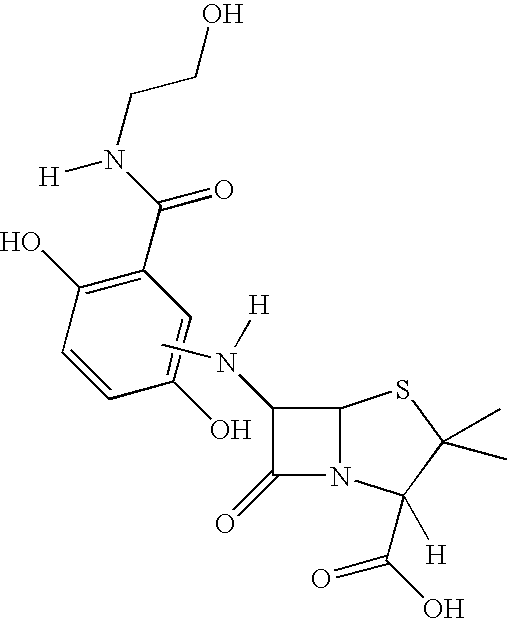
[0075] Preparation of Novel Antimicrobially Active Substances by Coupling 2,5-dihydroxy-N-(2-hydroxyethyl)Benzamide with 7-Aminocephalosporinic Acid by Means of Biotransformation

[0076] Methods: The preparation of the enzyme solution was effected according to Example 1.

[0077] The 2,5-dihydroxy-N-(2-hydroxyethyl)benzamide is reacted at an equimolar ratio with 7-aminocephalosporinic acid (1 mM) in sodium acetate buffer (pH 5; 0.02 M) under the influence of a laccase (975 nmol / 2 ml / min; obtained from Pycnoporus cinnabarinus) for 35 min at room temperature. For promoting the conversion rate, the reaction solution is shaken at 100 rpm. For processing, the reaction solution is extracted using an octadecane solid phase. Elution of the product is effected with ethyl acetate or acetonitrile. The residue remaining after removal of the solvent is purified by high-performance liquid chromatography.

[0078] Result: Coupling of the antibiotic parent substance 7-aminocephalosporinic acid with 2,5-dih...

example 3

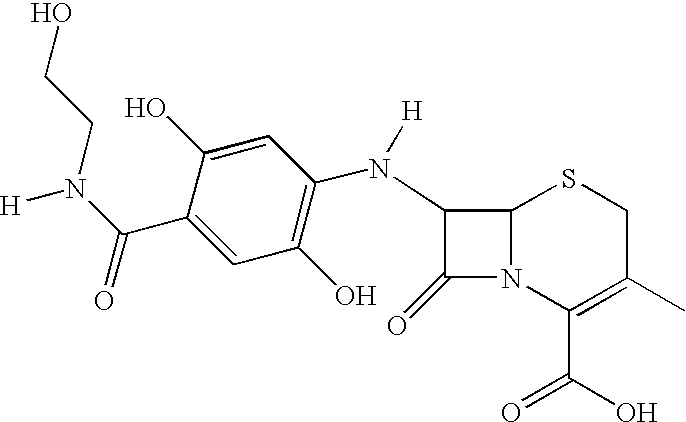
[0079] Preparation of Novel Antimicrobially Active Substances by Coupling 2,5-dihydroxy-N-(2-hydroxyethyl)Benzamide with 7-aminodeacetoxycephalospo-rinic Acid by Means of Biotransformation

[0080] Methods: The preparation of the enzyme solution was effected according to Example 1.

[0081] The 2,5-dihydroxy-N-(2-hydroxyethyl)benzamide is reacted at an equimolar ratio with 7-aminodeacetoxycephalosporinic acid (1 mM) in sodium acetate buffer (pH 5; 0.02 M) under the influence of a laccase (975 nmol / 2 ml / min; obtained from Trametes versicolor) for 40 min at room temperature. For promoting the conversion rate, the reaction solution is shaken at 100 rpm. For processing, the reaction solution is extracted using an octadecane solid phase. Elution of the product is effected with ethyl acetate. The residue remaining after removal of the solvent is purified by high-performance liquid chromatography.

[0082] Result: Coupling of the antibiotic parent substance 7-aminodeacetoxycephalosporinic acid with...

example 4

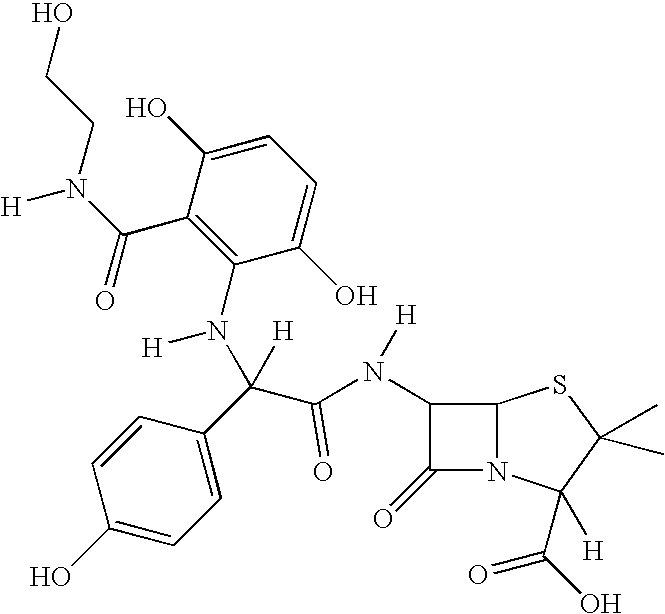
[0086] Preparation of Novel Antimicrobially Active Substances by Coupling 2,5-dihydroxy-N-(2-hydroxyethyl)Benzamide with Amoxicillin by Means of Biotransformation

[0087] Methods: The preparation of the enzyme solution was effected according to Example 1.

[0088] The 2,5-dihydroxy-N-(2-hydroxyethyl)benzamide is reacted at an equimolar ratio with amoxicillin (1 mM) in sodium acetate buffer (pH 5; 0.02 M) under the influence of a laccase (975 nmol / 2 ml / min; obtained from Trametes versicolor) for 50 min at room temperature. For promoting the conversion rate, the reaction solution is shaken at 100 rpm. For processing, the reaction solution is extracted using an octadecane solid phase. Elution of the product is effected with ethyl acetate or acetonitrile. The residue remaining after removal of the solvent is purified by high-performance liquid chromatography.

[0089] Result: Coupling of the antibiotic amoxicillin with 2,5-dihydroxy-N-(2-hydroxyethyl)benzamide results in an as yet unknown antim...

the structure of the environmentally friendly knitted fabric provided by the present invention; figure 2 Flow chart of the yarn wrapping machine for environmentally friendly knitted fabrics and storage devices; image 3 Is the parameter map of the yarn covering machine
Login to View More

PUM

PropertyMeasurementUnit
temperaturesaaaaaaaaaa
lipophilicaaaaaaaaaa
Login to View More

Abstract

A process for the preparation of biologically active compounds, wherein active substances having additional functional groups and a modified spectrum of activity and modified application properties are obtainable from medicinal substances and plant protective agents as substrates which bear at least one amino or hydroxy functional group by using a one-electron reaction catalyzed by enzymes or compositions having enzymatic activity and a broad spectrum of substrates, characterized in that free-radical forming enzymes are employed as enzymes and / or supernatants of ligninolytic fungi in solution are employed as compositions having enzymatic activity, wherein the following can be introduced as additional functional groups: A) polyfunctional synthones which provide the active substance with an altered dissolving behavior in aqueous and lipophilic systems and a high interfacial activity; B) aromatic molecules, heteroaromatic compounds; C) heterocyclic compounds; D) active substances having an independent biological activity; E) active substances combining an independent activity and surfactant properties in one molecule; which yield coupling products being covalently linked with the starting materials and having an altered partition behavior which enable polyfunctional interactions with the target organism.

Description

[0001] The invention relates to novel biologically active compounds, processes for the preparation thereof, and their use. From antibiotics and chemotherapeutics, coupling products which have either an improved antimicrobial activity or improved application properties can be obtained in a biotransformation catalyzed by the enzymes laccase or manganese peroxidase.PRIOR ART[0002] With respect to structure and biological activity, antibiotics form a heterologous group of compounds which are among those therapeutics mostly employed in human and veterinary medicine and in plant protection. Antibiotics include substances formed by microorganisms and derivatives formed therefrom which, when applied intrasomatically, can control infectious diseases. In addition to antibacterial antibiotics, antibiotics having antifungal, antiviral, trypanocidal or cancerostatic properties have been discovered. Due to the application of antibiotics prepared on a fermentative route in cancer chemotherapy, the...

Claims

the structure of the environmentally friendly knitted fabric provided by the present invention; figure 2 Flow chart of the yarn wrapping machine for environmentally friendly knitted fabrics and storage devices; image 3 Is the parameter map of the yarn covering machine
Login to View More

Application Information

Patent Timeline
25 Sep 2003
Publication
US20030180893A1
IPC
A01N43/90; A61K31/43; A61K45/00; A61P31/04; A61P43/00; C07D499/21; C07D499/68; C12P11/00; C12P13/00; C12P17/12; C12P17/14; C12P35/00; C12P37/00
CPC
C12P11/00; C12P13/001; C12P37/00; C12P17/14; C12P35/00; C12P17/12; A61P31/04; A61P43/00
Inventors
SCHAUER, FRIEDER; LINDEQUIST, ULRIKE