

Nanoparticle having an inorganic core
a technology of nanoparticles and cores, applied in the field of nanoparticles having a core, can solve the problems of loss of efficiency of nanoparticles in a given application
- Summary
- Abstract
- Description
- Claims
- Application Information
AI Technical Summary
Problems solved by technology
Method used
Image

Examples
example 2
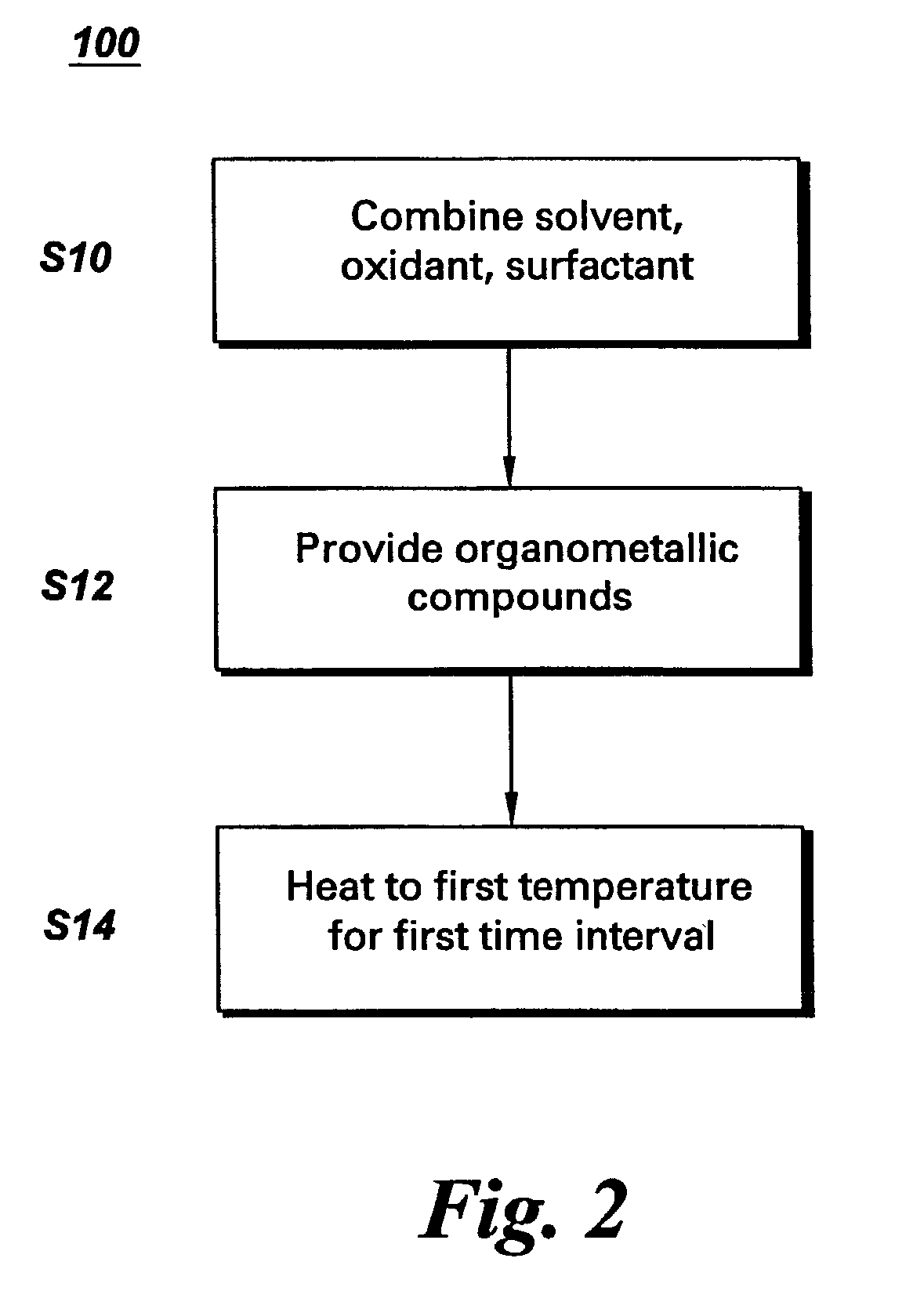
[0055] A mixture of trimethylamine-N-oxide (7.60 mmol), lauric acid (4.56 mmol), and 7 ml of deoxygenated dioctyl ether, each individually dehydrated, were added under an inert atmosphere in a glove box to a 50 ml 2-neck Schlenk flask. The flask was attached to a Schlenk vacuum line, and a column-reflux condenser assembly was attached under a blanket of N.sub.2. The mixture was homogenized with vigorous stirring and heating to about 100.degree. C.
[0056] About 1.52 mmol of iron carbonyl (Fe(CO).sub.5) were then added to the slowly stirred reaction solution, which was at a temperature in a range from about 100.degree. C. to about 105.degree. C., resulting in instantaneous and aggressive reaction. Iron carbonyl addition was complete and the intense reaction subsided in less than a minute. The reaction mixture was then heated to a temperature in a range from about 120.degree. C. to about 130.degree. C. under N.sub.2 and maintained at temperature for 1 hour with vigorous stirring.
[0057] ...
example 3
[0058] A mixture of trimethylamine-N-oxide (7.60 mmol), 10-undecenoic acid or lauric acid (4.56 mmol), and 7 ml of deoxygenated dioctyl ether, each individually dehydrated and deoxygenated, were added under an inert atmosphere to a 50 ml 2-neck Schlenk flask. The flask was attached to a Schlenk vacuum-line, and a column-reflux condenser assembly was attached under a blanket of N.sub.2. The mixture was homogenized with vigorous stirring and heating to about 100.degree. C.
[0059] About 1.52 mmol of iron carbonyl (Fe(CO).sub.5) were then added to the slowly stirred reaction solution, which was at a temperature in a range from about 100.degree. C. to about 105.degree. C., resulting in instantaneous and aggressive reaction. Iron carbonyl addition was completed in less than a minute and the intense reaction subsided. The reaction mixture was then heated to a temperature in a range from about 120.degree. C. to about 130.degree. C. under N.sub.2 and maintained at temperature for 1 hour with ...
PUM
| Property | Measurement | Unit |
|---|---|---|
| diameter | aaaaa | aaaaa |
| diameter | aaaaa | aaaaa |
| diameter | aaaaa | aaaaa |
Abstract
Description
Claims
Application Information
 Login to View More