Check patentability & draft patents in minutes with Patsnap Eureka AI!

Semiconductor device manufacturing method

a manufacturing method and semiconductor technology, applied in the direction of semiconductor/solid-state device details, liquid/solution decomposition chemical coating, coating, etc., can solve the problems of weak electro-migration resistance at the interface between sin or sic constituting the barrier film and copper, high effective dielectric constant of the semiconductor device including the copper wiring, and high rc delay (delay of the wiring). , to achieve the effect of high efficiency, high quality and simplified manufacturing steps

Inactive Publication Date: 2005-01-20
SONY CORP
View PDF9 Cites 51 Cited by
  • Summary
  • Abstract
  • Description
  • Claims
  • Application Information

AI Technical Summary

Benefits of technology

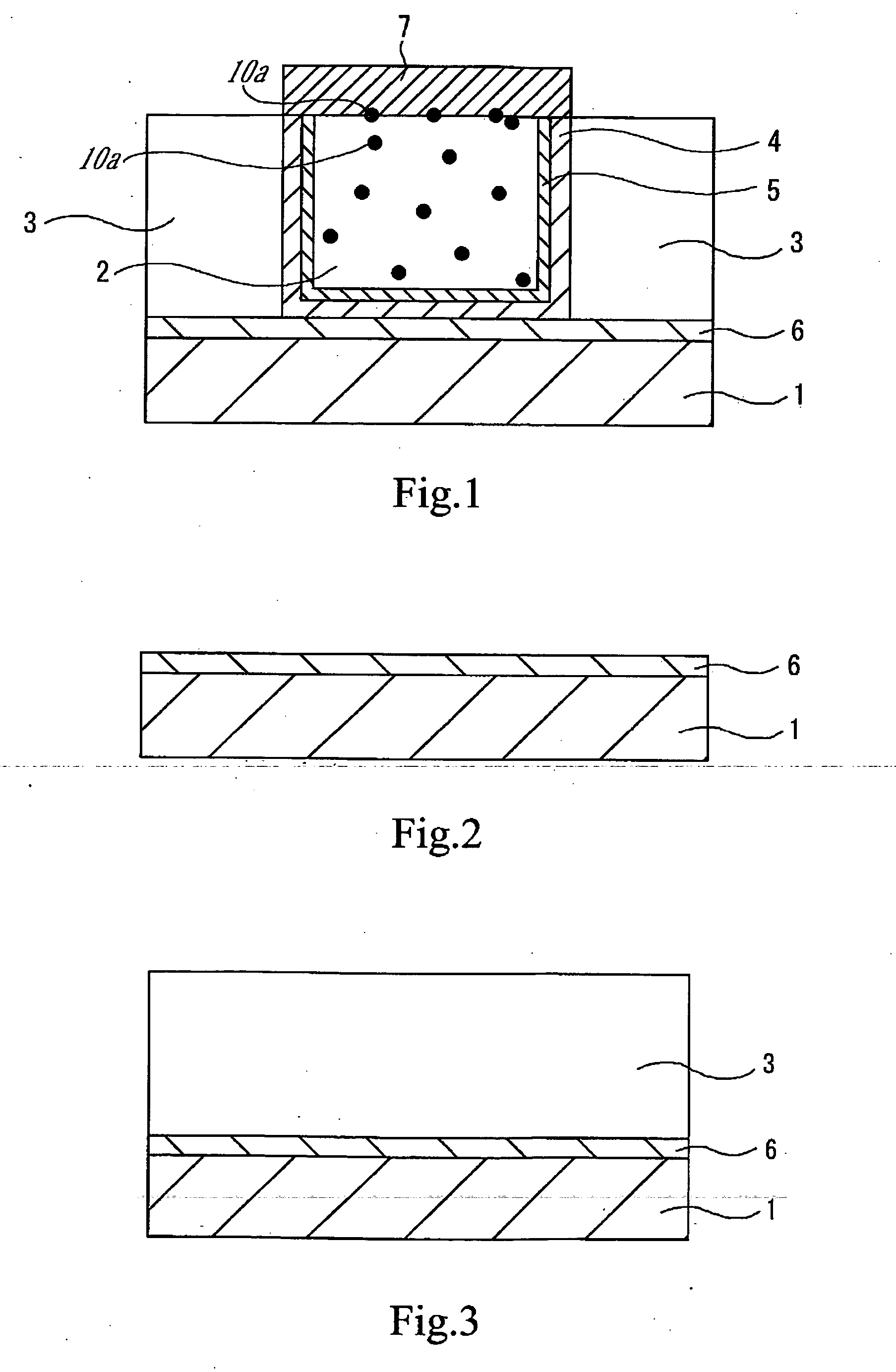
[0020] In the above-described method, the metallic wiring is formed by the electroplating using the electroplating liquid containing the catalyst metal preliminarily added thereto, whereby the catalyst metal for functioning as the catalyst in electroless plating is dispersed inside the metallic wiring and at the surface of the metallic wiring. This makes it possible to obtain the same effect as that in the case of applying the catalytically activating treatment in the conventional manufacturing method.
[0021] In the present invention, therefore, the catalytically activating treatment step indispensable to the conventional manufacturing method is unnecessitated, the barrier film can be efficiently formed by simplified manufacturing steps, and it is possible to manufacture at low cost a high-quality semiconductor device in which diffusion of copper atoms into an inter-layer insulating film is securely prevented.
[0022] Besides, in the method of manufacturing a semiconductor device according to the present invention, the metallic wiring itself will not be etched because the catalytically activating step is not conducted, as described above. Specifically, the metallic wiring is free of generation of holes in the metallic wiring due to etching, and is free of damages due to etching, such as generation of line breakage. Therefore, it is possible to manufacture a high-quality semiconductor device while obviating the problems which might cause malfunctions of the semiconductor device, such as a rise in the wiring resistance and a worsening of electro-migration resistance, arising from etching of the metallic wiring.
[0023] Furthermore, in the method of manufacturing a semiconductor device according to the present invention, the catalytically activating step is not carried out, and, therefore, the adsorption or remaining of the catalyst metal onto the inter-layer insulating film as in the conventional manufacturing method is obviated. As a result, the barrier film is not formed on the inter-layer insulating film, and, therefore, it is possible to enhance the selectivity of film formation at the time of forming the barrier film and to manufacture a high-quality semiconductor device.

Problems solved by technology

In formation of a wiring by use of copper, generally, the so-called Damascene process is used because dry etching of copper is difficult to carry out.
It should be noted here that silicon nitride (SiN) and silicon carbide (SiC) are higher in relative dielectric constant than silicon oxide (SiO2), which leads to the problems that the effective dielectric constant of the semiconductor device including the copper wiring will be high, the semiconductor will be high in RC delay (delay of the wiring due to resistance and capacitance), and the electro-migration resistance at the interface between the SiN or SiC constituting the barrier film and copper will be weak.
Copper is low in catalytic activity, and, therefore, it does not function as a sufficient catalyst for deposition of CoWP.
The above-mentioned method, however, has the problem that the Cu wiring is damaged by etching when the catalytically active layer is formed on the Cu surface by the Pd replacement plating.
Particularly, holes are locally formed in Cu along Cu grains, and, where etching is vigorous, the Cu wiring may be damaged to such an extent as to cause line breakage.
As a result, the resistance of the Cu wiring is raised by as much as 30%, for example, where the Cu wiring is severely damaged.
Furthermore, it is difficult to fill the holes, generated between the Cu grains, by the formation of the CoWP film.
As a result, even after the formation of the CoWP, voids would be left in the Cu wiring, and the electro-migration resistance would be rapidly worsened starting from the voids.

Method used

the structure of the environmentally friendly knitted fabric provided by the present invention; figure 2 Flow chart of the yarn wrapping machine for environmentally friendly knitted fabrics and storage devices; image 3 Is the parameter map of the yarn covering machine
View more

Image

Smart Image Click on the blue labels to locate them in the text.
Viewing Examples
Smart Image
  • Semiconductor device manufacturing method
  • Semiconductor device manufacturing method
  • Semiconductor device manufacturing method

Examples

Experimental program
Comparison scheme
Effect test

Embodiment Construction

[0045] Now, the method of manufacturing a semiconductor device according to the present invention will be described in detail below referring to the drawings. The present invention is not limited to the following description, and various modifications are possible within the gist of the invention. First, the case where the present invention is applied to a monolayer wiring will be described. In the following drawings, the contraction scale may differ from the actual one, for convenience of description.

[0046]FIG. 1 is a sectional view of an essential part of a semiconductor device produced by applying the present invention. The semiconductor device includes a copper-containing metallic wire, on which is formed a barrier film having a copper diffusion preventive function. The semiconductor device has a configuration in which the copper-containing metallic wire (hereinafter referred to as Cu wiring) 2 is filling a groove provided in an inter-layer insulating film 3, on a substrate 1 p...

the structure of the environmentally friendly knitted fabric provided by the present invention; figure 2 Flow chart of the yarn wrapping machine for environmentally friendly knitted fabrics and storage devices; image 3 Is the parameter map of the yarn covering machine
Login to View More

PUM

PropertyMeasurementUnit
Temperatureaaaaaaaaaa
Login to View More

Abstract

A method of manufacturing a semiconductor device for realizing a semiconductor device which is suitable for enhancing the operating speed thereof and which is high in quality and reliability is provided. The method of manufacturing a semiconductor device is a method of manufacturing a semiconductor device including a barrier film (7) having a copper diffusion preventive function and formed on a copper-containing metallic wire (9), the method including the steps of: conducting electroplating by use of an electroplating liquid containing a catalyst metal (10) added thereto so as thereby to form the metallic wiring (2) containing the catalyst metal (10); and conducting electroless plating by use of the catalyst metal (10) exposed at the surface of the metallic wiring (2) as a catalyst so as thereby to form the barrier film (7) having the copper diffusion preventive function on the metallic wiring (2).

Description

TECHNICAL FIELD [0001] The present invention relates to a method of manufacturing a semiconductor device including a metallic wiring containing copper, and particularly to a method of manufacturing a semiconductor device in which diffusion of copper into an inter-layer insulating film or the like is prevented. BACKGROUND ART [0002] Conventionally, aluminum-based alloys are used as a material of a minute wiring of a high-density integrated circuit formed on a semiconductor wafer. For enhancing the operating speed of a semiconductor device, however, it is necessary to use a material lower in resistivity than aluminum-based alloys as the wiring material, and copper, silver and the like are preferable for use as such a low-resistivity material. Particularly, copper is expected as a next-generation material because it has a low resistivity of 1.8 μΩcm, it is therefore advantageous for enhancing the operating speed of a semiconductor device, and it is higher in electro-migration resistanc...

Claims

the structure of the environmentally friendly knitted fabric provided by the present invention; figure 2 Flow chart of the yarn wrapping machine for environmentally friendly knitted fabrics and storage devices; image 3 Is the parameter map of the yarn covering machine
Login to View More

Application Information

Patent Timeline
no application Login to View More
IPC IPC(8): C23C18/16C23C18/18C23C18/31C23C18/50C25D3/12C25D3/58C25D7/12H01L21/02H01L21/285H01L21/288H01L21/306H01L21/321H01L21/768H01L23/532
CPCC23C18/50C25D7/123H01L21/02074H01L21/2855H01L21/288H01L21/2885H01L21/3212H01L21/76802H01L21/7681H01L21/76849H01L21/76877H01L23/53238H01L23/53295C23C18/1607C23C18/1637C23C18/1653C23C18/1831C25D5/02H01L2924/0002C25D3/58H01L2924/00H01L21/28
Inventor SEGAWA, YUJINOGAMI, TAKESHIHORIKOSHI, HIROSHIKOMAI, NAOKI
Owner SONY CORP
Features
  • R&D
  • Intellectual Property
  • Life Sciences
  • Materials
  • Tech Scout
Why Patsnap Eureka
  • Unparalleled Data Quality
  • Higher Quality Content
  • 60% Fewer Hallucinations
Social media
Patsnap Eureka Blog
Learn More