

Functional polymer film-coated electrode and electrochemical device using the same
a polymer film coating and electrode technology, applied in the field of electrochemical devices, can solve the problems of lithium ion polymer batteries generally having lower battery capacity than lithium ion secondary batteries, battery explosion, complex manufacturing processes, etc., and achieve the effect of improving battery safety and preventing degradation of battery performan
- Summary
- Abstract
- Description
- Claims
- Application Information
AI Technical Summary
Benefits of technology
Problems solved by technology
Method used
Image

Examples
reference example 1
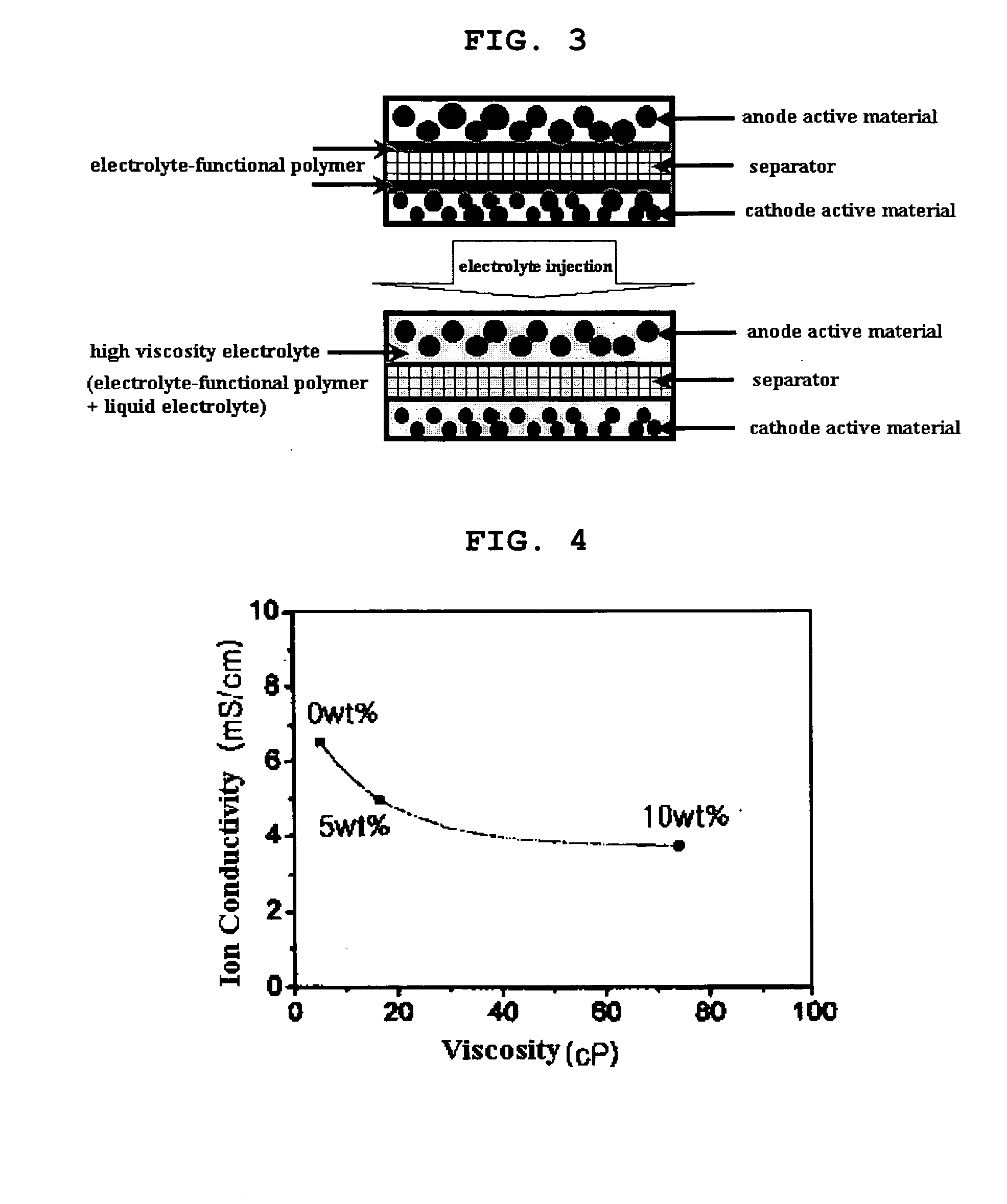
Measure of Viscosity and Ion Conductivity of Electrolyte Containing Polymer Dissolved Therein
[0066] Viscosity and ion conductivity of an electrolyte were measured, while varying the concentration of an electrolyte-soluble polymer.
[0067] In this example, the electrolyte-soluble polymer was cyanoethyl pullulan, and the electrolyte was a mixed organic solvent of EC / PC / DEC (weight ratio=3 / 2 / 5) containing 1M of LiPF6 dissolved therein. The concentration of cyanoethyl pullulan in the electrolyte was controlled to 0 wt %, 5 wt % and 10 wt %.
[0068] Variations in viscosity and ion conductivity depending on concentrations of cyanoethyl pullulan were visually monitored. The results are shown in the following Table 1 and FIG. 4. As shown in Table 1 and FIG. 4, as a small amount of an electrolyte-soluble polymer, i.e., cyanoethyl pullulan is dissolved, viscosity of the electrolyte increases significantly, but ion conductivity decreases very slightly.
TABLE 1Concentration ofelectrolyte-functi...
example [UNK]
[EXAMPLE 1˜6
Manufacture of Polymer-Coated Electrode and Separator, and Lithium Secondary Battery Comprising the Same]
EXAMPLE 1
Manufacture of Electrode Coated with Cyanoethyl Pullulan
[0069] 94 wt % of lithium cobalt composite oxide as a cathode active material, 3 wt % of carbon black as a conductive material and 3 wt % of PVDF as a binder were added to a N-methyl-2-pyrrolidone (NMP) solvent so as to produce a mixture slurry for cathode. The mixture slurry was applied on a 20 μm thick aluminum (Al) thin film as a positive current collector, and dried to produce a cathode.
[0070] Meanwhile, cyanoethyl pullulan (degree of polymerization of about 600) was dissolved in acetone for about 1 hour at about 30° C. to form a solution with a concentration of 1 wt %. The preformed cathode was dipped into the polymer solution through a dip coating method for about 1 to 3 minutes until all bubbles in the pores are evacuated, and then the coated cathode was dried under vacuum at room temperature. ...
example 2
Cyanoethylpolyvinyl Alcohol
[0076] Example 1 was repeated to manufacture a cathode and battery, except that cyanoethylpolyvinyl alcohol was used as a polymer instead of cyanoethyl pullulan.
PUM
| Property | Measurement | Unit |
|---|---|---|
| frequency | aaaaa | aaaaa |
| dielectric constant | aaaaa | aaaaa |
| thickness | aaaaa | aaaaa |
Abstract
Description
Claims
Application Information
 Login to View More