

Method of forming particles
a particle and particle technology, applied in the field of particle formation methods, can solve the problems of limiting the size distribution of particles, affecting the morphology of particles, and limiting the control of particle size distribution, and it is difficult to obtain uniform particles with diameters in the lower micron and submicron range using conventional solvent-based methods
- Summary
- Abstract
- Description
- Claims
- Application Information
AI Technical Summary
Benefits of technology
Problems solved by technology
Method used
Image



Examples
example 1
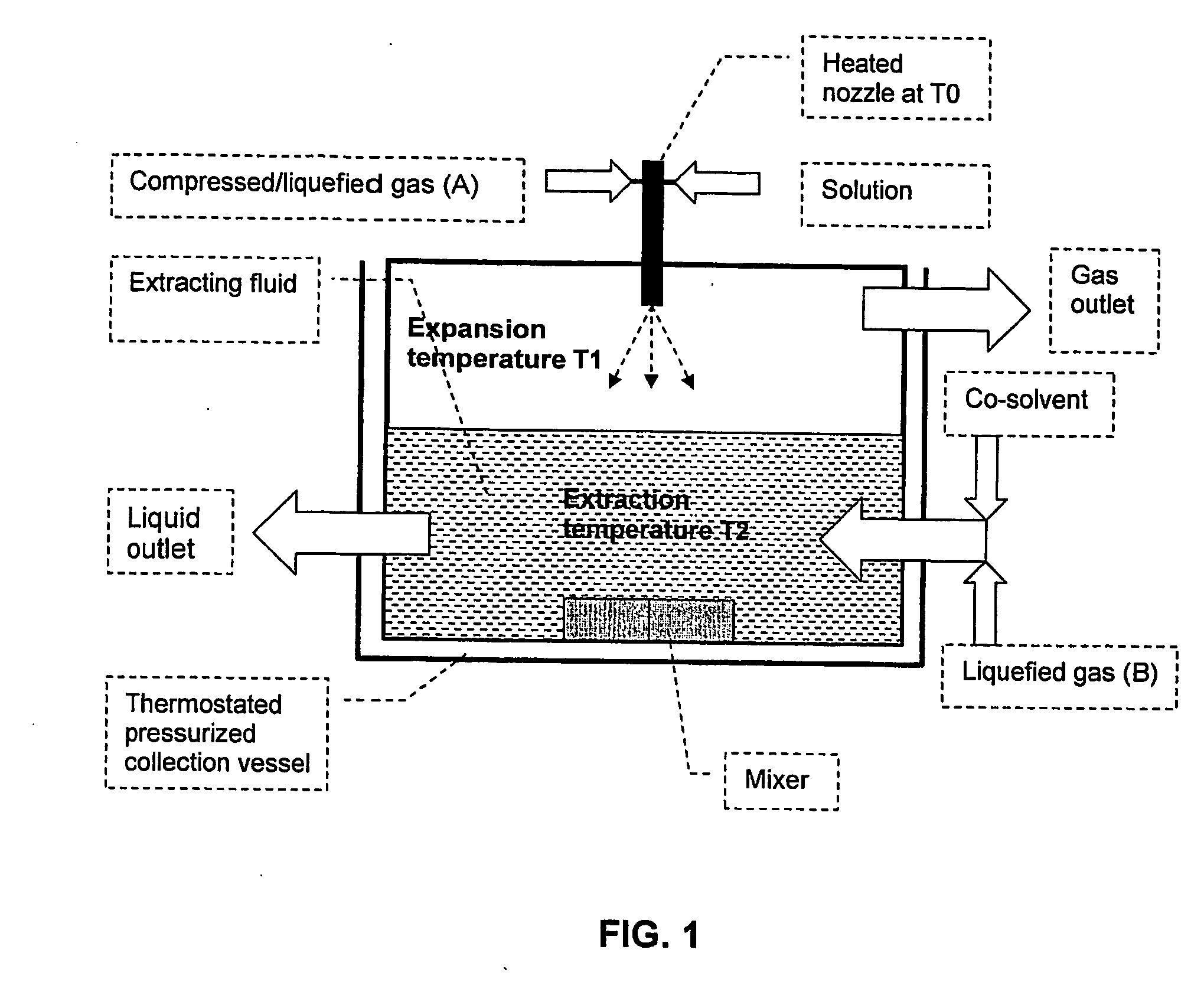
[0061] Griseofulvin, a water insoluble drug, was formed into microparticles using the third embodiment of the method according to the invention. Generally speaking, solution droplets were frozen on contact with an extracting fluid, and then the solvent was removed from the solution by solid-liquid extraction to produce the particles.
[0062] Procedure:
[0063] Griseofulvin (GF) was dissolved in Dimethyl Sulfoxide (DMSO) at 5% weight / weight to form a solution. High-pressure nitrogen heated to 95° C. was used as the first compressed gas. The extracting fluid comprised a mixture CO2, ethanol and water in approximately equal proportions. The extracting fluid was placed in an extraction vessel and was maintained at−23° C. Care was taken to ensure that the temperature of the extracting fluid was maintained significantly below the freezing point of DMSO (18° C.). The temperature of the extraction vessel was maintained constant using a cooling bath.
[0064] The first compressed gas (nitrogen) ...
example 2
[0067] The following example illustrates the precipitation of lactose, a water-soluble sugar, in the form of porous microparticles using the third embodiment of the method of the invention. As in Example 1, droplets of solution were frozen upon contact with an extracting fluid. The solvent was then removed from the solution by solid-liquid extraction, resulting in the production of particles.
[0068] Procedure:
[0069] Lactose was dissolved in water at 7% weight / weight to form a solution. Particle precipitation experiments were carried out in the same manner and under the same extraction conditions as described in Example 1. The extraction solution was again a mixture of CO2, ethanol and water in equal proportions. The flow rate of the lactose solution was 1 ml / min and was introduced after being mixed with the atomizing heated nitrogen gas (75 bar) in the low dead volume tee through a 150-μm nozzle.
[0070] Porous lactose particles were formed by solid-liquid extraction of water from t...
PUM
| Property | Measurement | Unit |
|---|---|---|
| mean diameter | aaaaa | aaaaa |
| mean diameter | aaaaa | aaaaa |
| mean diameter | aaaaa | aaaaa |
Abstract
Description
Claims
Application Information
 Login to View More