Unfortunately, although previous exercise machines such as stationary bikes, treadmills,
rowing machines and the like, may have provided adequate workouts, most users became bored with the monotonous exercise process, and stopped exercising over time.
These systems however have been expensive and inaccessible to the vast majority of those who could benefit from their use.
The expense of previous systems was due in part to the high cost of computers, which lacked the performance to run
high fidelity simulations in real-time, the exorbitant price of computerized sensors and high end
physics software.
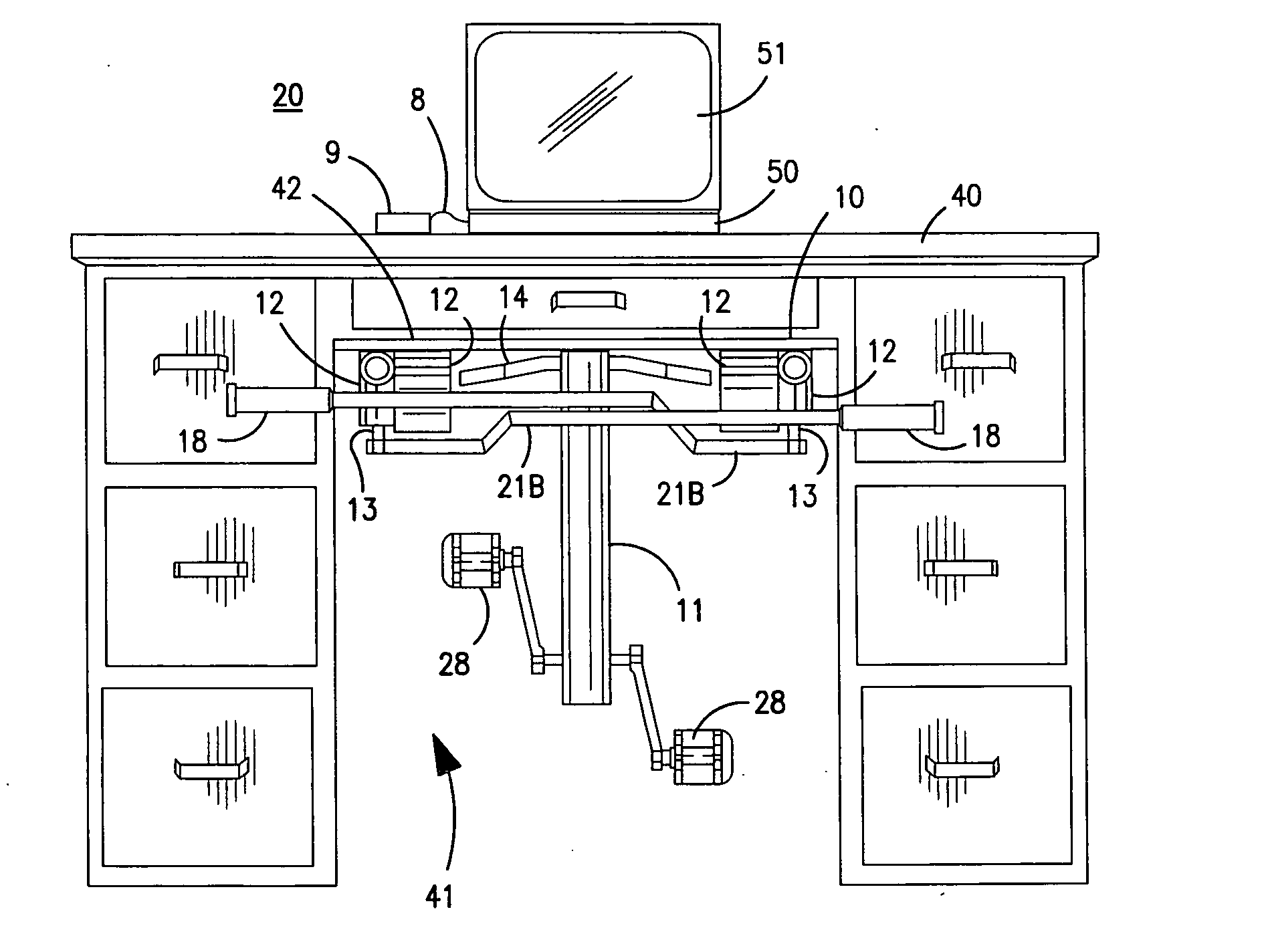
First, most current exercise devices are not compact enough to fit under a
desk, are not multifunctional (e.g., for multiple exercises such as
cycling,
rowing, dipping, etc.), do not provide for
variable resistance training, and do not provide for adjustment of the gripping mechanism, including, e.g., the pedal position and rowing
arm lengths.
Second, most current
computer simulation enhanced exercise systems do not provide real-time sensor feeds to the simulation application because current sensors are too costly.
Third, current systems rely on first-generation
physics models for simulations that are (1) limited by computational efficiency because first-generation physics-based simulation algorithms are not optimized for real-time applications running on PCs, and (2) are less accurate than modem algorithms, such as Pacejka's formula, for modeling tire forces.
Fourth, current systems do not manage
visual modeling complexity well because they relied upon a purely functional approach (non-object oriented approach) using
OpenGL directly, which is not object-oriented because it is comprised of C functions as opposed to C++ objects.
Fifth, current systems do not efficiently or accurately model moving cameras because they required complex camera updates due to the lack of
model complexity management provided by a
scene graph.
Sixth, current rail vehicle simulators do not properly model the vehicle due to the oversimplification of the
vehicle dynamics (due to attempts to make it fast enough for real-time), and / or do not model the complex rail /
track geometry accurately in a real-time environment, combined with real-time sensor inputs for propulsion updates.
Seventh, current systems do not provide the user with accurate
calorie burn rates and / or a
visualization of the amount of calories burned by accurately associating calories with common food items.
Eighth, current systems do not provide fully integrated multi-user environments, or other
network connectivity enhancements and thus limit the amount of game interaction and
restrict enhancement of the exercise experience.


 Login to View More
  Login to View More