
Aromatic compound and organic electroluminescent device using same
an organic electroluminescent device and aromatic compound technology, applied in the direction of luminescent screen of discharge tube, organic semiconductor device, natural mineral layered product, etc., can solve the problems of inferior electroluminescent properties, inability to wet-type film forming process, poor solubility of anthracene compounds, etc., to prolong the half-life of luminance, enhance light emission efficiency, and enhance the effect of light emission
- Summary
- Abstract
- Description
- Claims
- Application Information
AI Technical Summary
Benefits of technology
Problems solved by technology
Method used
Image

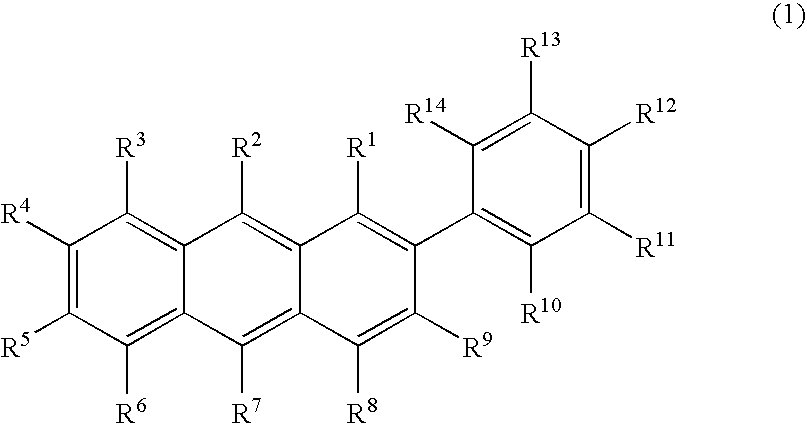
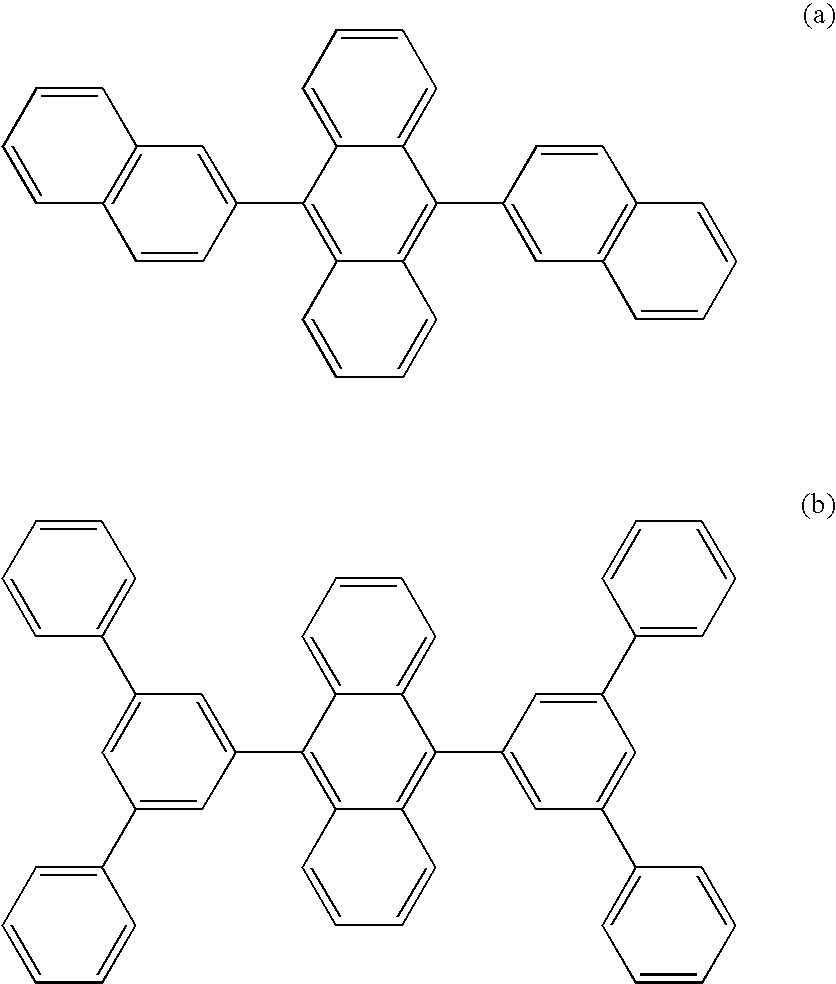
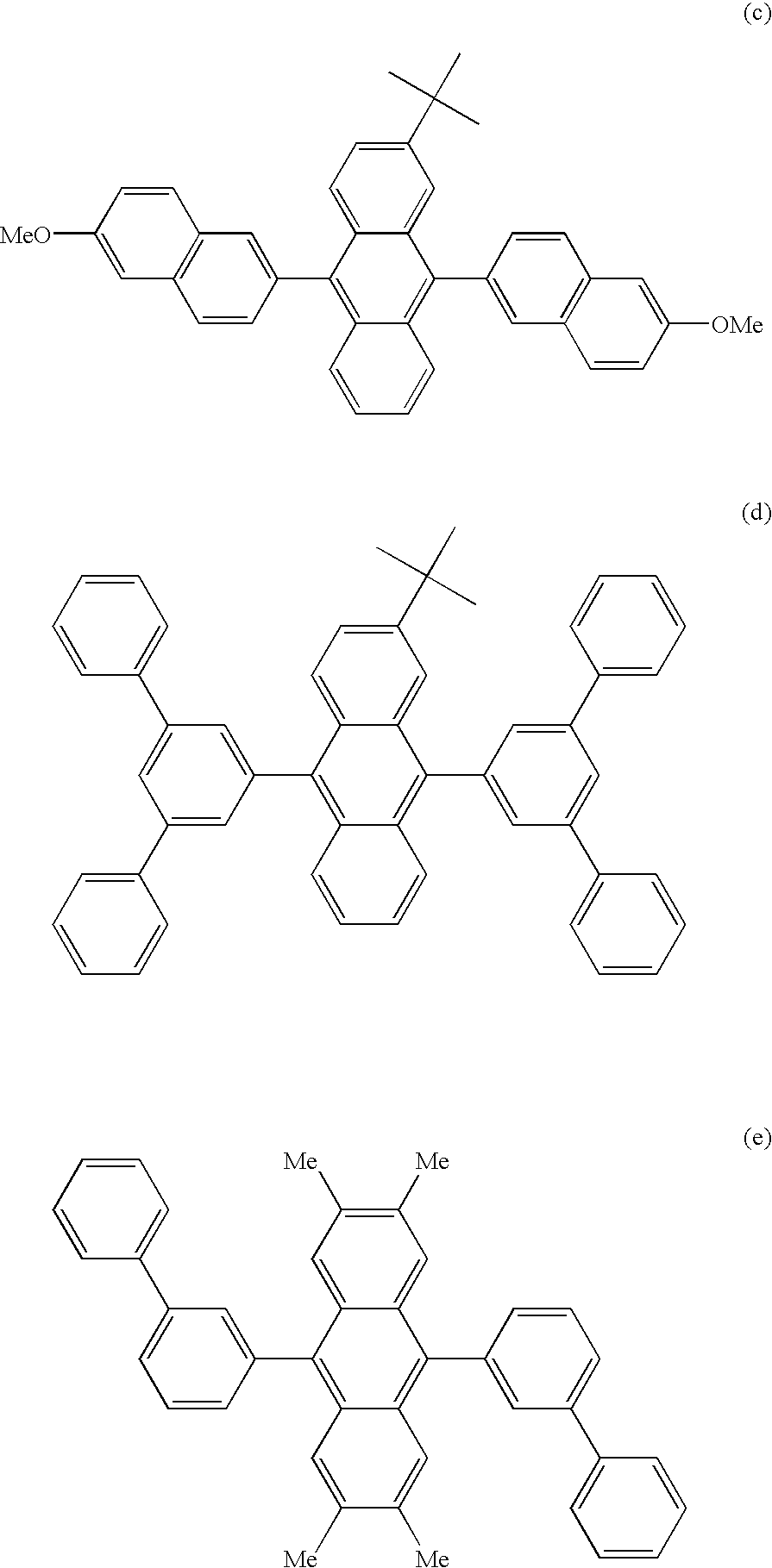
Examples
example 1
[0066] Compound (A4) was synthesized in accordance with the following route of reactions:
(1) Synthesis of 2-(2-biphenylyl)-9,10-anthraquinone [Compound (A)]
[0067] Under an atmospheric argon gas flow, 2-chloroanthraquinone in an amount of 3.4 g (14 mmol), 2-biphenylylboronic acid in an amount of 5 g (17 mmol; 1.2 eq), tris(dibenzylideneacetone)dipalladium (0) in an amount of 0.32 g (0.35 mmol; 5% Pd) and cesium carbonate in an amount of 14 g (43 mmol; 2.5 eq) are suspended into 40 milliliter of anhydrous dioxane, and adding a toluene solution of tricyclohexylphosphine in an amount 1.1 milliliter (25% by mass, 0.98 mmol; 1.4 equivalent to Pd), the resultant solution was stirred at 80° C. for 10 hours.
[0068] The resultant reaction mixture was diluted with the use of water in an amount of 100 milliliter and further with the use of toluene in an amount of 300 milliliter and then, insolubles were filtrated by means of celite. An organic layer was separated from the filtrate and washed ...
example 2
[0084] Compound (A5) was synthesized in accordance with the following route of reactions:
(1) Synthesis of 2-(2-biphenylyl)-9,10-bis(3-(4-biphenylyl)phenyl)-9,10-dihydroxy-9,10-dihydro anthracene [Compound (A5-0)]
[0085] Under an atmospheric argon gas flow, 3-(4-biphenylyl)-1-bromobenzene in an amount of 5.9 g (19 mmol, 3eq) was dissolved into a mixed solvent of anhydrous toluene in an amount of 90 milliliter and anhydrous THF in an amount of 40 milliliter, followed by cooling down to a temperature of −20° C. by means of dry ice / methanol bath. Adding hexane solution of n-butyllithium in an amount of 13 milliliter (1.59 mol / litter, 1.21 mmol; 1.1 eq), the resultant solution was stirred at a temperature of −20° C. for 1 hour. Into the resultant solution, 2-(2-biphenylyl)-9,10-anthraquinone [Compound (A)] in an amount of 2.3 g (6.4 mmol) was added and after stirring at a room temperature for 9 hours, it was stood alone for a night.
[0086] The resultant reaction mixture was deactivated ...
example 3
[0098] Compound (A6) was synthesized in accordance with the following route of reactions:
(1) Synthesis of 2-(2-biphenylyl)-9,10-bis(3-(1-naphthyl)phenyl-9,10-dihydroxy-9,10-dihydro anthracene [Compound (A6-0)]
[0099] Under an atmospheric argon gas flow, 3-(4-biphenylyl)-1-bromobenzene in an amount of 4.2 g (15 mmol; 2.7 eq) was dissolved into a mixed solvent of anhydrous toluene in an amount of 25 milliliter and anhydrous THF in an amount of 25 milliliter, followed by cooling down to a temperature of −20° C. by means of dry ice / methanol bath. Adding hexane solution of n-butyllithium in an amount of 10 milliliter (1.59 mol / litter, 15.9 mmol; 1.06 eq), the resultant solution was stirred at the temperature of −20° C. for 1 hour. Into the resultant solution, 2-(2-biphenylyl)-9,10-anthraquinone [Compound (A)] in an amount of 2.0 g (5.6 mmol) was added and after stirring at the room temperature for 5 hours, it was stood alone for a night.
[0100] The resultant reaction mixture was deactiv...
PUM
| Property | Measurement | Unit |
|---|---|---|
| Efficiency | aaaaa | aaaaa |
| Luminescence | aaaaa | aaaaa |
Abstract
Description
Claims
Application Information
 Login to View More