
Cross-linking reagents for hemoglobin and hemoglobin products cross-linked therewith
a technology of cross-linking reagents and hemoglobin products, which is applied in the field of hemoglobin, processes and reagents for modifying hemoglobin, and hemoglobin products, can solve the problems of becoming progressively more difficult to bond a third hemoglobin tetramer to a multi-functional cross-linking reagent, and achieves 100% efficiency, prevent dissociation, and efficient preparation of bis-tetrameric hemoglobin
- Summary
- Abstract
- Description
- Claims
- Application Information
AI Technical Summary
Benefits of technology
Problems solved by technology
Method used
Image

Examples
example 1
Preparation of Materials
[0026] THF was dried by distilling with metallic sodium and acetone was further dried by distilling with mixed Drierite every time before use. Freshly dried THF and acetone were stored under nitrogen. Other commercially available reagents and solvents were applied without further treatment. The reagents used for the HPLC solutions were HPLC grade. Water used to prepare all the buffers and solutions was doubly distilled and deionized. Compounds newly synthesized were characterized by 1H NMR Spectroscopy, 31P NMR Spectroscopy, ESI Mass Spectroscopy and UV-Vis Spectroscopy. 1H NMR and 31P NMR spectra were carried out at 400 MHz and 300 MHz separately. UV-Vis spectroscopy was scanned at room temperature. Molecular modeling studies for the design of the cross-linker molecule were performed using Spartan® '04 for Windows® (Wavefunction, Inc.). Hemoglobin used in this experiment was purified from human whole blood through the method described by Winslow et al1. Pur...
example 2
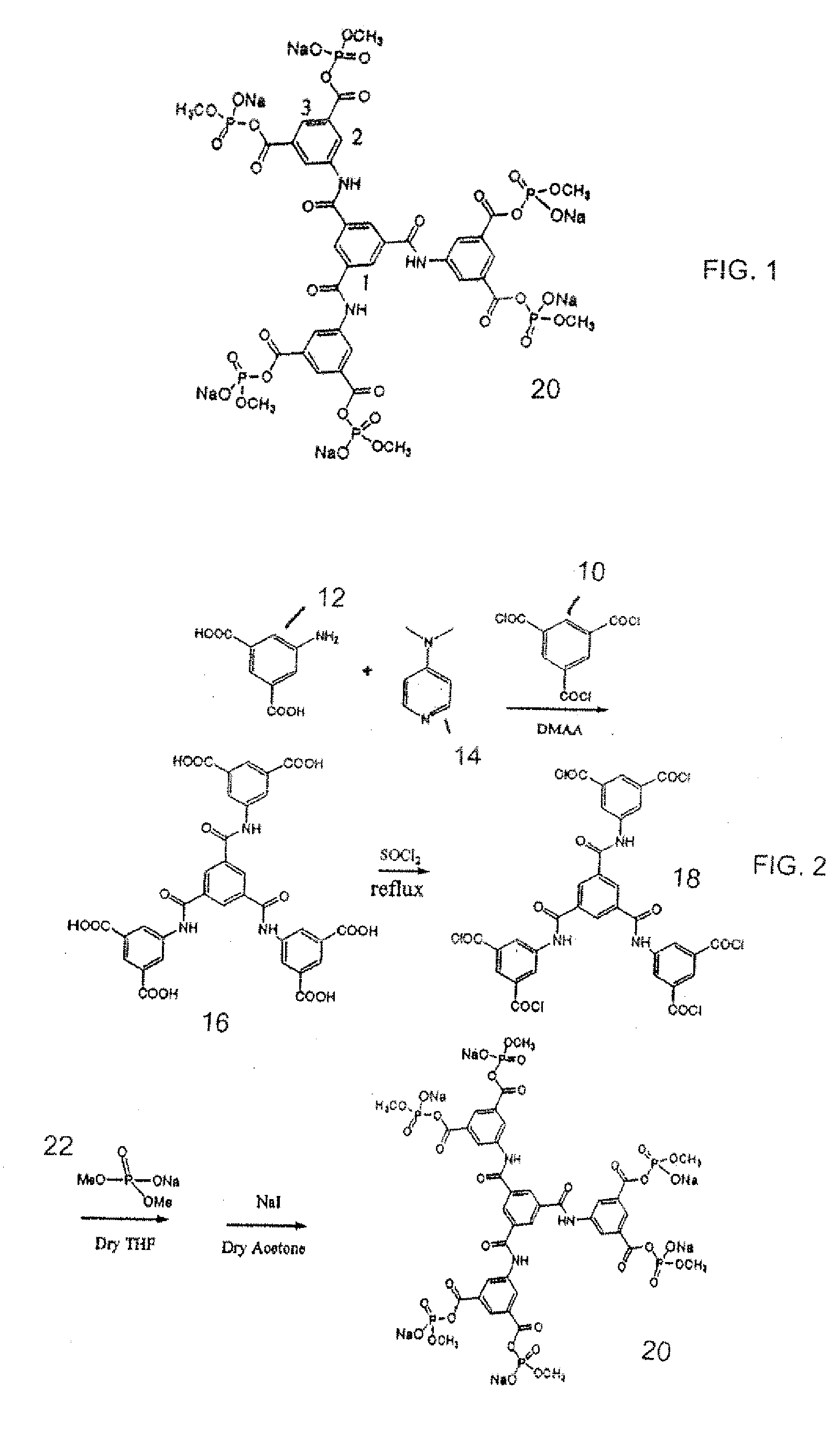
Synthesis of N,N′,N″-Tris(isophthalyl)-1,3,5-Benzenetricarboxylate, compound 16
[0027] 5-Aminoisophthalic acid (2.73 g, 15.1 mmol) and 4-(dimethylamino)-pyridine (0.18 g, 1.5 mmol) were dissolved in 50 mL anhydrous N,N-dimethylacetamide under N2 in a 100 ml, round bottom flask. 1,3,5-Benzenetricarbonyl chloride (1.33 g, 5.0 mmol) was added in. The mixture was stirred under N2 for 96 hours to give a light yellow solution. The reaction mixture was then transferred to a 250 mL flask. Distilled water (200 mL) was added to precipitate the product as a white fluffy powder. The solid was separated by vacuum filtration and suspended in 150 mL dd water. The solid was then precipitated in the centrifuge set under 10 k RPM for 30 minutes. The supernatant solution was decanted. The solid product was washed 5 times using this process to remove the organic solvent DMAA. The wet solid was lyophilized overnight to give a light yellow crystalline product (3.35 g, 95.8% yield). 1H NMR(DMSO-d6). δ 13....
example 3
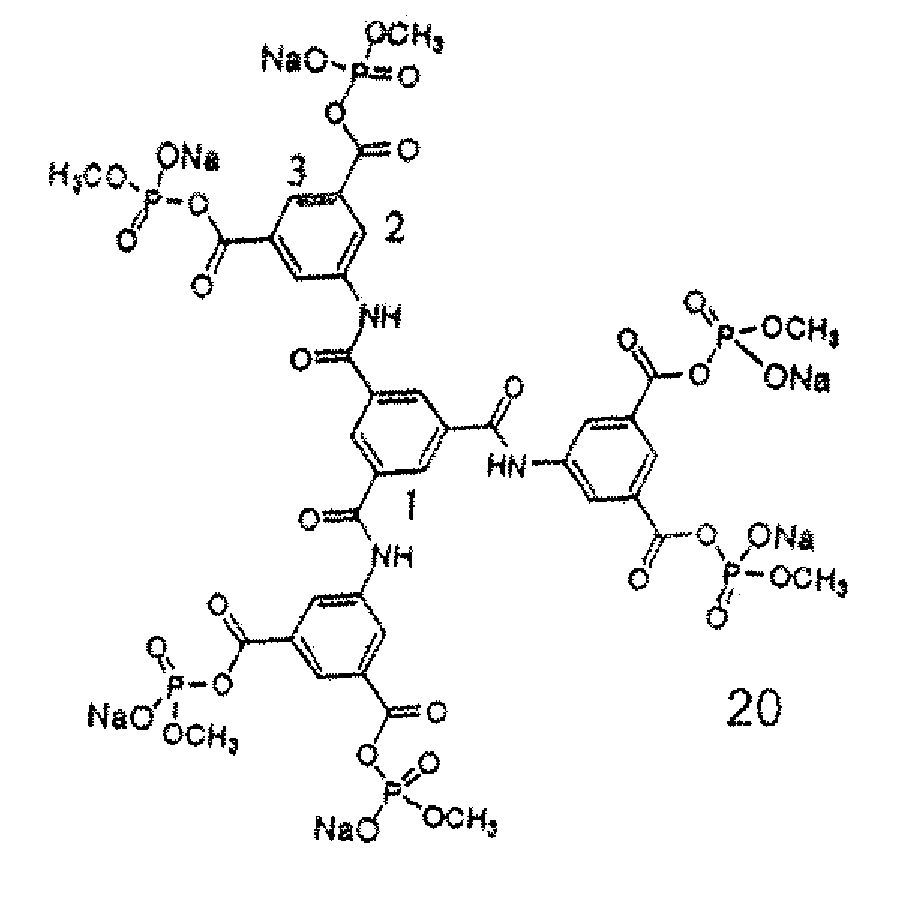
Synthesis of N,N′,N″-Tris[bis(sodium methyl phosphate )isophthalyl]-1,3,5-Benzenetricarboxylate, 20
[0028] N,N′,N″-Tris(isophthalyl)-1,3,5-Benzenetricarboxylate (0.28 g, 0.4 mmol) was dissolved in 25 mL thionyl chloride under N2 and refluxed for 18 hours. Thionyl chloride was then removed by vacuum distillation to give an orange solid. The solid (0.31 g, 0.38 mmol) was dried under vacuum pump for 2 hours to remove thionyl chloride with a trap cooled in liquid nitrogen. Sodium dimethyl phosphate (0.34 g, 2.3 mmol; 1H NMR (D20): B 3.58 q, 31P NMR (D20): 63.0), which was synthesized using trimethyl phosphate and NaI4 in dry acetone, was dissolved in 30 mL freshly distilled THF and added into under nitrogen. The mixture was stirred under N2 for 64 hours to give a yellow solution with some precipitated sodium chloride, which was then removed by vacuum filtration. THF in the filtrate was removed by vacuum distillation. The dark yellow solid obtained was further dried under vacuum pump for...
PUM
| Property | Measurement | Unit |
|---|---|---|
| pH | aaaaa | aaaaa |
| pH | aaaaa | aaaaa |
| pH | aaaaa | aaaaa |
Abstract
Description
Claims
Application Information
 Login to View More