[0022] The cleaning compositions of the present invention containing an
oxidizing agent in combination with other cleaning compounds have
environmentally friendly ingredients and utilize various types of surfactants which yield synergistic results with regard to cleaning ability and extended stability of the
oxidizing agent either alone or when used with alkaline compounds, and are also low foaming and can be used for high-energy spray applications. They can also be used to boost the cleaning
efficacy of both alkaline and acidic cleaners in spray and manual cleaning applications. Their surfactancy and oxidizing
chemistry allow for a multitude of cleaning mechanisms. The cleaning compositions can be effectively used to clean hard to remove soils of the pharmaceutical,
personal care,
nutraceutical and other industries requiring effective, validatable cleaning. The surfactants comprise at least one hydrophilic surfactant that has a
hydrophile-lipophile balance (HLB) value of 10 to 20 and comprise surfactants such as primary and secondary
alcohol alkoxylates containing a relatively small number of carbon atoms derived from the
alcohol and a relatively large number of repeat groups of alkylene oxides having from 2 to about 4 carbon atoms. Another component of the cleaning composition is a
hydrotrope which is utilized to stabilize the various surfactants in order to allow them to remain soluble in an acidic or an alkaline
aqueous solution. Hydrotropes include various
alkyl glucosides or
alkyl polyglucosides, various modified carboxylic acids or carboxylates, various
phosphate esters, various
quaternary fatty amine ethoxylates, various amino compounds such as coco imino organo compounds, and various
alkyl amino organo compounds. An optional but desired surfactant or combination of surfactants include various hydrophobic surfactants which have an HLB value of less than 10 such as various
alcohol alkoxylates wherein the
hydrocarbon portion derived from the alcohol has a relatively high number of carbon atoms and the alkylene
oxide has a relatively low number of repeat groups.
[0023] An important aspect of the present invention is the utilization of an
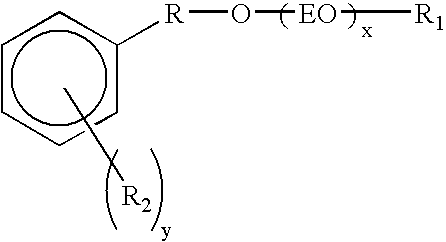
ultraviolet light analyzable surfactant that contains a
chromophore such as UV analyzable aromatic functional group. In general, a validatable cleaning method comprising: (a) cleaning the surface with a cleaning composition which contains a detectable, stable substance, (b) rinsing the surface to remove the cleaning composition to produce a rinsate; and (c) analyzing the rinsate using
high performance liquid chromatography for the detectable substance such as a surfactant that is detectable at a concentration of 10 ppm or below to serve as an indicator of whether the cleaning composition has been removed from the surface. By stable, it is meant that the surfactant does not appreciably degrade (i.e., the detectable substance does not degrade and become undetectable) over the expected storage lifetime of the cleaning composition.
[0026] The cleaning compositions can be used for removing various residues such as dried or baked
polymer and have several advantages over conventional cleaning systems in that they are
environmentally friendly since they are biodegradable, non-toxic, non-hazardous, low foaming, and have a UV analyzable surfactant with respect to detecting any cleaning composition residue in
rinse water. By “biodegradable” it is meant but not limited to the definition of “the structural change (transformation) of a surfactant by micro-organisms resulting in the loss of its surface-active properties due to the degradation of the parent substance and consequential loss of the surfactant-active property measured by test methods listed in Annex II, Official Journal of the European Union 8.4.2004 (Article 2, Definitions 6 and 7)”. Another significant
advantage is that, the cleaning compositions are very stable and that the
decomposition rate of the
oxidizing agent such as
hydrogen peroxide is very low even in the presence of an alkaline compound or formulated alkaline cleaner.




 Login to View More