Nitrogen oxide-reducing catalyst and method for reducing nitrogen oxide
a nitrogen oxide and catalyst technology, applied in the field of nitrogen oxide reduction, can solve the problems of unsatisfactory ferrosilicate catalysts, and achieve the effect of enhancing hydrothermal stability and high catalytic activity
- Summary
- Abstract
- Description
- Claims
- Application Information
AI Technical Summary
Benefits of technology
Problems solved by technology
Method used
Image

Examples
example 1
[0136]18.79 g of aluminum nitrate nine hydrates and 4.63 g of iron nitrate nine hydrates were dissolved in 257 g of an aqueous 35% tetraethylammonium hydroxide solution (hereinafter referred to as “TEAOH”). To the thus-obtained solution, 209 g of tetraethylorthosilicate (TEOS) was added, and the mixture was thoroughly stirred at room temperature to be thereby hydrolyzed. The produced ethanol was evaporated and then a required amount of water was evaporated. To the reaction mixture, 20.88 g of 48% hydrofluoric acid was added, and the resulting mixture was thoroughly mixed in a mortar. The reaction mixture was put into a stainless steel autoclave and was heated at 150° C. for 240 hours to be thereby crystallized. The composition of the reaction mixture was 40SiO2:Al2O3:0.23Fe2O3:20HF:24.4TEAOH:300H2O. The crystallized slurry mixture was white. The mixture was then filtered, and the solid was washed with pure water and then dried at 110° C. The thus-obtained dry powder was calcined at ...
example 2
[0138]A reaction mixture to be crystallized was prepared by the same procedure described in Example 1 except for the composition of the mixture that was changed as follows.[0139]70SiO2:Al2O3:0.47Fe2O3:35HF:42TEAOH:490H2O. The reaction mixture was put into a stainless steel autoclave and was heated at 150° C. for 160 hours to be thereby crystallized. The crystallized slurry mixture was white. The mixture was then filtered, and the solid was washed with pure water and then dried at 110° C. The thus-obtained dry powder was calcined at 600° C. for 2 hours.
[0140]X-ray diffraction measurement of the β-type ferrosilicate showed a X-ray diffraction pattern shown in Table 1.
example 3
[0141]A reaction mixture to be crystallized was prepared by the same procedure described in Example 1 except for the composition of the mixture that was changed as follows.[0142]70SiO2:Al2O3:Fe2O3:35HF:42TEAOH:490H2O. The reaction mixture was put into a stainless steel autoclave and was heated at 150° C. for 240 hours to be thereby crystallized. The crystallized slurry mixture was white. The mixture was then filtered, and the solid was washed with pure water and then dried at 110° C. The thus-obtained dry powder was calcined at 600° C. for 2 hours.
[0143]X-ray diffraction measurement of the β-type ferrosilicate showed a X-ray diffraction pattern shown in Table 1.
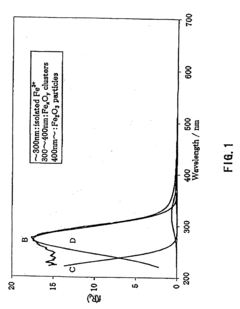
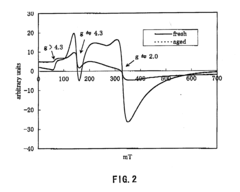
[0144]An ultraviolet-visible light absorption spectrum of the β-type ferrosilicate 1 as obtained before hydrothermal aging is shown in FIG. 1. An electron spin resonance (ESR) spectrum of the β-type ferrosilicate, as analyzed before and after hydrothermal aging, is shown in FIG. 2.
PUM
| Property | Measurement | Unit |
|---|---|---|
| Fraction | aaaaa | aaaaa |
| Fraction | aaaaa | aaaaa |
| Fraction | aaaaa | aaaaa |
Abstract
Description
Claims
Application Information
 Login to View More