Check patentability & draft patents in minutes with Patsnap Eureka AI!

Method for producing adenovirus vectors for gene therapy and DNA sequences used therefor

a technology of adenovirus and gene therapy, applied in the direction of dsdna viruses, viruses/bacteriophages, organic chemistry, etc., can solve the problems of inability to completely resolve, difficult to readministrate future readministraciones, and illness caused by the ad, even when associated with well-defined pathologies,

Inactive Publication Date: 2010-07-08
AUTONOMOUS UNIVERSITY OF BARCELONA +1
View PDF1 Cites 1 Cited by
  • Summary
  • Abstract
  • Description
  • Claims
  • Application Information

AI Technical Summary

Benefits of technology

[0024]Surprisingly, the simple presence of an attB sequence recognized by the recombinase of the Streptomyces ΦC31 bacteriophage flanking the 5′ end of the Ψ sequence of the helper adenovirus has noW been found to lead to a sensible delay in the packaging process of the helper adenovirus in comparison with that of the control adenovirus. Based on this, the invention provides a method for the production of gutless adenoviruses that allows for obtaining the latter with a level of helper adenovirus contamination that is lower than the level obtained with the use of methods known until now, and which do not necessarily require the use of specific cell lines that express a determined recombinase, but rather which is based on careful selection of the time of recovering the gutless adenovirus from the culture.
[0033]Comprise a packaging signal Ψ between both ITRs, located in such a way that the distance between the 5′ end of the packaging signal and the 3′ end of the ITR closest to it does not exceed the distance that would prevent packaging of the natural adenovirus, a distance that is 200 base pairs in the case of the human serotype 5 adenovirus and which is assumed, by analogy, to be approximately equal in the case of other serotypes, since it has been seen that the introduction of sequences between the ITR and the packaging signal in the sequence that naturally separates them decreases the packaging capacity of the adenoviral genome35, causing a reduction in the total number of adenovirus particles obtained, even though there is no significant change in the time necessary for their packaging;
[0041]When working on a large scale, that is when the range of magnitude of millilitres or centilitres of cultures has been surpassed so that cultures are run in large volume reactors (the most common of which are 2 litres or above, although there are also reactors for 0.5 litres), recovery of the gutless adenovirus from the culture medium may be more appropriate. As such the time of recovery of said adenoviruses is chosen in such a way that their viral cycle has finalized, lysis has occurred in the cells where they have multiplied and packaged, and they have passed to the cell culture medium. Again it is convenient that the time for proceeding with recovery be near, although after, the finalization of the viral cycle of the gutless adenovirus and, in any event, prior to the finalization of the helper adenovirus viral cycle. In this way the presence in the culture medium of particles of helper adenovirus produced in cells in which there was no cotransduction is avoided to the extent possible, the helper adenovirus is the only one that has multiplied itself and the cell lysis is caused by finalization of the viral cycle of the helper adenovirus, whose cycle finalizes after the finalization of the viral cycle of the gutless adenovirus. Therefore, it is preferable that the time of recovery of the gutless adenovirus from the culture medium is later than, but close to the moment of finalization of the viral cycle of the gutless adenovirus. When this embodiment of the invention is selected, particles of gutless adenovirus can be recovered from the culture medium using purification techniques known to the skilled in the art, such as for example FPLC which allows the purification of large amounts of various biomolecules and particles and which makes working with large volumes feasible.
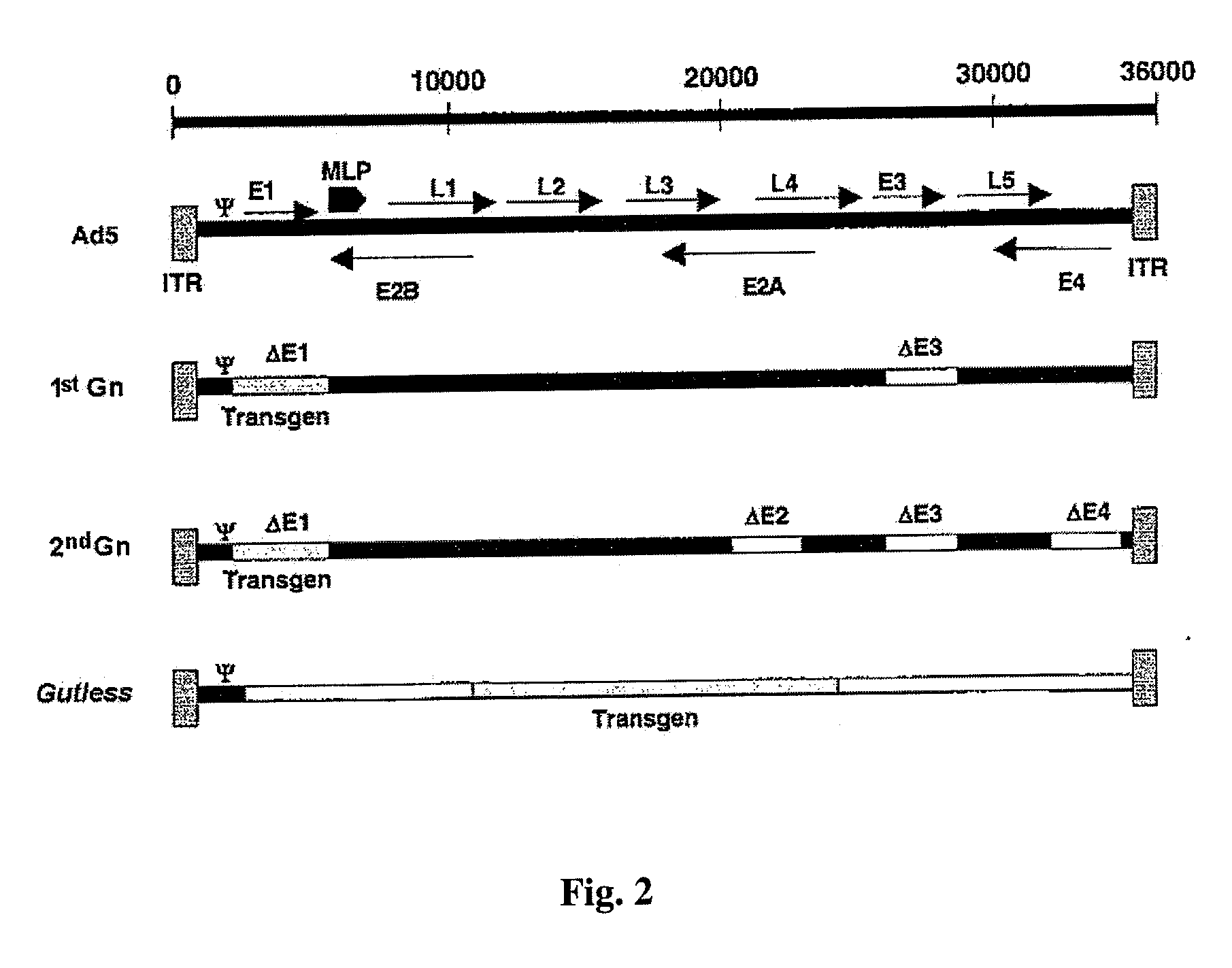
[0047]The method of the invention requires the DNA sequence corresponding to a gutless adenovirus being cotransduced together with the DNA sequence corresponding to a helper adenovirus presenting an attB sequence of ΦC31 recombinase located between the packaging signal Ψ and the end of the adenovirus genome that is closest to that Ψ sequence. The structure of the helper adenovirus DNA can correspond to the structure represented in the upper part of FIG. 2, immediately below the scale, that is, to comprise the complete genome of an adenovirus, or it also can also correspond to any of the structures represented below (except that corresponding to the gutless adenovirus), deriving from the deletion of part of the gene sequences, forms that correspond to first and second generation adenoviruses. The use of adenoviruses that lack the E1 region is preferred, to prevent the possibility of the minimal amount of helper adenovirus that could be present in the final preparation of gutless adenovirus from being competent for replication.
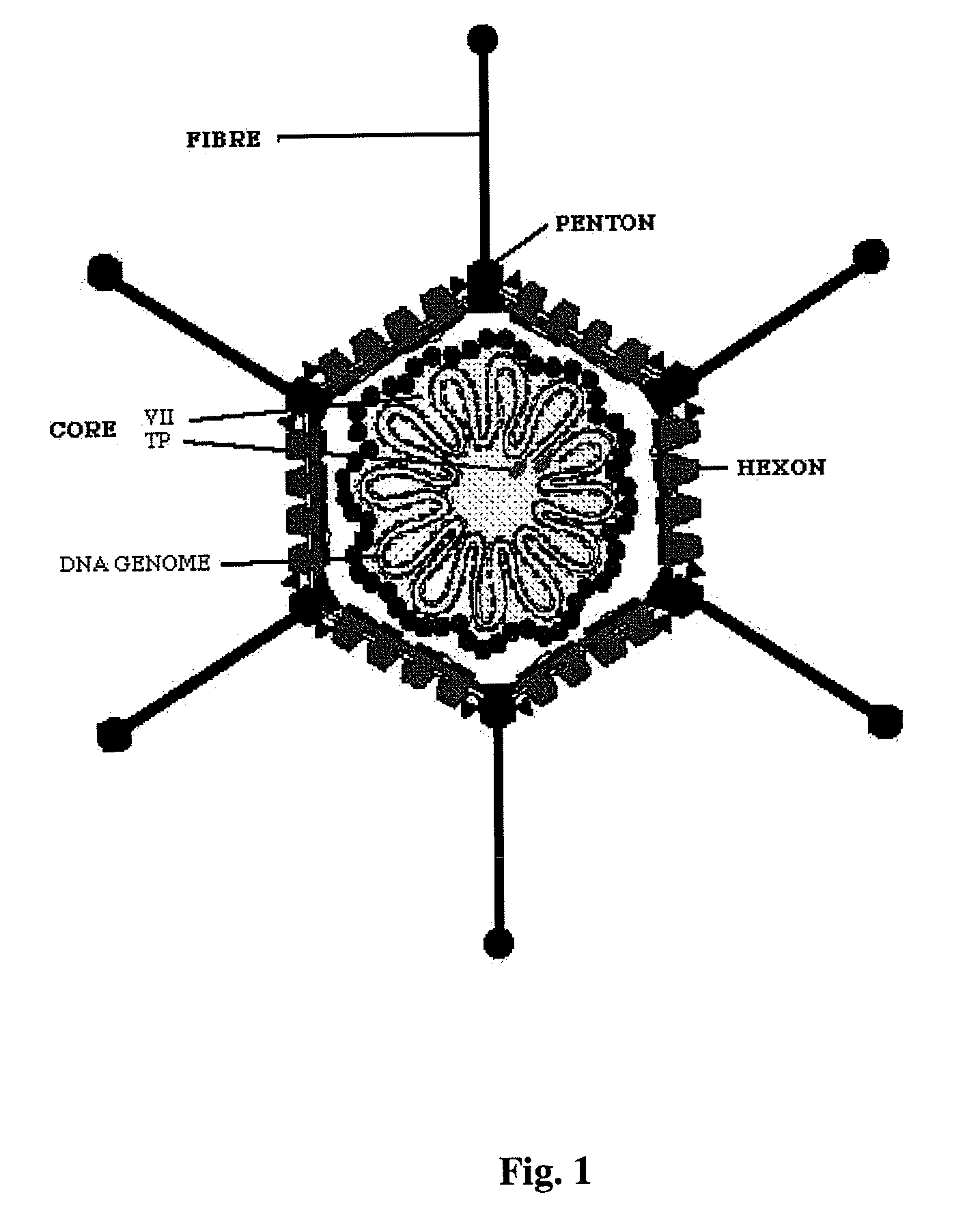
[0051]When the penetration of the DNA sequences of the helper and / or gutless adenoviruses occurs in the form of complete adenovirus particles, via the receptor-mediated endocytosis mechanism, then the surface of the cell membrane must also possess receptors adequate to interact with the fibres that extend beyond the capsids of the helper adenovirus and / or the gutless adenovirus, and integrins that favour internalization of the viral particle. In the case of helper adenoviruses deriving from Ad5, cell lines such as the before mentioned HEK293, PERC6 or N52E6 are valid, or any other permissive cell in which the adenovirus particles can penetrate and where the replication of helper and gutless adenovirus genomes, the expression of adenovirals and the packaging of new particles can occur. However contrary to the methods described in the state of the art, it is not necessary for the cells in which the gutless adenoviruses are cotransduced and where they multiply themselves to express any type of exogenous recombinase, and so, the method of the invention allows the amplification of the repertoire of cells useful for the production of gutless adenovirus.
[0052]On the other hand, although the method of the invention is based on using the difference between the time of packaging of the gutless adenovirus and that of the helper adenovirus when the latter contains an attB sequence located between the packaging signal Ψ and the ITR sequence located at the end of the adenovirus genome closest to said signal IP, it is compatible with the combination with classic systems based on the use of recombinases to contribute a lower degree of contamination by helper adenovirus in the gutless adenovirus obtained, provided that the helper adenovirus used comprises an attB sequence in the localization indicated and there is still a delay in the packaging moment of the helper adenovirus with regard to the gutless adenovirus which could be advantageous to determine the time to proceed to isolation of the gutless adenovirus. Therefore, embodiments wherein the helper adenovirus used, additionally to exhibit the attB sequence, has its Ψ signal flanked by sequences that allow recognition by recombinases and wherein the cells in which the gutless adenoviruses and the helper adenovirus are cotransduced express the recombinase that recognizes said flanking sequences, are also embodiments of the method the invention, encompassed in its scope. One of the possibilities is to use, in the method of the invention, adenoviruses that comprise an attP sequence of ΦC31 bacteriophage flanking the packaging signal tP at the end opposite to the that where the attB sequence is found, and to cotransduce the helper adenovirus and the gutless adenovirus in a cell line that expresses ΦC31 recombinase, such as cell line 293ΦC31; in this case, it is preferable that the attB sequence is separated from its corresponding attP sequence by 1.5-2 kb, to try to favour the activity of the ΦC31 recombinase which, like all recombinases, varies its activity based on the number of base pairs found among the specific sequences recognized by it. The helper adenovirus comprising an attB sequence and optionally, an attP sequence can have its Ψ sequence also flanked by sequences recognizable by other recombinases, such as for example loxP sequences or frt sequences. In this case, the method of the invention could be carried out by the cotransduction of the helper adenovirus and the gutless adenovirus in cell lines that express, respectively, Cre recombinase (such as for example cell line 293Cre) or FLP recombinase (such as for example cell line 293FLPe). It is also possible to use cell lines that express more than one recombinase functional in eukaryotic cells, such as line 293CreΦC31 (which expresses the Cre and ΦC31 recombinases and could be a cell to select when using with helper adenoviruses having an attB sequence of ΦC31 and a loxP sequence located 5′ to the packaging signal Ψ, as well as an attP sequence of ΦC31 and another loxP sequence located 3′ to the packaging signal Ψ.)


Problems solved by technology

The fundamental disadvantage of the adenoviral vectors is that a high dosis-dependent immunity is induced, both humoral, making future readministraciones difficult, as well as cellular by T lymphocytes (CTL).
Illnesses caused by the Ad, even when associated with well described pathologies, generally are relatively unimportant.
The creation of 2nd generation vectors in which the E1 and E3 regions have been eliminated as well as zones of regions E2 and E4, did not completely resolve this problem.
However although there are a high number of advantages, their use in clinical tests is still questionable due firstly to the elevated contamination which is normally caused by the so called helper Ad, and secondly because an efficient system has not yet been developed for their large scale production in bioreactor.
However high levels of contamination from wild type Ad were detected after purification, as well as the presence of various recombinases between both8.
Consequently the genome could not be packaged.
One of the limitations of the Cre-loxP and FLPe-frt systems is that they present bi-directional activity; that is in high enzyme concentration conditions they can act in both directions of the reaction, making it difficult to reduce helper Ad contamination to levels below 0.1%.
Cre recombinase is also toxic to the cell at the high levels36 necessary to completely excise the Ψ sequence.

Method used

the structure of the environmentally friendly knitted fabric provided by the present invention; figure 2 Flow chart of the yarn wrapping machine for environmentally friendly knitted fabrics and storage devices; image 3 Is the parameter map of the yarn covering machine
View more

Image

Smart Image Click on the blue labels to locate them in the text.
Viewing Examples
Smart Image
  • Method for producing adenovirus vectors for gene therapy and DNA sequences used therefor
  • Method for producing adenovirus vectors for gene therapy and DNA sequences used therefor
  • Method for producing adenovirus vectors for gene therapy and DNA sequences used therefor

Examples

Experimental program
Comparison scheme
Effect test

example 1

Production of Helper Adenovirus (Ad Helper)

[0124]The strategy followed to generate helper Ad was the introduction of the attB / attP sequences flanking its packaging signal and a GFP (green fluorescent protein, a protein which produces a characteristic green glow when observed under ultraviolet light) marker gene on this signal's 3′ end for easy analysis of the potential of these vectors.

[0125]The production of helper Ad was based on the human serotype 5 (Ad5) adenoviral genome, which can be accessed in the GenBank database under code AC—000008. The Ad5 adenoviral genome is inserted in the pKP1.4 plasmid, which contains the entire viral coding region, except for part of the E1 region and part of the E3 region (the 28250 to 30757 nucleotides for the Ad5 genome sequence shown in GenBank). It also contains the CMV promoter, a multiple cloning site (MCS) that allows for the incorporation of genes, and the polyA for SV40. To clone the signal or therapeutic genes, a shuttle plasmid called p...

example 2

Amplification of Adenovirus Ad5 / attP.—

[0159]2.1 Production of Ad5 / attP.

[0160]Prior to the production of the vector, the viral genome to be transduced needed to be prepared. The pKP1.4ΔCMVΔMCSattBloxPΨGFPattP plasmid contains the gene for ampicillin resistance and its origin of replication, which must be eliminated. This region is flanked by 2 Pac I targets. To accomplish this, 100 μg of plasmid was digested with the Pac I enzyme, and it was purified for subsequent transduction in HEK293 cells. In this way, the plasmid's Amp+ori region was eliminated and the viral genome was opened, producing a linear molecule, which is the form that the Ad genome takes when it enters the cell nucleus.

[0161]To amplify the adenoviral genomes, a transduction was performed with PEI (polyethylenimine at 25000 Da average molecular weight, supplied by Aldrich, ref.=40,872-7) in a 6-well plate. Once the pTG6600ΔMCSattBloxPΨGFPattP and pTG6600ΔMCSΨGFPattP plasmids were transduced, at 24 hours the expression ...

example 3

Amplification of Different Constructs of Helper Adenovirus

[0165]The adenoviral vectors derived from Ad5 usually have a 36-hour cycle. To achieve this, in the final production the cells are collected at 36 hours, so that most of the mature virion produced is found in the cell nucleus, just before cell lysis. This will concentrate the cells for further purification.

[0166]When the various plasmids are transduced and the producing cells are collected, it was noted that the Ad was not amplified in successive steps. After repeating this process up to 4 times, it was thought that the Ad was not functional, even though it expressed the GFP protein in the cells. Even though a correct digestion band was observed, it was thought that some essential gene of the Ad cycle had mutated. However, another option was that the percentage of the initial transduction was low and that this would lead to a slower viral cycle. To determine if this was the cause, the number of process hours was increased to ...

the structure of the environmentally friendly knitted fabric provided by the present invention; figure 2 Flow chart of the yarn wrapping machine for environmentally friendly knitted fabrics and storage devices; image 3 Is the parameter map of the yarn covering machine
Login to View More

PUM

PropertyMeasurementUnit
Timeaaaaaaaaaa
Timeaaaaaaaaaa
Digital informationaaaaaaaaaa
Login to View More

Abstract

Method for producing adenovirus vectors for gene therapy and auxiliary vectors used therefor. The method is based on the multiplication of gutless adenoviruses that lack adenovirus-coding sequences by cotransfecting them with an auxiliary or helper adenovirus that has an attB sequence of the &phis;C31 bacteriophage inserted between the adenovirus packaging signal and the ITR closest to it and / or utilizing the delay arising at the time of packaging the helper adenovirus with respect to that of the gutless adenovirus owing to the presence of the atttB sequence in order to recover the gutless adenovirus from the culture before the helper adenovirus completes its viral cycle. This gives rise to high gutless adenovirus titres that are essentially free from helper adenovirus, thereby allowing them to be used in gene therapy, minimizing the likelihood of the appearance of a cellular immune response on the part of the treated individual against cells transduced by the adenovirus vector produced.

Description

TECHNICAL FIELD[0001]The invention refers to obtaining adenovirus vectors without adenovirus coding regions (gutless adenovirus) with low contamination levels in helper adenoviruses, to allow multiplication and packaging of the vectors. The invention specifically refers to a method to produce these adenovirus without the need to use cells that express an exogenous recombinase, as well as helper adenoviruses which allow this method to be carried out.BACKGROUND OF THE INVENTION[0002]Gene therapy is one of the disciplines of biomedicine that has allowed the development of techniques and protocols with therapeutic potential to treat diseases of a genetic origin. Gene therapy consists of introducing nucleic acids (DNA and RNA) for therapeutic purposes in a target cell, to permit, increase or decrease the genetic expression of a specific gene. Generally speaking treatment of the majority of genetic illnesses by somatic gene therapy requires the expression of a therapeutic gene throughout ...

Claims

the structure of the environmentally friendly knitted fabric provided by the present invention; figure 2 Flow chart of the yarn wrapping machine for environmentally friendly knitted fabrics and storage devices; image 3 Is the parameter map of the yarn covering machine
Login to View More

Application Information

Patent Timeline
no application Login to View More
IPC IPC(8): C12N7/00C07H21/04
CPCA61K48/0091C12N2710/10343C12N15/86C12N7/00
Inventor CHILLON RODRIGUEZ, MIGUELALBA FERNANDEZ, RA LBOSCH MERINO, ASSUMPCIO
Owner AUTONOMOUS UNIVERSITY OF BARCELONA
Features
  • R&D
  • Intellectual Property
  • Life Sciences
  • Materials
  • Tech Scout
Why Patsnap Eureka
  • Unparalleled Data Quality
  • Higher Quality Content
  • 60% Fewer Hallucinations
Social media
Patsnap Eureka Blog
Learn More