

Surface enhanced raman scattering nano-tagging particle and method for preparing thereof
a nano-tagging and nano-tagging technology, applied in the field of surface enhanced raman scattering nano-tagging particles, can solve the problems of difficult human body handling, inconvenient safekeeping with a person or an experiment, and long detection time, so as to facilitate analysis of nano-tagging particles and facilitate detection. , the effect of convenient manufacturing
- Summary
- Abstract
- Description
- Claims
- Application Information
AI Technical Summary
Benefits of technology
Problems solved by technology
Method used
Image

Examples
embodiment 1
Manufacture of the Surface Enhanced Raman Scattering Nano-Tagging Particles
[0038]1-1. Silica Core Particle Synthesis
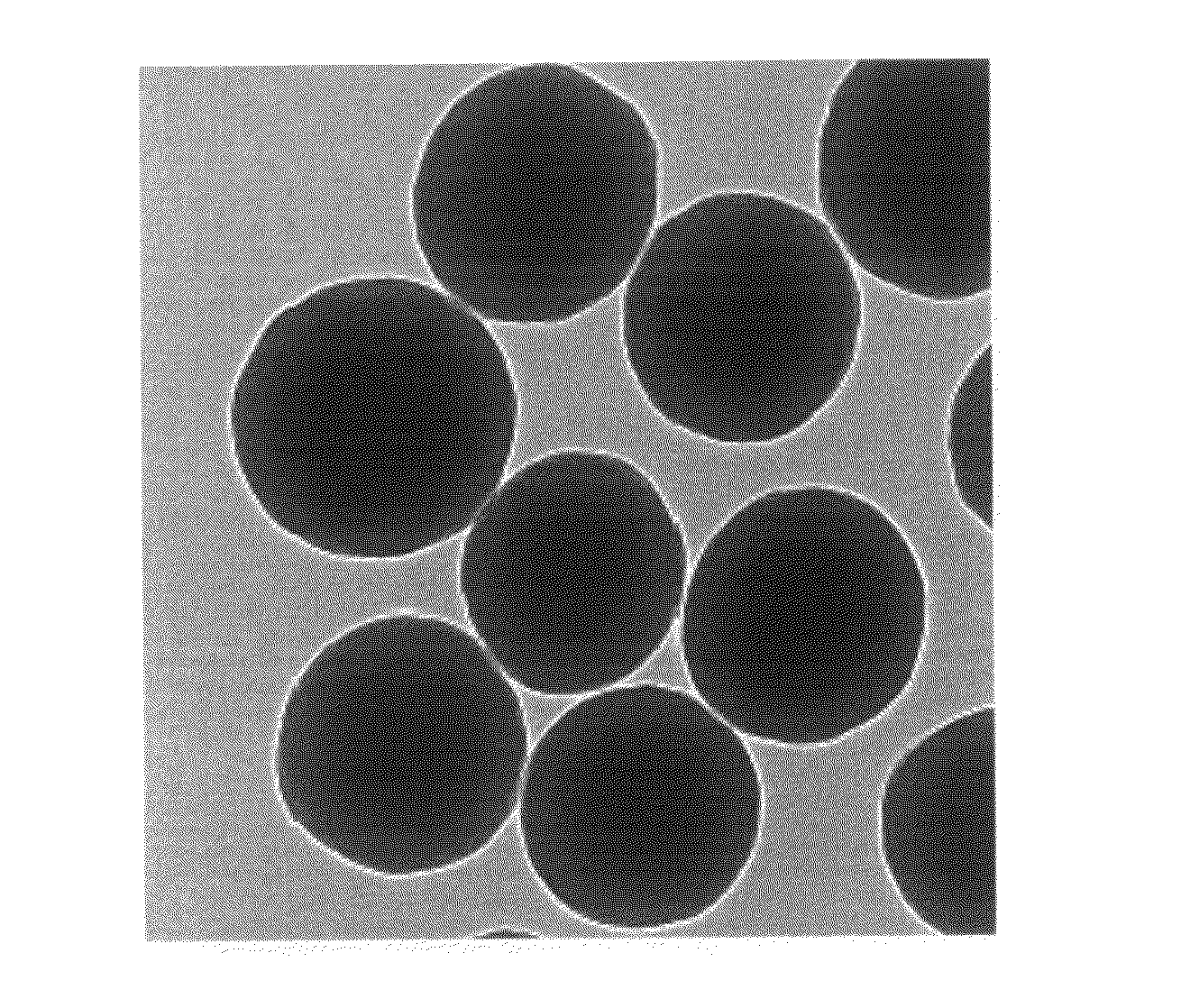
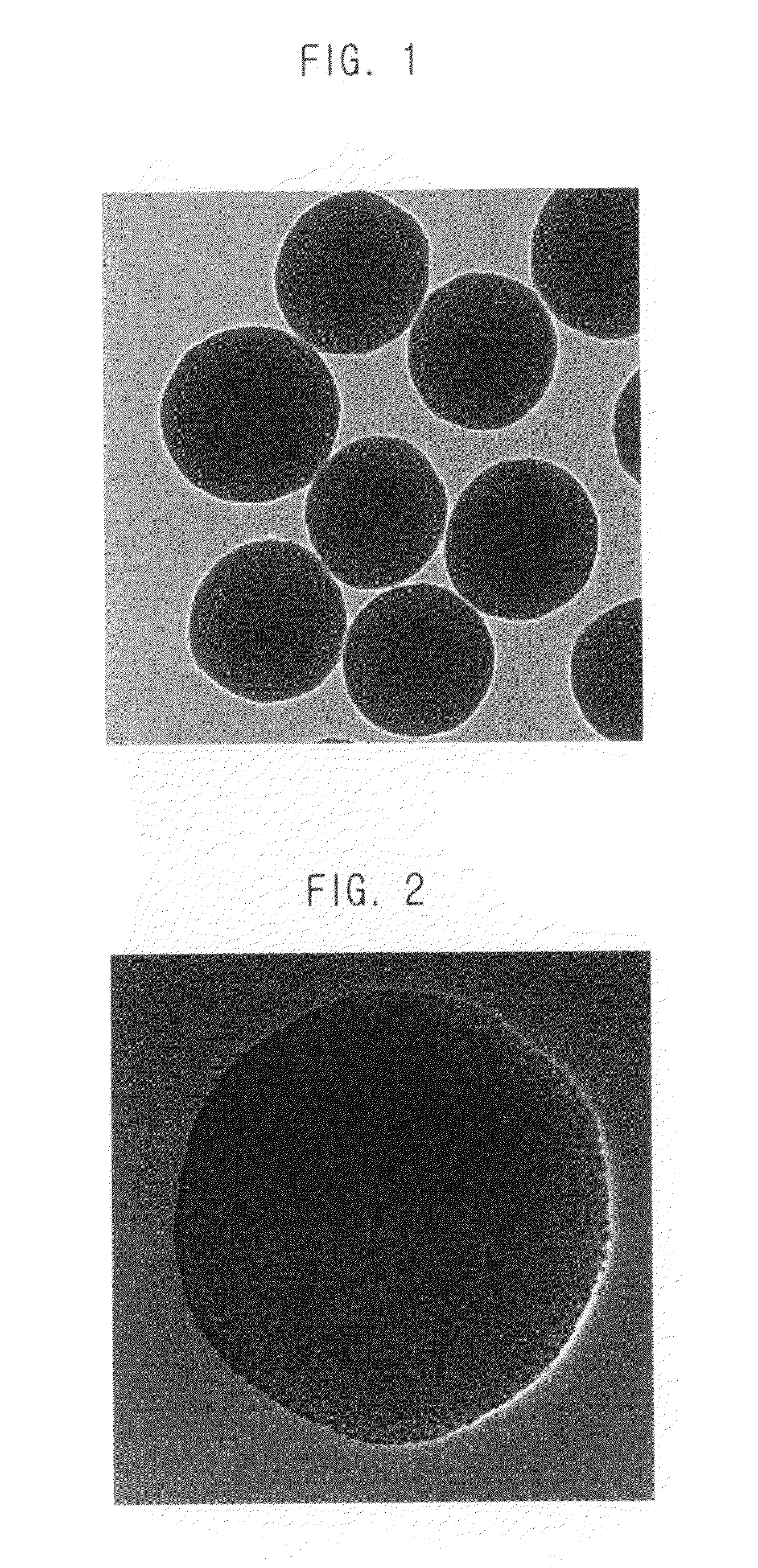
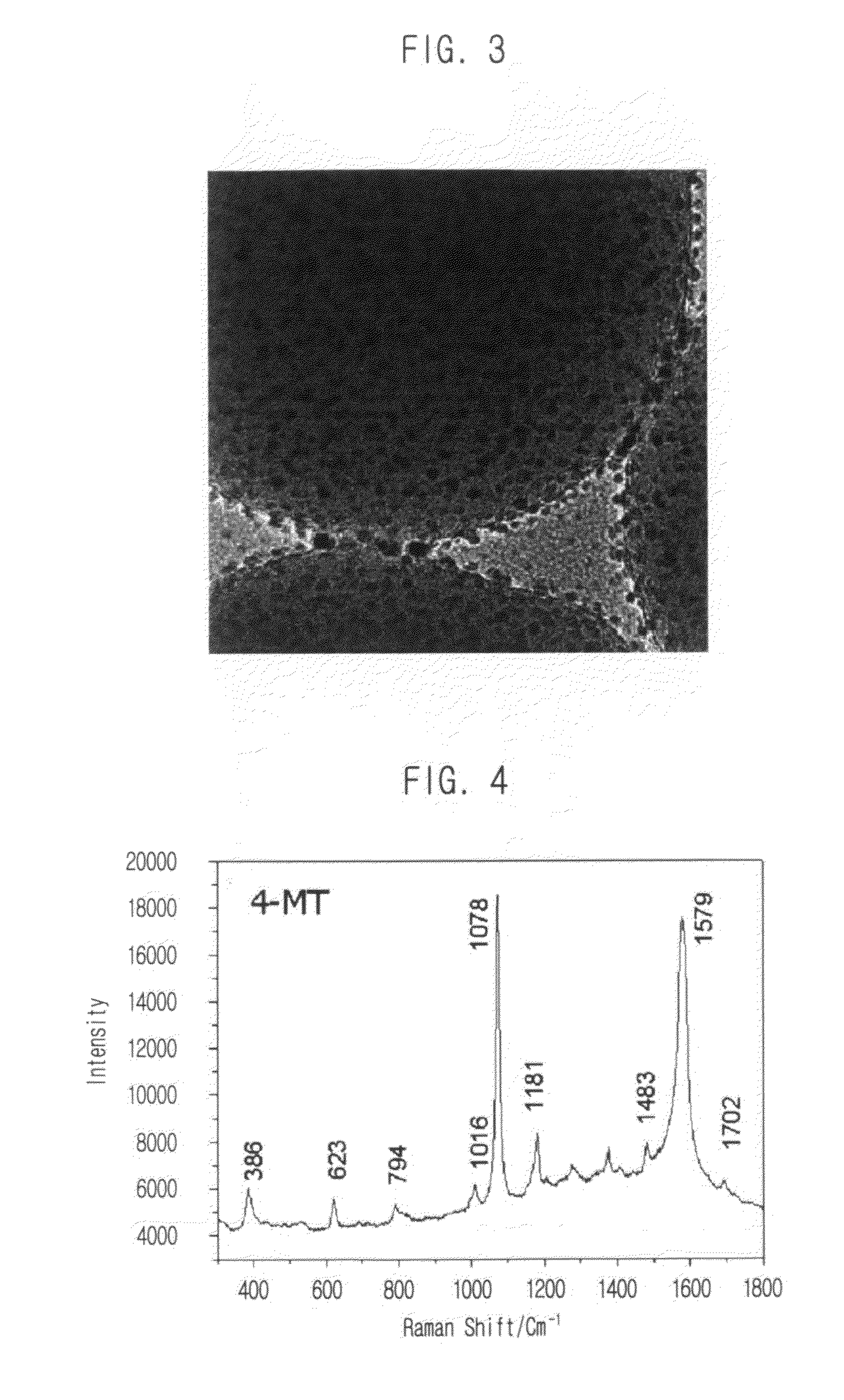
[0039]First, after reacting tetraethyl orthosilicate (1.6 g) with a mixed solution of ethanol (40 ml) and ammonia (3 ml) for 12 hours, the silica core particle of which the size is 50 to 300 nm is compounded through hydrolysis and concentration processes (J. Colloid Interface Sci. 1968, 26, 62) (FIG. 1). The silver nanoparticles are introduced on the surface of the silica core particle by reacting the precursor of silver particles, 30 mM AgNO3 (3 ml) and ethylene glycol (3 ml) and ammonia (50 μl), with the silica core particle for 10 hours at a temperature of 50° C. (FIGS. 2 and 3).
[0040]In order to confirm that the synthesized silica core particles can be used appropriately as a template for a surface enhanced Raman scattering nano-tagging particle, an analysis is performed after introducing 4-methylbenzenethiol, as a tagging material, on the surface of silver nanopar...
embodiment 2
Experiment in Possibility of Biomolecule Detection with Surface Enhanced Raman Scattering Nano-Tagging Particle
[0047]2-1. Experiment of Introducing Nano-Tagging Particle into a Cell
[0048]In order to confirm the bio-applicability of the surface enhanced Raman scattering nano-tagging particle manufactured in the above-motioned embodiment 1, the Raman analysis is performed after treating the nano-tagging particles in a cell and the results are shown in FIGS. 8 and 9.
[0049]In FIG. 8, “A” denotes the Raman spectrum about a culture medium and “B” denotes the Raman spectrum about a control group. Also, in FIG. 9, “A” denotes the Raman spectrum about 4-methylbenzenethiol and “B” denotes the Raman spectrum about the cell into which the surface enhanced Raman scattering tagging particle is introduced.
[0050]As shown in FIGS. 8 and 9, the Raman spectrum of the tagging material does not show up in the control group to which the culture medium or the particle are not introduced, but the reproduci...
PUM
| Property | Measurement | Unit |
|---|---|---|
| particle size | aaaaa | aaaaa |
| thickness | aaaaa | aaaaa |
| temperature | aaaaa | aaaaa |
Abstract
Description
Claims
Application Information
 Login to View More