[0014]For example, the material of the layer has a value of the coefficient of
thermal expansion (CTE) different from that of the IC's substrate itself. The difference between the CTE values of the substrate and the layer causes a temperature-dependent stress that affects the mobility of the charge carriers in the devices of the IC. In turn, these mobility changes can be considered as representative of the temperature and, therefore, this phenomenon can be exploited to create a temperature sensor. Localization of these
layers in certain areas (i.e., transistors) opens up the way to miniaturize temperature sensors. Another method of fabricating a temperature sensor is using
polymer films (with high CTE value) embedded in the IC. If the
layers are placed / localized at the specific areas,
miniaturization of embedded temperature sensors is brought back to the dimension of a single
transistor.
[0020]In another embodiment, the
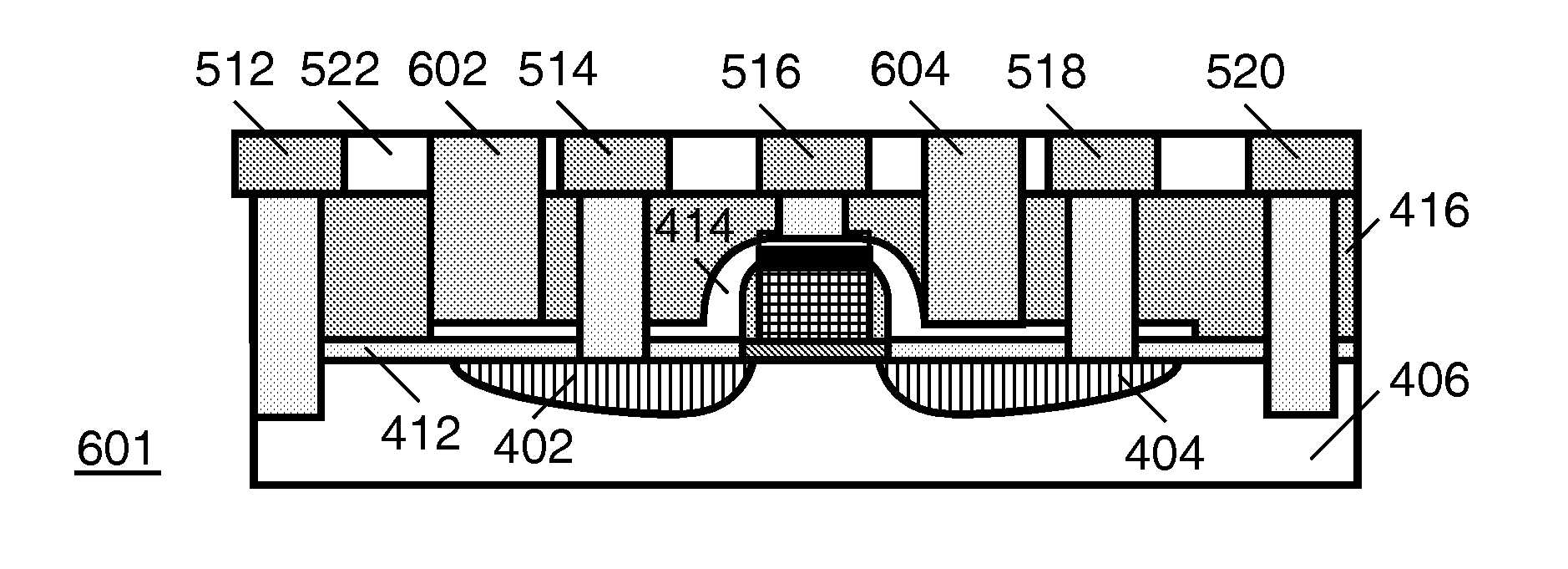
electronic circuit is substantially covered by the layer. This may facilitate the manufacturing of the sensor. Also, if multiple functional components are involved and covered by the same layer, their combined effect can be used to generate an output
signal that more accurately represents the value of the physical parameter, e.g., by means of taking the average of the signals generated by the functional components.
[0024]The
coupling of the sensor layer with the substrate could be implemented as a
direct coupling or as an
indirect coupling. In a
direct coupling, the layer is formed on the
silicon of the substrate. In an
indirect coupling, one or more intermediate
layers are present between the sensor's layer of the material with the first coefficient of expansion and the substrate. The intermediate layers serve to, e.g., isolate the substrate from the sensor layer so as to prevent that the environmental parameter chemically affects the circuitry, or to
expose the substrate to a reduced stress. For example, in the embodiment of the invention with a sensor for sensing
moisture in the
ambient air or an acid in the ambient fluid,
moisture or acid could damage the circuitry when in direct contact with the substrate. The intermediate layer(s) may also serve to combine the sensor layer with the substrate to obtain a higher aggregate coherence between the sensor layer and the substrate than in the absence of the intermediate layer(s). The intermediate layer(s) may also serve to overcome the problem of undesirable chemical or
physical interaction at the interface between the sensor layer and the substrate if these were in direct contact with each other.
[0030]US
patent application publication 20060269693, incorporated herein by reference, teaches that
deposition process and treatment conditions can be tailored to deposit a compressive stressed material on the substrate or to treat a material during or after deposition to increase its compressive stress value. Stressing the atomic lattice of a deposited material improves the electrical properties of the material itself, or of underlying or overlying material that is strained by the force applied by a stressed deposited material. A
silicon nitride stressed material having higher compressive stress values can be obtained by increasing the RF bombardment to achieve higher
film density by having more Si—N bonds in the deposited material and reducing the density of Si—H and N—H bonds. Higher deposition temperatures and
radio frequency (RF) power improved the compressive stress levels of the deposited film. In addition, higher compressive stresses levels were obtained in the deposited material at higher
kinetic energy levels of
plasma species. It is believed that bombardment of energetic
plasma species, such as
plasma ions and neutrals, generates compressive stresses in the deposited material because
film density increases. The process gas used to deposit compressive stressed
silicon nitride includes the silicon-containing and
nitrogen-containing gases. Depositing a
nitride layer at higher temperatures improves the compressible stress levels of the deposited nitride film. The deposition temperatures of the substrate lie in the range of 300° C.-600° C. This publication neither teaches nor suggests implementing a sensor using a difference in expansion values in order to create stress in a
transistor as an indication of the parameter to be measured.



 Login to View More
  Login to View More