

Separation of tungsten from ammonium molybdate solutions
a technology of ammonium molybdate and tungsten, which is applied in the direction of molybdeum compounds, iron compounds, chromates/bichromates, etc., can solve the problems of difficult work, difficult to separate tungsten from molybdenum in aqueous solutions, and difficult to work with tungsten
- Summary
- Abstract
- Description
- Claims
- Application Information
AI Technical Summary
Benefits of technology
Problems solved by technology
Method used
Image

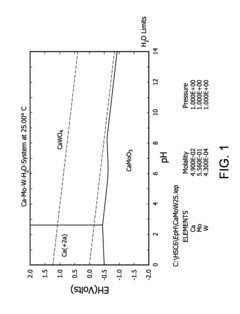
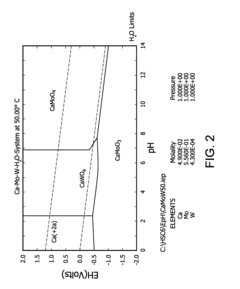
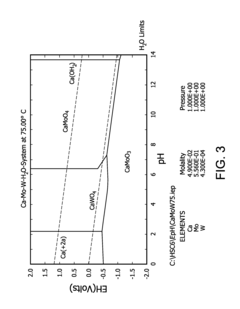
Examples
example 1
[0054]Calcium acetate and calcium hydroxide were used to experimentally verify the general concept of the feasibility of using calcium to precipitate tungsten from ammonium molybdate solutions.
[0055]Required aliquots of either calcium acetate solution or calcium hydroxide (as set forth in Table 4) were added to 100 mL of the ammonium molybdate solution at room temperature (25° C.). The pH was kept at about 10.1. The slurry was agitated for three hours and the precipitate was filtered and washed. The solutions were submitted for analysis. The results are set forth in Table 4.
TABLE 4Precipitation of Tungsten with Calcium CompoundsVol-ume,MoW% WMlg / Lmgg / LmgRemovedMo / WFeedSolutionFiltrate100263263000.34934.90754CalciumAcetateAddition =4 mLFiltrate174115200100.08915.5421290CalciumAcetateAddition =5 mLFiltrate174510887400.09817.1865189Ca(OH)2Addition =0.3 gFiltrate170478812600.07713.1886203Ca(OH)2Addition =0.3 gFiltrate186193358980.10018.6611930
example 2
[0056]In this example, ferric molybdate was used for tungsten precipitation. A sample of ferric molybdate was prepared by dissolving 100 grams of ferric sulfate (20 grams iron) in water and then adding to an ammonium molybdate solution. The slurry was agitated for an hour and the precipitate was filtered and washed. The weight of the wet cake containing 5% iron was 400 grams. An ammonia digestion of 440 grams of leached cake was started by sequential additions of cake and ammonium hydroxide maintaining the pH at 8.5 to 8.7 at approximately 60° C. Thirty minutes after the last addition, 100 grams of the ferric molybdate cake was added (about 5 g Fe / L) and the slurry was agitated for another 30 minutes. The slurry was filtered and the cake was washed. Afterwards, 200 mL aliquots were heated to 60° C. and ferric molybdate additions of 2, 4, 8, and 16 grams were made (0.5, 1.0, 2.0, and 4.0 g Fe / L). After one hour of agitation, the slurries were filtered. The solutions and the solids th...
PUM
| Property | Measurement | Unit |
|---|---|---|
| Temperature | aaaaa | aaaaa |
| Temperature | aaaaa | aaaaa |
| Temperature | aaaaa | aaaaa |
Abstract
Description
Claims
Application Information
 Login to View More