Check patentability & draft patents in minutes with Patsnap Eureka AI!

Ethylene-a-Olefin Copolymer and Article

a technology of ethylene-a-olefin and copolymer, applied in the field of ethylene-a-olefin copolymer and article, can solve the problems of limited utility, insufficient swell ratio of 2098 of ethylene-a-olefin copolymer, and disclosure of ethylene-a-olefin copolymer

Inactive Publication Date: 2013-12-05
SUMITOMO CHEM CO LTD
View PDF2 Cites 5 Cited by
  • Summary
  • Abstract
  • Description
  • Claims
  • Application Information

AI Technical Summary

Benefits of technology

The present invention is about a type of plastic made from ethylene and α-olefin. It has specific properties like a density, melt flow rate, ratio of molecular weights, swell ratio, and activation energy. The invention also includes articles made from this plastic. The technical effects of the invention are improved properties of plastic made from ethylene and α-olefin, which make it suitable for various applications.

Problems solved by technology

However, ethylene-α-olefin copolymers produced via polymerization using conventional metallocene catalysts are not sufficient in molding processability because of their high extrusion load at the time of extrusion and their low melt tension and swell ratio, and therefore they are of limited utility.
However, the ethylene-α-olefin copolymer disclosed in JP-A-2006-2098 is still insufficient in swell ratio.
The ethylene-α-olefin copolymer disclosed in JP-A-2005-206777 is still insufficient in swell ratio and also insufficient in melt tension of the molecular chain of the ethylene-α-olefin copolymer melted.
Therefore, the take-up property at the time of processing the copolymer and the appearance of an article obtained by processing the copolymer have been not sufficiently satisfactory.

Method used

the structure of the environmentally friendly knitted fabric provided by the present invention; figure 2 Flow chart of the yarn wrapping machine for environmentally friendly knitted fabrics and storage devices; image 3 Is the parameter map of the yarn covering machine
View more

Image

Smart Image Click on the blue labels to locate them in the text.
Viewing Examples
Smart Image
  • Ethylene-a-Olefin Copolymer and Article
  • Ethylene-a-Olefin Copolymer and Article
  • Ethylene-a-Olefin Copolymer and Article

Examples

Experimental program
Comparison scheme
Effect test

example 1

(1) Preparation of Component (B)

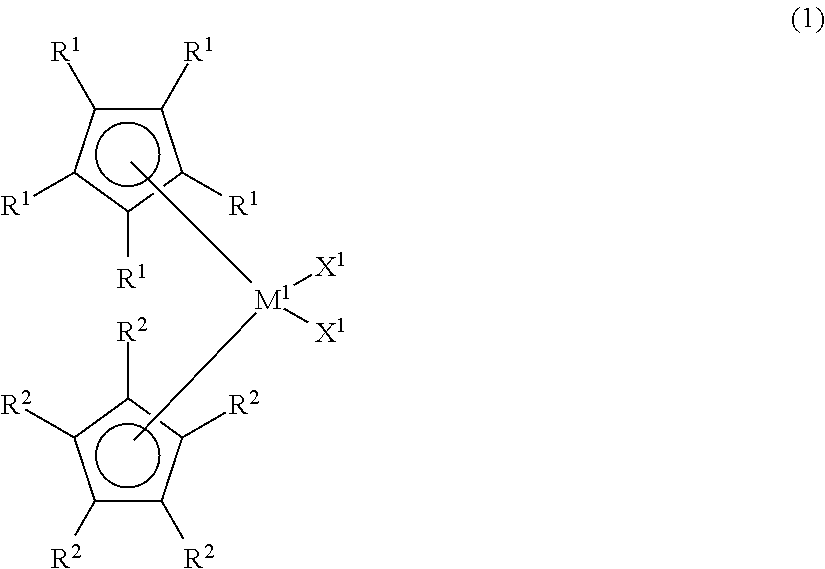
[0473]To a 50-liter, nitrogen-purged reactor equipped with a stirrer, 9.68 kg of silica (Sylopol 948 produced by Davison Corp; average particle diameter=55 μm; pore volume=1.67 ml / g; specific surface area=325 m2 / g) thermally treated at 300° C. under a nitrogen flow as a solid state carrier for component (b) was charged. After the addition of 100 liters of toluene, the reactor was cooled to 2° C. To this, 26.3 liters of a toluene solution (2.9M) of methylalumoxane was dropped over one hour. After stirring at 5° C. for 30 minutes, the resultant was heated to 95° C. over 90 minutes, followed by stirring for 4 hours. Then, after cooling to 40° C., the resultant was left at rest for 40 minutes, thereby allowing a solid component to settle, and then the top slurry portion was removed. As a washing operation, 100 liters of toluene was added thereto, followed by stirring for 10 minutes, and then the stirring was stopped and the mixture was left at rest to all...

example 2

(1) Polymerization

[0476]An autoclave having an internal volume of 3 liters and equipped with a stirrer, the autoclave having been purged with argon after drying under reduced pressure, was evacuated, hydrogen was added so that its partial pressure might become 0.004 MPa, and then 230 ml of 1-hexene and 650 g of butane as a polymerization solvent were fed, and the temperature was raised to 70° C. Thereafter, ethylene gas was added so that the partial pressure of ethylene gas might become 1.6 MPa, and the system was stabilized. Gas chromatography analysis found that the gas composition in the system was hydrogen=0.20 mol %. Into this, 0.9 ml of a hexane solution of triisobutylaluminum as an organoaluminum compound (C), the concentration of which had been adjusted to 1 mol / l, was fed. Next, 35.6 mg of the powdery contact mixture (X-1) prepared in Example 1(2) described above was fed. During polymerization, while ethylene gas was supplied continuously, ethylene and 1-hexene were polymer...

example 3

(1) Preparation of Contact Mixture (X-2)

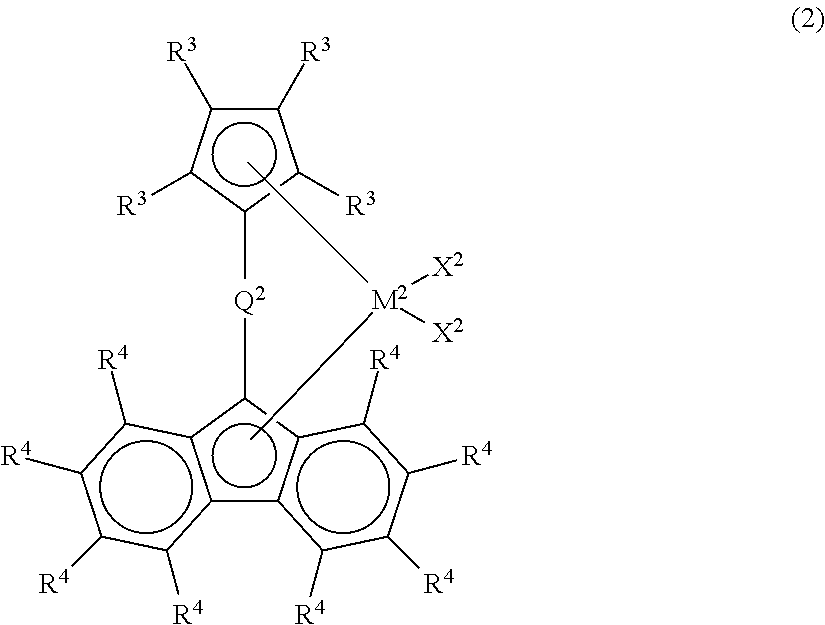
[0477]To a 200 ml glass eggplant flask flushed with nitrogen were added 4 g of the component (B) prepared in Example 1 (1) and 50 ml of toluene, which were thereby slurried. Then, 10.4 ml of a toluene solution of bis(n-butylcyclopentadienyl)zirconium dichloride [corresponding to transition metal compound (A1)], the concentration of which had been adjusted to 2 μmol / ml, and 4.1 ml of a toluene solution of diphenylmethylene(cyclopentadienyl)(9-fluorenyl)zirconium dichloride [corresponding to transition metal compound (A2)], the concentration of which had been adjusted to 1 μmol / ml, were charged into a dropping funnel and mixed, and then the mixed liquid was dropped into the slurry within the eggplant flask over about 30 minutes under stirring. After the dropping, the eggplant flask containing the slurry of the mixture was moved into an oil bath of 80° C. to increase the temperature, and then a reaction was advanced for one hour. One hour later, ...

the structure of the environmentally friendly knitted fabric provided by the present invention; figure 2 Flow chart of the yarn wrapping machine for environmentally friendly knitted fabrics and storage devices; image 3 Is the parameter map of the yarn covering machine
Login to View More

PUM

PropertyMeasurementUnit
Densityaaaaaaaaaa
Bond energyaaaaaaaaaa
Login to View More

Abstract

The present invention rerates to an ethylene-α-olefin copolymer comprising monomer units derived from ethylene and monomer units derived from an α-olefin having 3 to 20 carbon atoms, wherein the ethylene-α-olefin copolymer has a density of 860 to 950 kg / m3, a melt flow rate of 0.1 to 20.0 g / 10 minutes, a ratio of a weight average molecular weight to a number average molecular weight measured by gel permeation chromatography of 2.0 to 3.5, a swell ratio of 2.0 to 2.8, and an activation energy of flow of 31.0 to 35.0 kJ / mol.

Description

TECHNICAL FIELD[0001]The present invention relates to ethylene-α-olefin copolymers and articles obtained by extruding the ethylene-α-olefin copolymers.BACKGROUND ART[0002]Ethylene-α-olefin copolymer have been molded into films, sheets, bottles, and so on by various molding techniques and have been used for various applications such as food wrapping materials.[0003]Ethylene-α-olefin copolymers produced via polymerization using metallocene catalysts are known to be superior in mechanical strength such as impact strength and tensile strength. For this reason, articles can be expected to be reduced in weight and in cost by reduction in thickness of the articles while their mechanical strength is maintained, and accordingly such copolymers are currently considered to be used for various applications. However, ethylene-α-olefin copolymers produced via polymerization using conventional metallocene catalysts are not sufficient in molding processability because of their high extrusion load a...

Claims

the structure of the environmentally friendly knitted fabric provided by the present invention; figure 2 Flow chart of the yarn wrapping machine for environmentally friendly knitted fabrics and storage devices; image 3 Is the parameter map of the yarn covering machine
Login to View More

Application Information

Patent Timeline
no application Login to View More
IPC IPC(8): C08F210/16
CPCC08F210/16C08F210/14C08F2500/03C08F2500/09C08F2500/12C08F2500/14C08F2500/17C08F10/00C08F4/65904C08F4/65916C08F4/65925C08F4/65927C08F4/65912
Inventor NOZUE, YOSHINOBU
Owner SUMITOMO CHEM CO LTD
Features
  • R&D
  • Intellectual Property
  • Life Sciences
  • Materials
  • Tech Scout
Why Patsnap Eureka
  • Unparalleled Data Quality
  • Higher Quality Content
  • 60% Fewer Hallucinations
Social media
Patsnap Eureka Blog
Learn More