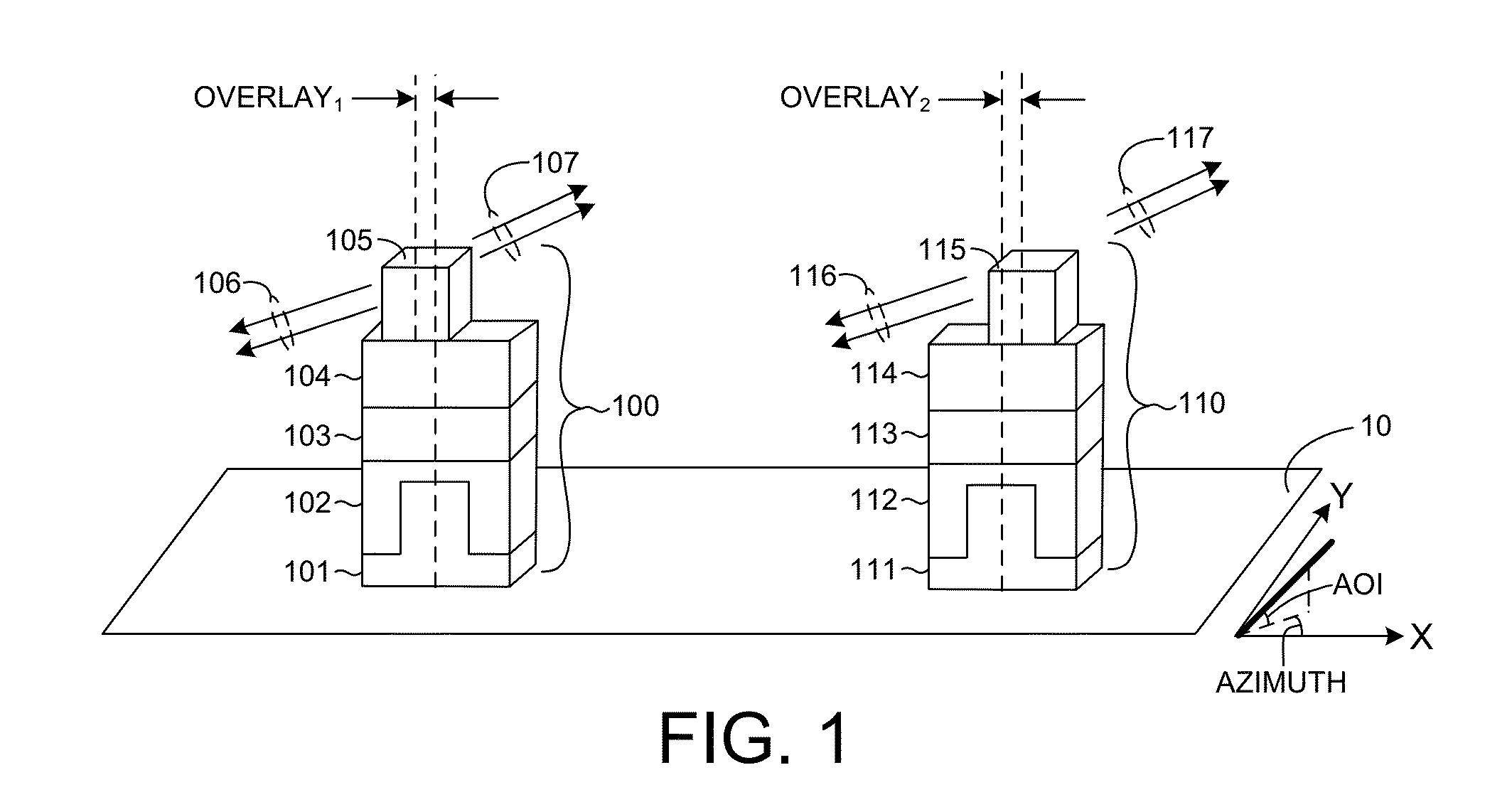
The greater the overlay error, the more the structures are misaligned.
If the overlay error is too great, the performance of the manufactured electronic device may be compromised.
However, relying on
asymmetry as the indicator of overlay error is problematic because other asymmetries such as line profile
asymmetry or beam illumination
asymmetry couple into the overlay-generated asymmetry in the measurement
signal.
This results in an inaccurate measurement of overlay error.
Unfortunately, these specialized target structures often do not conform to the design rules of the particular semiconductor manufacturing process being employed to generate the electronic device.
This leads to errors in
estimation of overlay errors associated with actual device structures that are manufactured in accordance with the applicable design rules.
Since the available illumination wavelengths are typically limited, this limits overlay sensitivity especially when the
layers between the gratings are opaque for the available wavelengths.
A
disadvantage of this approach is that six or eight
cell targets are typically required to measure both X and Y overlay.
The modeling effort is complex and
time consuming, and the resulting regression routines require a large amount of computing effort and time to reach a result.
Future overlay metrology applications present challenges for metrology due to increasingly small resolution requirements and the increasingly high value of
wafer area.
For this reason, traditional
image based metrology algorithms cannot perform reliably with arbitrary targets or device structures.
In addition, information is lost because the algorithms are applied to limited areas of the image.
Moreover, traditional image based algorithms are sensitive to process variations, asymmetry, and optical
system errors as these algorithms lack a systematic way to capture the
impact of these error sources on the captured images.
The use of dedicated metrology structures may introduce significant measurement errors.
Discrepancies between actual device structures and dedicated metrology targets limit the ability of metrology data to accurately reflect the status of the actual device features in the die.
In one example, discrepancies arise due to location dependent differences in process loading, pattern density, or aberration fields because the dedicated metrology targets and actual device structures are not collocated.
Hence, even if the dedicated metrology target and the actual device structure are in close proximity, discrepancies result from differences in size.
Furthermore, dedicated metrology structures require space in the device
layout.
Future metrology applications present challenges for image based metrology due to increasingly small resolution requirements and the increasingly high value of
wafer area.



 Login to View More
  Login to View More