Three-Dimensional (3D) Tissue Scaffold with Cell Alignment
a tissue scaffold and three-dimensional technology, applied in the field of three-dimensional tissue scaffolds, can solve the problems of limiting the cell templating of holes, unfavorable cell viability of 3d sheets, and limiting the depth of the device, so as to facilitate the transport of nutrients and waste products throughout the device, and the spread of template cells
- Summary
- Abstract
- Description
- Claims
- Application Information
AI Technical Summary
Benefits of technology
Problems solved by technology
Method used
Image



Examples
embodiments
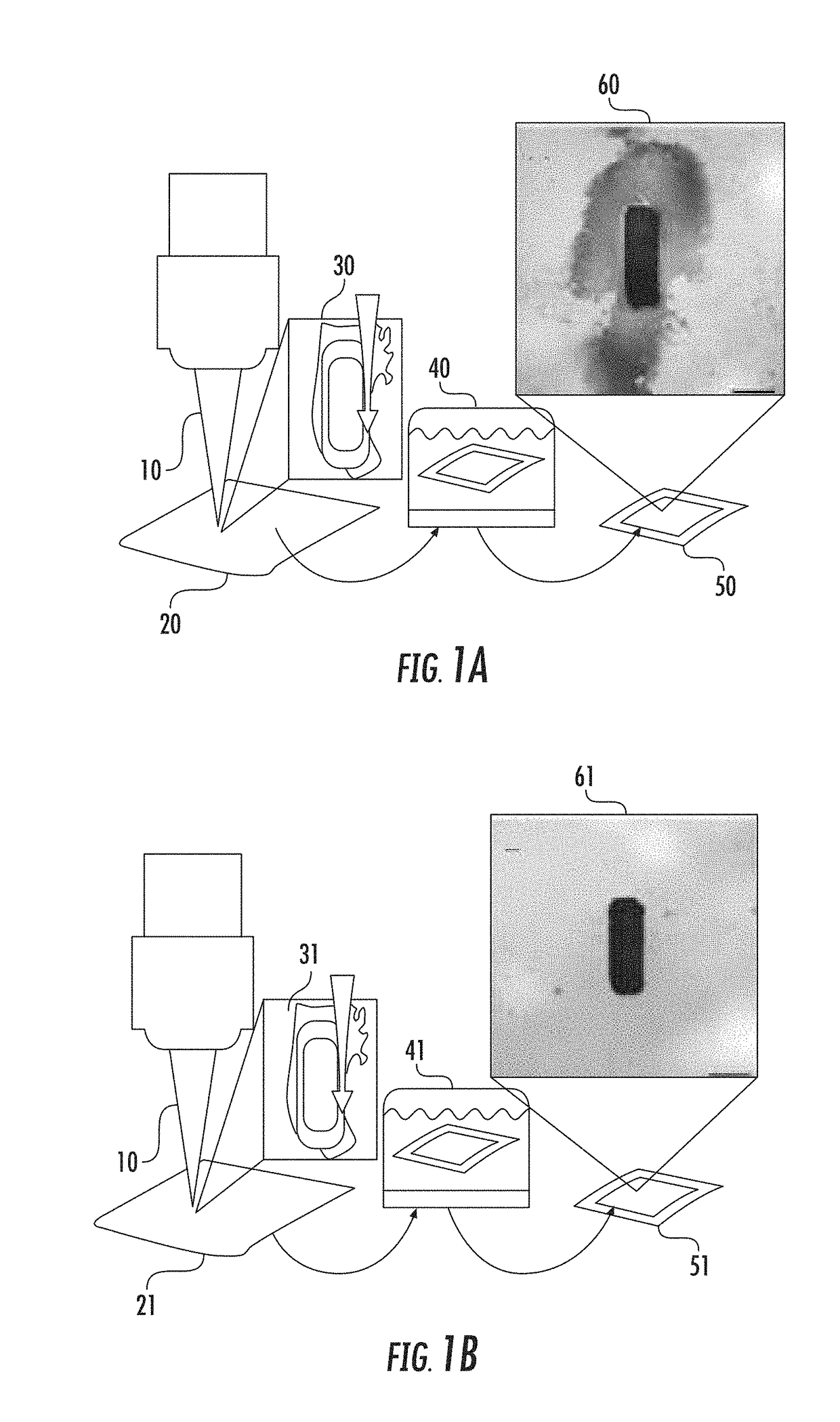
[0019]As disclosed herein, polymeric substrates, such as those in sheet-form, can be perforated by ablation or another method that provides holes through the substrate, where the holes are approximately cell-sized or slightly larger, e.g. about 20-40 microns, up to about 130 microns, and are uncompromised by a debris field when the substrates are first treated with a thin protective layer of photoresist. Preferably the ablation is laser ablation, which cleanly provides holes of controlled size. Polymer substrates, e.g. sheets, perforated with holes comprising 5%, 10%, 20% up to about 30% of the nominal surface area are then patterned in stripes by photolithography, which is followed by synthesis in exposed regions of a cell-adhesive organometallic / α,ω-diphosphonate adduct interface. Preferably the α,ω-diphosphonate is a C3-C16 α,ω-diphosphonate, more preferably 1,4-butanediphosphonic acid or 1,2-dodecanediphosphonic acid. Microscopic and SEM analyses following removal of unexposed p...
example 1
DS Analysis
[0039]Perforated polymer substrates were characterized with an FEI Quanta 200 Environmental-SEM equipped with an Oxford INCA Synergy 450 energy-dispersive X-ray microanalysis system with an X-Max 80 large area analytical silicon drift detector (SDD) at an acceleration voltage of 5 keV. SEM and EDS were performed in low-vacuum mode (0.53 torr) to avoid melting of the polymer by the electron beam.
example 2
on of Polymer Films for Laser Ablation
[0040]PEEK films were cut into 1 cm×1 cm coupons and cleaned by sonication in ethanol for 15 minutes. Films were rinsed with isopropanol and baked at 95° C. to remove moisture. Both sides of the PEEK films were spin-coated with a layer of AZ-5214E photoresist to protect the native polymer surfaces from debris created during the laser ablation process. The photoresist was cured by heating at 95° C. for 45 seconds.
PUM
| Property | Measurement | Unit |
|---|---|---|
| Fraction | aaaaa | aaaaa |
| Adhesivity | aaaaa | aaaaa |
| Surface area | aaaaa | aaaaa |
Abstract
Description
Claims
Application Information
 Login to View More
 - R&D
- Intellectual Property
- Life Sciences
- Materials
- Tech Scout
- Unparalleled Data Quality
- Higher Quality Content
- 60% Fewer Hallucinations
Browse by: Latest US Patents, China's latest patents, Technical Efficacy Thesaurus, Application Domain, Technology Topic, Popular Technical Reports.
© 2025 PatSnap. All rights reserved.Legal|Privacy policy|Modern Slavery Act Transparency Statement|Sitemap|About US| Contact US: help@patsnap.com