Check patentability & draft patents in minutes with Patsnap Eureka AI!

Method for producing 1-palmitoyl-2-linoleoyl-3-acetyl glycerol

Inactive Publication Date: 2021-04-15
ENZYCHEM LIFESCI CORP
View PDF0 Cites 0 Cited by
  • Summary
  • Abstract
  • Description
  • Claims
  • Application Information

AI Technical Summary

Benefits of technology

The present invention relates to a method for producing 1-palmitoyl-2-linoleoyl-3-acetyl glycerol with high purity and yield without the need for additional purification steps. The method suppresses the formation of impurities and degradation products.

Problems solved by technology

However, the side reaction cannot be completely suppressed, dicyclohexylurea is formed as a by-product, and it is difficult to completely remove the by-product by a filtration and an extraction.
However, when acetyl chloride or acetyl bromide is used as the acetylating agent, strong acids such as hydrochloric acid or bromic acid are produced as reaction by-products, the stability decreases as the reaction time increases, and the reaction product may be decomposed.

Method used

the structure of the environmentally friendly knitted fabric provided by the present invention; figure 2 Flow chart of the yarn wrapping machine for environmentally friendly knitted fabrics and storage devices; image 3 Is the parameter map of the yarn covering machine
View more

Image

Smart Image Click on the blue labels to locate them in the text.
Viewing Examples
Smart Image
  • Method for producing 1-palmitoyl-2-linoleoyl-3-acetyl glycerol
  • Method for producing 1-palmitoyl-2-linoleoyl-3-acetyl glycerol
  • Method for producing 1-palmitoyl-2-linoleoyl-3-acetyl glycerol

Examples

Experimental program
Comparison scheme
Effect test

example 1

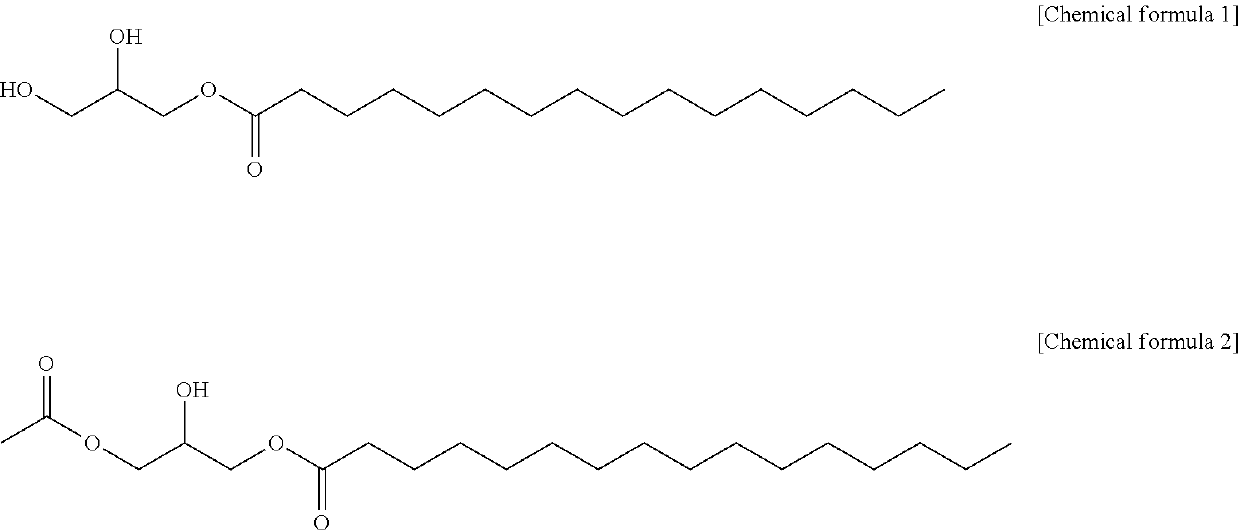
[Example 1] Preparation of 1-palmitoyl-3-acetyl Glycerol Intermediate

[0021]To a 250 mL 3-neck round flask, 20 g of 1-palmitoyl glycerol, 140 mL of dichloromethane, 33.5 g of pyridine and 0.15 g of dimethylaminopyridine were added, and the mixture was heated to 30° C. to dissolve 1-palmitoyl glycerol. 3.1 g of acetic anhydride was added dropwise while maintaining the temperature of the reactant at 18° C., and 5.7 g of acetyl chloride and 11 mL of dichloromethane were added dropwise while maintaining the temperature at 5° C., and the reaction was carried out for 18 hours. After the reaction was completed, 90 mL of purified water and 40 g of concentrated hydrochloric acid were added, the temperature was raised to 25° C., and the aqueous layer was separated to obtain an organic layer. The obtained organic layer was further subjected to a layer separation process using purified water once more. Magnesium sulfate and potassium carbonate were added to the separated organic layer, stirred f...

example 2

[Example 2] Preparation of 1-palmitoyl-3-acetyl Glycerol Intermediate

[0022]To a 250 mL 3-neck round flask, 30 g of 1-palmitoyl glycerol, 180 mL of dichloromethane, 50.3 g of pyridine and 0.22 g of dimethylaminopyridine were added, and the mixture was heated to 25 to 30° C. to dissolve 1-palmitoyl glycerol. 9.2 g of acetic anhydride was added dropwise while maintaining the temperature of the reactant at 18° C. After the dropwise addition, the temperature was maintained at 5° C., and the reaction was carried out for 22 hours.

[0023]After the reaction was completed, 90 mL of purified water and 40 g of concentrated hydrochloric acid were added, the temperature was raised to 25° C., and the aqueous layer was separated to obtain an organic layer. The obtained organic layer was further subjected to a layer separation process using purified water once more. Magnesium sulfate and potassium carbonate were added to the separated organic layer, stirred for 1 hour, and then magnesium sulfate and ...

example 3

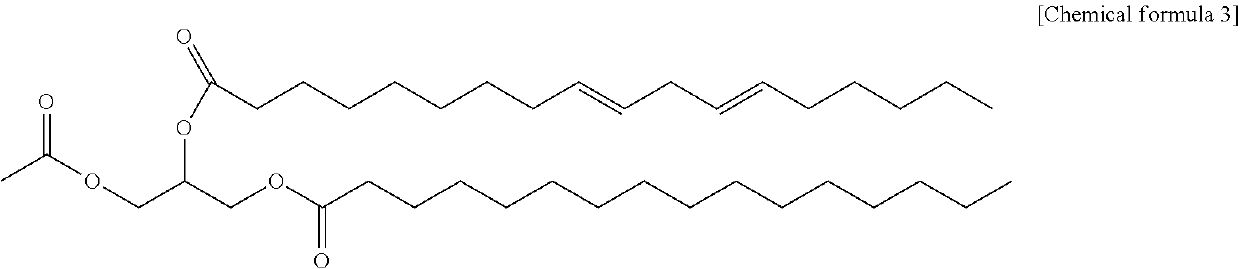
[Example 3] Preparation of 1-palmitoyl-2-linoleoyl-3-acetyl Glycerol

[0024]To a 250 mL 3-neck round flask, 7.67 g of linoleic acid, 80 mL of normal hexane and 3.31 g of pivaloyl chloride were added, and the reactant was cooled to −5 to 10° C. and 5.97 g of triethylamine was added dropwise. After adding 10 g of 1-palmitoyl-3-acetyl glycerol and 0.328 g of 4-dimethylaminopyridine to the reactant, the reactant was reacted for 12 hours while stirring under nitrogen gas.

[0025]After the reaction was completed, 40 mL of purified water was added to the reactant, and the aqueous layer was layer-separated to obtain a washed organic layer. To the separated organic layer, a mixed solution of 27 mL of methanol and 13.5 mL of 0.1N KOH was added, washed twice, and further washed with 40 mL of a mixed solution of 95 vol % methanol purified water, washed with 10 mL of 0.1 vol % hydrochloric acid, and then washed with 40 mL of an aqueous 0.05 weight % sodium hydrogen carbonate solution. 8 g of activat...

the structure of the environmentally friendly knitted fabric provided by the present invention; figure 2 Flow chart of the yarn wrapping machine for environmentally friendly knitted fabrics and storage devices; image 3 Is the parameter map of the yarn covering machine
Login to View More

PUM

PropertyMeasurementUnit
Temperatureaaaaaaaaaa
Equivalent massaaaaaaaaaa
Login to View More

Abstract

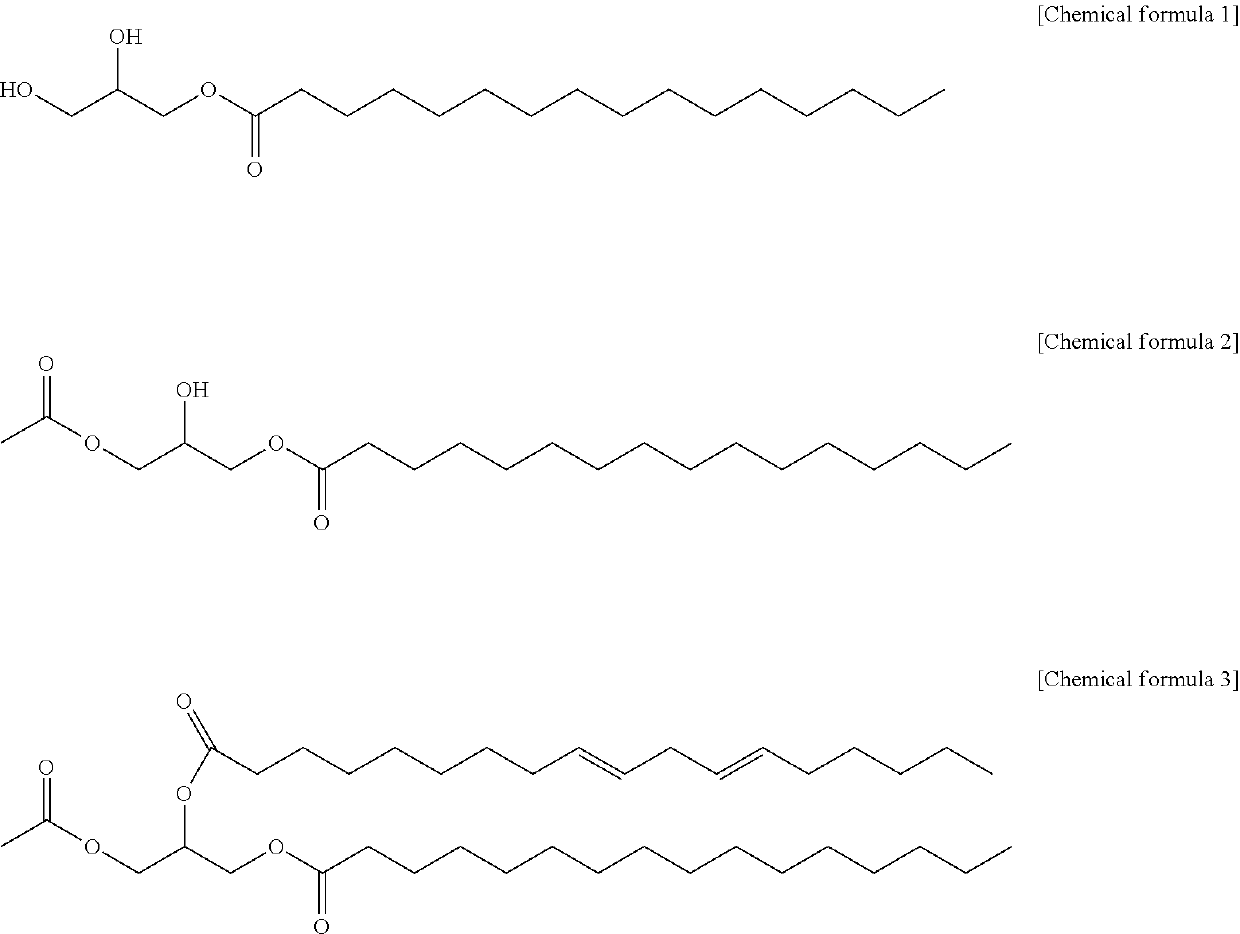
Disclosed is a method for producing 1-palmitoyl-2-linoleoyl-3-acetyl glycerol of high purity with high yield by carrying out acetylation of 1-palmitoyl glycerol with acetic anhydride or a mixture of acetic anhydride and acetyl chloride. The method for producing 1-palmitoyl-2-linoleoyl-3-acetyl glycerol comprises the steps of: preparing 1-palmitoyl-3-acetyl glycerol intermediate of Chemical formula 2 in the specification by reacting 1-palmitoyl glycerol of Chemical formula 1 in the specification and an acetylating agent selected from the group consisting of (i) acetic anhydride and (ii) a mixture of acetic anhydride and acetyl chloride; and reacting the 1-palmitoyl-3-acetyl glycerol intermediate and linoleic acid.

Description

CROSS-REFERENCE TO RELATED APPLICATION[0001]This application claims benefit of priority to Korean Patent Application No. 10-2019-0128021 filed on Oct. 15, 2019, the entire content of which is incorporated herein by reference.FIELD OF INVENTION[0002]This invention relates to a method for producing 1-palmitoyl-2-linoleoyl-3-acetyl glycerol, and more particularly, to a method for producing 1-palmitoyl-2-linoleoyl-3-acetyl glycerol of high purity with high yield by carrying out acetylation of 1-palmitoyl glycerol with acetic anhydride or a mixture of acetic anhydride and acetyl chloride.BACKGROUND OF INVENTION[0003]Rac-1-palmitoyl-2-linoleoyl-3-acetyl glycerol is one of components of deer antler, is separated from chloroform extracts of deer antler, and shows the growth-stimulating effects of hematopoietic stem cells and megakaryocytes (Korean Patent No. 10-0283010). Chemical synthesis methods of rac-1-palmitoyl-2-linoleoyl-3-acetyl glycerol are disclosed in Korean Patent Nos. 10-029174...

Claims

the structure of the environmentally friendly knitted fabric provided by the present invention; figure 2 Flow chart of the yarn wrapping machine for environmentally friendly knitted fabrics and storage devices; image 3 Is the parameter map of the yarn covering machine
Login to View More

Application Information

Patent Timeline
no application Login to View More
IPC IPC(8): C07C67/12C07C67/08
CPCC07C67/12C07C67/08C07C67/14C07C69/30C07C69/587C07C69/604C07C69/003B01J31/0244
Inventor SOHN, KI YOUNGKANG, BYUNG KYU
Owner ENZYCHEM LIFESCI CORP
Features
  • R&D
  • Intellectual Property
  • Life Sciences
  • Materials
  • Tech Scout
Why Patsnap Eureka
  • Unparalleled Data Quality
  • Higher Quality Content
  • 60% Fewer Hallucinations
Social media
Patsnap Eureka Blog
Learn More