Check patentability & draft patents in minutes with Patsnap Eureka AI!

Solid oxide fuel cell with scandium-modified nickel felt anode collector

a solid oxide fuel cell and nickel-modified technology, applied in the direction of fuel cells, electrochemical generators, electrical equipment, etc., can solve the problems of high cost associated with high temperature of operation, large deployment of sofc, and high cost of sealing and precious metal current collection

Pending Publication Date: 2022-06-02
ARIEL UNIV OF SAMARIA
View PDF0 Cites 0 Cited by
  • Summary
  • Abstract
  • Description
  • Claims
  • Application Information

AI Technical Summary

Benefits of technology

The invention is a solid oxide fuel cell (SOFC) assembly that can be connected to a source of hydrocarbon fuel. The assembly includes at least one SOFC with a nickel felt-made anode current collector, an electrolyte layer, and a cathode with a cathode current collector. The nickel felt is doped with scandium. The cathode is made of a LSM / ScSZ composite material. The anode support member is made of sintered Ni—ScSZ. The electrolyte layer is a ScSZ paste. The felt-made anode current collector is doped with scandium made by spraying a solution of Sc2O3 in HNO3. The method of manufacturing the SOFC assembly involves several steps, including manufacturing the anode and cathode current collectors. The technical effects of the invention include improved performance and durability of the SOFC assembly, as well as simplified manufacturing process.

Problems solved by technology

One of the key barriers to widespread deployment of the SOFC has been its high cost associated with its high temperature of operation, typically in the 800-1000° C. This high operating temperature enables fuel flexibility (Eguchi, K., et al.
However, this high operating temperature tends to use of expensive sealant and precious metals current collection for cell operation.
“Layered oxygen-deficient double perovskite as an efficient and stable anode for direct hydrocarbon solid oxide fuel cells.”Nature materials 14.2 (2015): 205) However, the high cost of the precious metals current collector is a major hurdle for commercialization (Hiraiwa, Chihiro, et al.
However, this practice leads to a loss of the performance and efficiency of compared to the Ni-based cermet (Lanzini, A. et al.

Method used

the structure of the environmentally friendly knitted fabric provided by the present invention; figure 2 Flow chart of the yarn wrapping machine for environmentally friendly knitted fabrics and storage devices; image 3 Is the parameter map of the yarn covering machine
View more

Image

Smart Image Click on the blue labels to locate them in the text.
Viewing Examples
Smart Image
  • Solid oxide fuel cell with scandium-modified nickel felt anode collector
  • Solid oxide fuel cell with scandium-modified nickel felt anode collector
  • Solid oxide fuel cell with scandium-modified nickel felt anode collector

Examples

Experimental program
Comparison scheme
Effect test

example 1

Fabrication of the Anode-Supported SOFC

[0035]The slurry composition of the NiO—ScSZ anode support layer is shown in Table-1. At first, the NiO and ScSZ powder and pore-former (cornstarch) are ball-milled in the azeotropic mixture of ethanol-MEK (2-butanone) with dispersant triethanolamine (TEA) for 24 h using zirconia ball (4 mm). After homogenization of the powders in the solvent system, the primary plasticizer Dibutyl phthalate (DBP) and secondary plasticizer polyethylene glycol (PEG-400) were mixed to the slurry and milled for 6 h, finally, the binder polyvinyl butyral (PVB) is mixed into the slurry and further milled for 48 h. The slurry is de-aired in a polycarbonate vacuum desiccators (Sanplatec) applying the vacuum of 100 psi for 2 h. The viscosity of the slurry then measured by Brookfield LV viscometer (model—MLVT115) using Spindle-LV4. The measured viscosity of the slurry was 8550 and 6730 cps at 20 rpm and 50 rpm, respectively, at room temperature. The slurry then tape cas...

example 2

Current Collector Preparation

[0037]Commercial nickel fiber felt (Magnex co.ltd, Japan), wire thickness=0.05 cm, the diameter of the nickel wire ˜7×10⁻³ cm and areal density ˜0.0865 gm cm−2 were used for current collector preparation (see FIG. 9a) The Ni-felt was cut into 3.5×3.5 cm2, a stock solution of scandium (concentration=93.27 g / L) is prepared by dissolving the Sc2O3 (99.9%, Terio corporation) in HNO3 overnight at 80° C. Stoichiometry amount of scandium solution was then sprayed on the pre-shaped Ni-felt and dried at 40° C. for 2 h (see FIG. 9c) The Crofer 22H grid (thickness=0.23 mm, area=3.5×3.5 cm2) with a mesh opening 0.9×1.5 mm (Fiaxell, Switzerland) are used as cathode current collector, before fitting on the manifold the grid are molded into a V-shape groove (height 0.1 cm) for the gas channel.

example 3

Characterizations and Electrochemical Tests

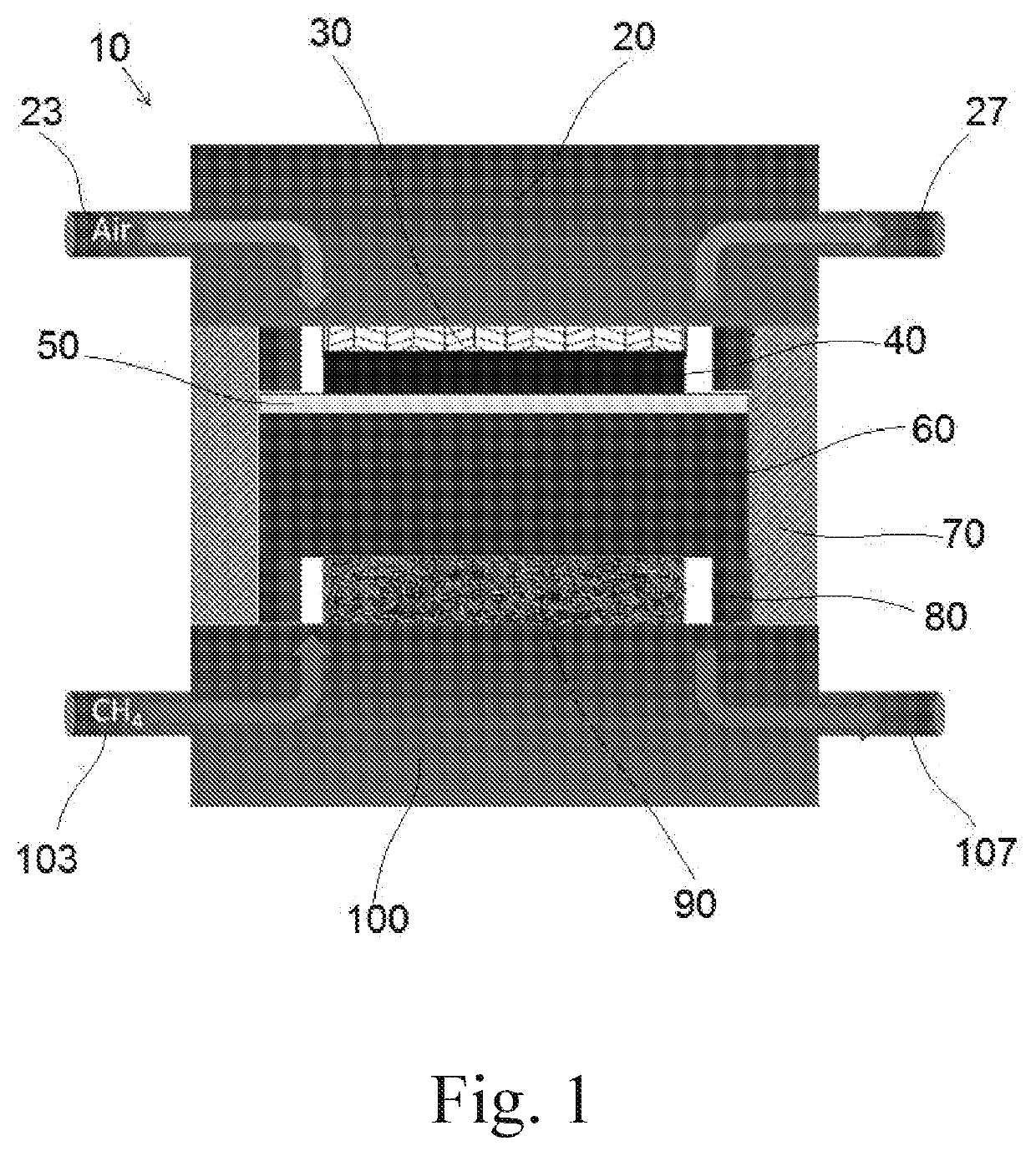
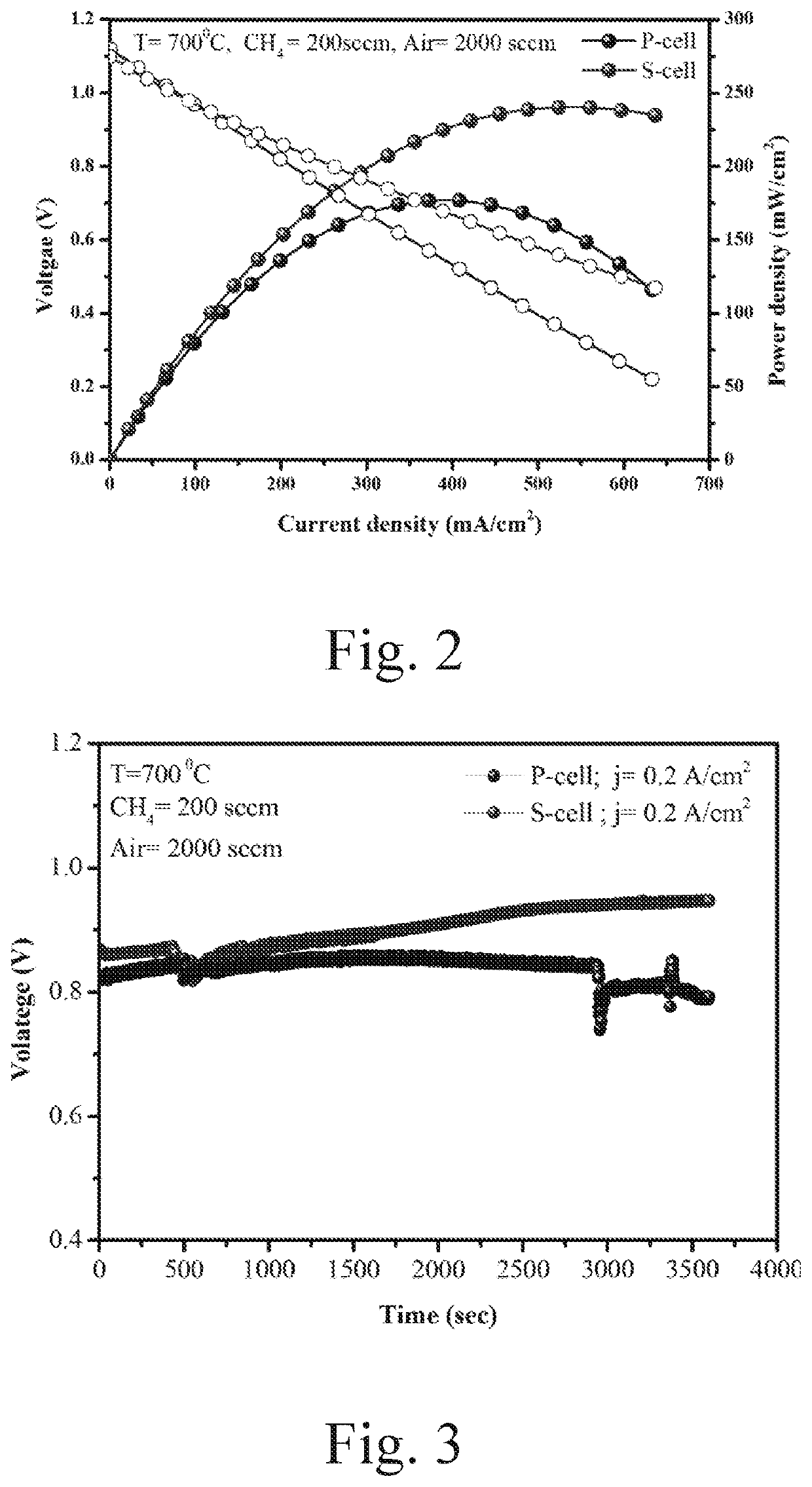
[0038]The cell was tested by the Scribner test station (855 SOFC), at first the ASC is fixed between a pair of Crofer manifolds (5.1×5.1 cm2), two gaskets (Thermiculite 866 Flexitallic, USA) are used for sealing, the anode current collector (Ni or Sc: Ni-mesh) and the cathode current collector are fixed on the specified manifold using Ni-paste and LSM-paste (fuel cell materials), respectively, the Crofer 22APU wire is used as the current lead for both anode and current. The cell with ‘Sc: Ni-felt’ and ‘Ni-felt’ current collector are named as ‘S-cell’ and respectively, in the manuscript. After stacking the cell, ceramic bond (ceramabond 552, Aremco product Inc, USA) is brush coated to seal the manifold. The schematic of the stacking is shown in FIG. 1. The sealed cell setup is then placed in the furnace with a load of 5 psi, the furnace is programmed with ramp 1° C. min−1 up to 800° C. Upon reaching the temperature, the cell is purged with N...

the structure of the environmentally friendly knitted fabric provided by the present invention; figure 2 Flow chart of the yarn wrapping machine for environmentally friendly knitted fabrics and storage devices; image 3 Is the parameter map of the yarn covering machine
Login to View More

PUM

No PUM Login to View More

Abstract

A solid oxide fuel cell (SOFC) assembly connectable to a source of a hydrocarbon fuel; said SOFC assembly comprises at least one SOFC. Each SOFC further comprises: (a) an anode support member having a nickel felt-made anode current collector; (b) an electrolyte layer disposed on the anode support member; and a cathode having a cathode current collector; the cathode disposed on said electrolyte layer. The nickel felt-made anode current collector is doped with Scandium.

Description

FIELD OF THE INVENTION[0001]The present invention relates to a solid oxide fuel cell (SOFC) and, more particularly, to a SOFC with a scandium-doped nickel felt anode collector.BACKGROUND OF THE INVENTION[0002]Solid oxide fuel cells (SOFCs) are electrochemical energy conversion device which converts various fuels based on hydrocarbons (natural gas, LPG) into electricity and heat with an unparalleled fuel-to-electric conversion efficiency among other types of fuel cells (Stambouli, A, et al. “Solid oxide fuel cells (SOFCs): a review of an environmentally clean and efficient source of energy.”Renewable and sustainable energy reviews 6.5 (2002): 433-455; Wang, Wei, et al. “Progress in solid oxide fuel cells with nickel-based anodes operating on methane and related fuels.”Chemical reviews 113.10 (2013): 8104-8151). One of the key barriers to widespread deployment of the SOFC has been its high cost associated with its high temperature of operation, typically in the 800-1000° C. This high ...

Claims

the structure of the environmentally friendly knitted fabric provided by the present invention; figure 2 Flow chart of the yarn wrapping machine for environmentally friendly knitted fabrics and storage devices; image 3 Is the parameter map of the yarn covering machine
Login to View More

Application Information

Patent Timeline
no application Login to View More
IPC IPC(8): H01M4/86H01M4/90H01M8/1231H01M4/88
CPCH01M4/8621H01M4/9033H01M4/9066H01M8/1231H01M2008/1293H01M4/8885H01M4/886H01M2300/0077H01M4/8835H01M8/1226H01M8/0232H01M4/8663H01M8/1253Y02E60/50Y02P70/50
Inventor RATH, MANASA KUMARKOSSENKO, ALEXEYKRASNOPOLSKI, ALEXANDERZINIGRAD, MICHAEL
Owner ARIEL UNIV OF SAMARIA
Features
  • R&D
  • Intellectual Property
  • Life Sciences
  • Materials
  • Tech Scout
Why Patsnap Eureka
  • Unparalleled Data Quality
  • Higher Quality Content
  • 60% Fewer Hallucinations
Social media
Patsnap Eureka Blog
Learn More