Controlled free radical grafting from polyolefins
a free radical grafting and polyolefin technology, applied in the field of polyolefins with functionalized monomers, to achieve the effect of high functional incorporation of polyolefin materials
- Summary
- Abstract
- Description
- Claims
- Application Information
AI Technical Summary
Benefits of technology
Problems solved by technology
Method used
Image

Examples
example 1
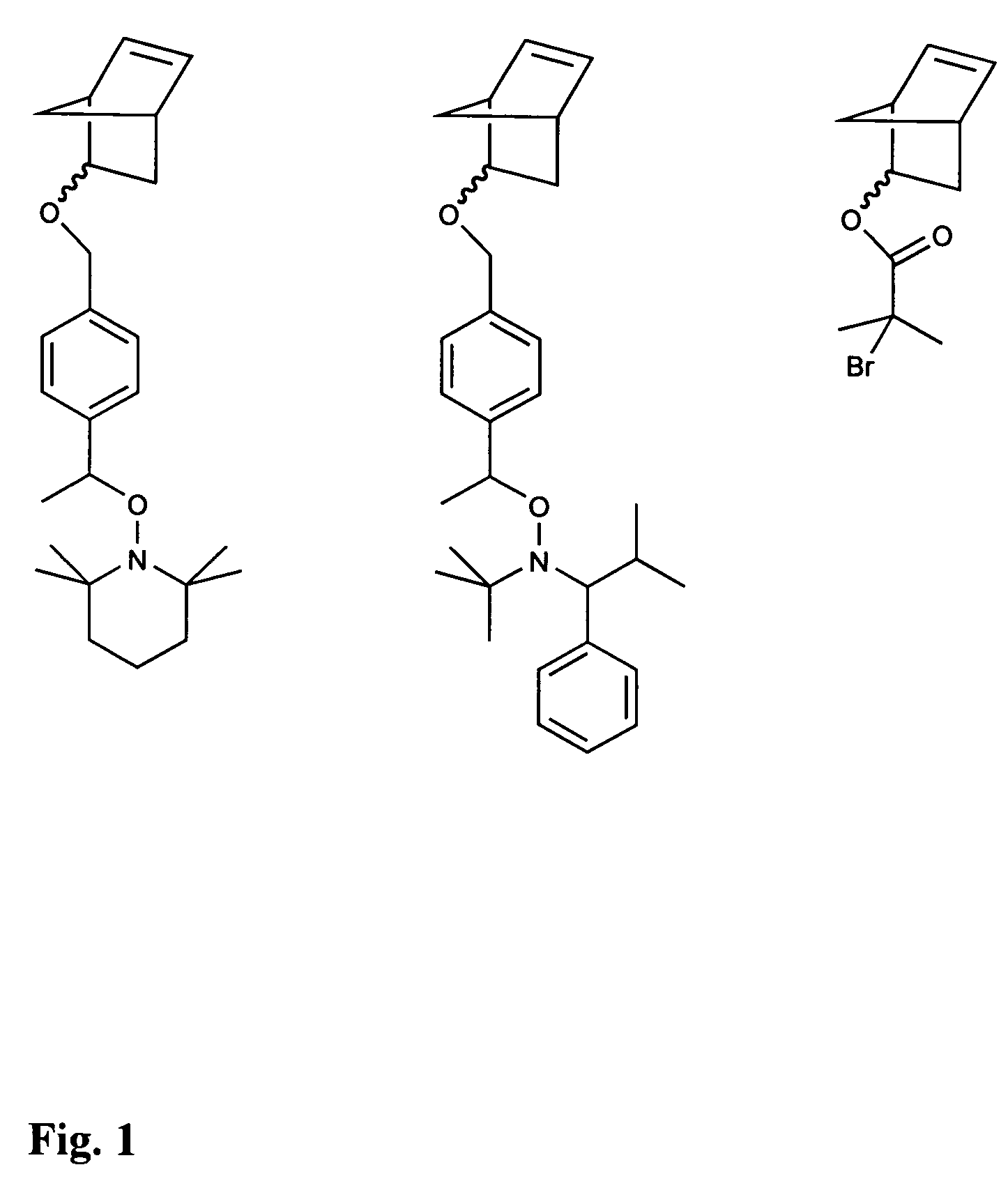
[0038]5-norbornen-2-yl 4-(1-(1-(2,2,6,6-tetramethylpiperidinoxy))ethyl)benzyl ether (Initiating Monomer 1) is synthesized according to the schematic below:
[0039]
[0040]The synthesis was carried out under an inert atmosphere. To a 5-norbornen-2-ol solution (0.500 g, 4.54 mmol in 100 mL of THF) was added potassium hydride (0.188 g, 4.70 mmol) in small portions over 15 minutes with stirring. After 30 min, N-(1-(4′-chloromethyl)phenylethoxy)-2,2,6,6-tetramethylpiperidine [7] (1.27 g, 4.1 mmol in 30 mL THF) was added over 5 minutes. After stirring at room temperature for 24 hrs, the mixture was filtered through a sintered glass filter and the resultant filtrate was evaporated to dryness. The residue was redissolved in ether (250 mL) and washed with water (3×500 mL). The organic layer was then dried and the solvent removed in vacuo to give 1.45 g of crude product. The product was then purified by column chromatography using EMD™ Silica Gel 60 as the stationary phase, eluting with 40:1, the...
example 2
[0041]5-Norbornen-2-yl 4-(1-(3-(2,2,5-trimethyl-4-phenyl-3-azahexoxy))ethyl)benzyl ether (Initiating Monomer 2) is synthesized according to the schematic in below.
[0042]
[0043]The synthesis was carried out under an inert atmosphere. To a 5-norbornen-2-ol solution (0.500 g, 4.54 mmol in 100 mL of THF) was added potassium hydride (0.188 g, 4.70 mmol) in small portions over 15 minutes with stirring. After 30 min, 2,2,5-trimethyl-3-(1-(4′-chloromethyl)phenylethoxy)-4-phenyl-3-azahexane [7] solution (1.52 g, 4.06 mmol in 30 mL THF) was added over 5 minutes. After stirring at room temperature for 24 hrs, the mixture was filtered through a sintered glass filter and the resultant filtrate was evaporated to dryness. The residue was redissolved in ether (250 mL) and washed with water (3×500 mL). The organic layer was then dried and the solvent removed in vacuo to give 1.72 g of crude product. The product was then purified by column chromatography using EMD™ Silica Gel 60 as the stationary phas...
example 3
[0044]5-Norbornen-2-yl 2-bromo-2-methylpropionoate (Initiating Monomer 3) is synthesized according to the schematic below.
[0045]
[0046]To a degassed solution of 5-norborne-2-ol (7.52 g, 68.2 mmol) and triethylamine (10.25 g, 101.3 mmol) in 400 mL THF a 2-bromoisobutyric bromide solution (20.62 g, 89.7 mmol in 50 mL THF) was added drop wise at 0° C. The reaction was left to warm slowly and stir at room temperature for 12 hrs. The reaction mixture was then filtered, and the solvent was removed in vacuo. The resultant residue was then redissolved in ether (300 mL) and washed with water (3×500 mL), saturated NaHCO3 (300 mL), followed by water (500 mL). The organic layer was dried over anhydrous magnesium sulfate, and the solvents were evaporated giving 21.03 g of crude product. The product was then purified by column chromatography using EMD™ Silica Gel 60 as the stationary phase, eluting with 10:1 hexane / ethyl acetate to afford 15.9 g (90% yield) of pure product as a viscous, colorless ...
PUM
| Property | Measurement | Unit |
|---|---|---|
| temperature | aaaaa | aaaaa |
| volume | aaaaa | aaaaa |
| pressure | aaaaa | aaaaa |
Abstract
Description
Claims
Application Information
 Login to View More
 - R&D
- Intellectual Property
- Life Sciences
- Materials
- Tech Scout
- Unparalleled Data Quality
- Higher Quality Content
- 60% Fewer Hallucinations
Browse by: Latest US Patents, China's latest patents, Technical Efficacy Thesaurus, Application Domain, Technology Topic, Popular Technical Reports.
© 2025 PatSnap. All rights reserved.Legal|Privacy policy|Modern Slavery Act Transparency Statement|Sitemap|About US| Contact US: help@patsnap.com