Check patentability & draft patents in minutes with Patsnap Eureka AI!

Methods and compositions for delivery of growth factor to fibrous connective tissue

a technology of growth factor and fibrous connective tissue, which is applied in the direction of drug compositions, peptide/protein ingredients, prosthesis, etc., can solve the problems of muscle atrophy, desire to reduce the immobilization period of a limb or joint, and inability to move and recover

Inactive Publication Date: 2011-11-29
AFFINERGY INC
View PDF25 Cites 0 Cited by
  • Summary
  • Abstract
  • Description
  • Claims
  • Application Information

AI Technical Summary

Problems solved by technology

Long periods of immobilization and rehabilitation are required because healing of fibrous connective tissue, such as tendons and ligaments, is a time consuming process.
Further, a decrease in the immobilization period of a limb or joint is desired, as even a period of 6-8 weeks of immobilization can lead to muscle atrophy, joint stiffness, tendon adhesions, risk of osteoarthritis, and other complications.
Although current surgical procedures for repair of injured fibrous connective tissue are generally fairly successful, complications including failure of the repair are not uncommon.
For example, chronic degenerative rotator cuff tears present a significant challenge to orthopedic surgeons.
Due to tissue loss and retraction, the rotator cuff tears can generate excessive tension following primary repair, and cause failure of the primary repair.
GDF-5 deficiency has also been shown to alter the ultrastructure, mechanical properties, and composition of the Achilles tendon, and significantly delay its healing in an injury model.
Therefore, application of GDFs in a dosage other than a proper dose range to a tendon repair site, or application of GDF outside a tendon repair site, runs the risk of inducing the formation of unwanted bone and / or cartilage.
Thus, while growth factors often exert potent therapeutic activity on tissue, they can also trigger ectopic or unwanted responses from healthy or untargeted tissue.
Therefore, delivery of these growth factors must employ a minimal effective dosage of growth factor which is tightly restricted to a particular region.
Although few techniques have been explored for delivering growth factors (e.g., polymers eluting growth factor) and to satisfy these delivery demands, there remains a lack of success.

Method used

the structure of the environmentally friendly knitted fabric provided by the present invention; figure 2 Flow chart of the yarn wrapping machine for environmentally friendly knitted fabrics and storage devices; image 3 Is the parameter map of the yarn covering machine
View more

Image

Smart Image Click on the blue labels to locate them in the text.
Viewing Examples
Smart Image
  • Methods and compositions for delivery of growth factor to fibrous connective tissue
  • Methods and compositions for delivery of growth factor to fibrous connective tissue

Examples

Experimental program
Comparison scheme
Effect test

example 1

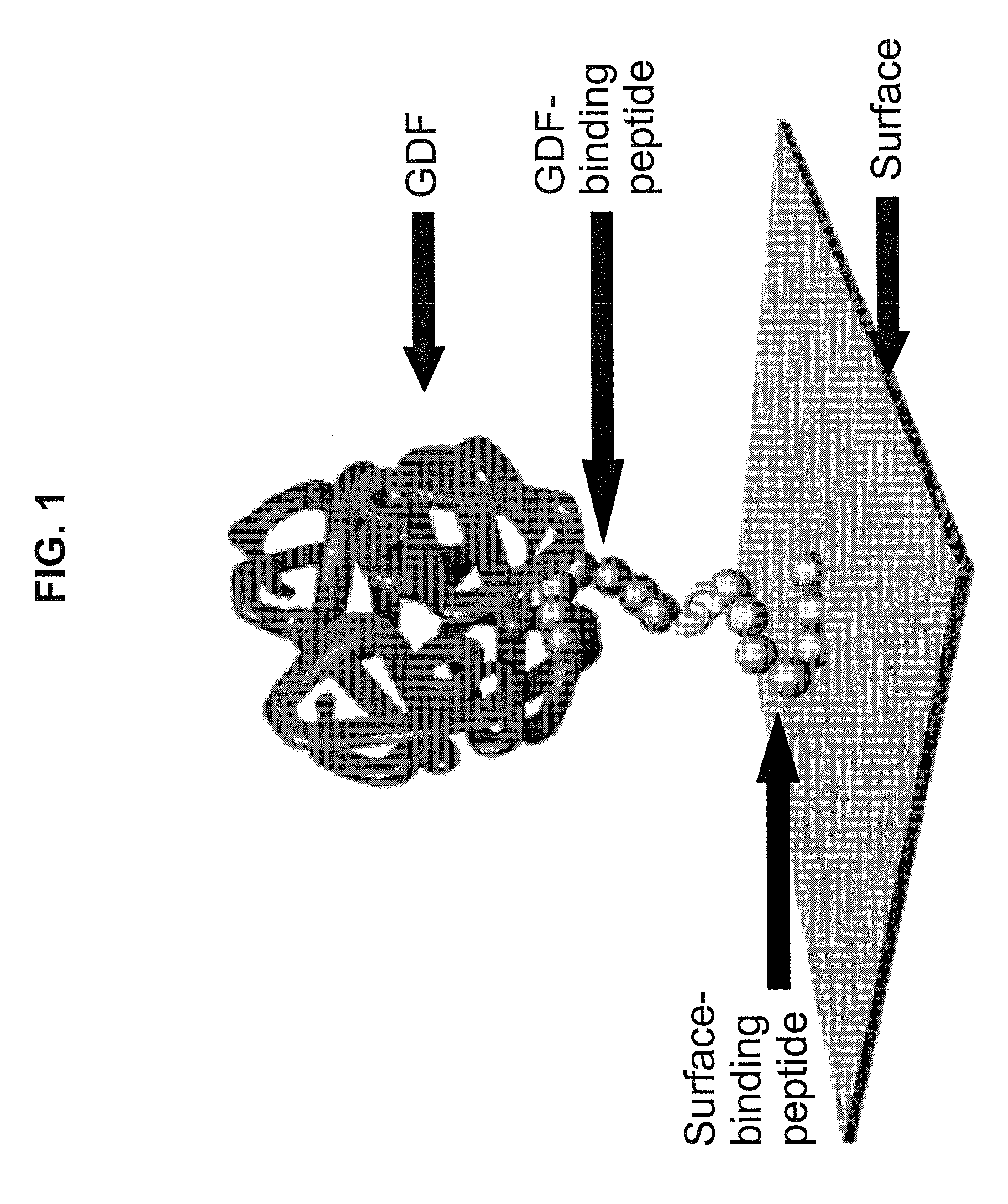
[0044]Illustrated in this example are various methods for utilizing phage display technology to produce a peptide having binding affinity for fibrous connective tissue-inducing growth factor according to the presently disclosed subject matter. Many of the peptides comprising the binding domains in a coating composition according to the presently disclosed subject matter (i.e., a peptide having binding affinity for a surface of an implant, and a peptide having binding affinity for fibrous connective tissue-inducing growth factor) were initially developed using phage display technology, followed by peptide design and peptide synthesis to result in improved binding properties.

Phage Screening and Selections

[0045]Phage display technology is well-known in the art, and can be used to try to identify phage-displayed peptides having binding affinity for a certain target substrate used in screening. In general, using phage display, a library of diverse peptides can be presented to a target su...

example 2

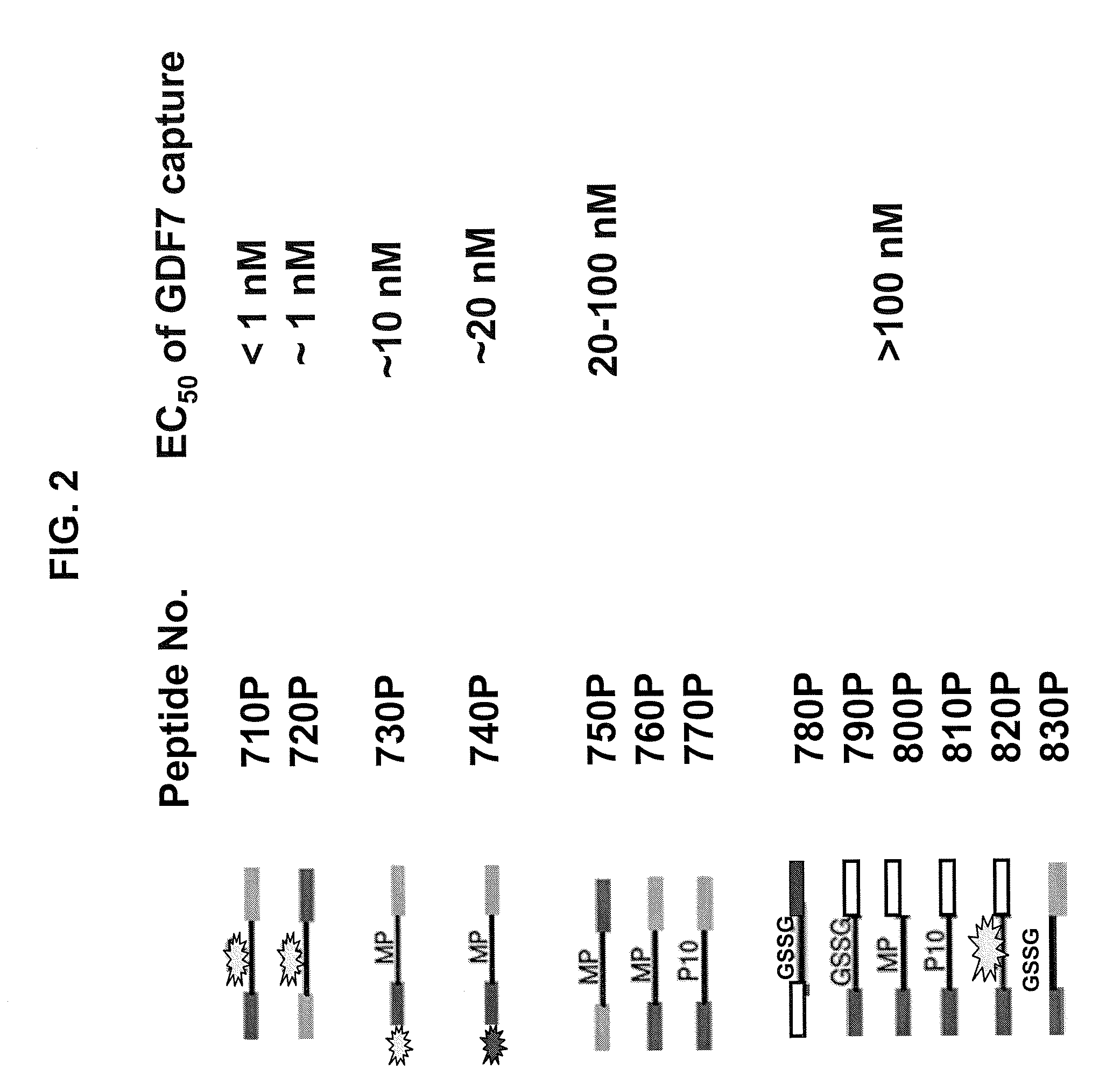
[0056]In this example, illustrated are further characterizations of peptides according to the presently disclosed subject matter. Peptides according to the presently disclosed subject matter can be synthesized using any method known to those skilled in the art including, but not limited to, solid phase synthesis, solution phase synthesis, linear synthesis, and a combination thereof. In this example, peptides were synthesized using standard solid-phase peptide synthesis techniques on a peptide synthesizer using standard Fmoc chemistry. After all residues were coupled, simultaneous cleavage and side chain deprotection was achieved by treatment with a trifluoroacetic acid (TFA) cocktail. Crude peptide was precipitated with cold diethyl ether and purified by high performance liquid chromatography (HPLC) using a linear gradient of water / acetonitrile containing 0.1% TFA. Homogeneity of the synthetic peptides was evaluated by analytical reverse phase-HPLC, and the identity of the peptides ...

example 3

[0062]Table 3 illustrates exemplary peptides having binding affinity for a surface material of an implant (“surface-binding peptides”). For example, surface-binding peptides include amino peptides comprising surface binding domains and having binding affinity for materials including but not limited to, for example, polystyrene, polyurethane, polyglycolic acid, polycarbonate, nylon, Teflon®, polyethylene terephthalate fibers and collagen-based substrates. Exemplary surface-binding peptides include SEQ ID NOs: 13-71. In some embodiments, at least one surface-binding peptide can be coupled to at least one peptide having binding affinity for fibrous connective tissue-inducing growth factor in producing a composition according to the presently disclosed subject matter.

[0063]

TABLE 3Binding affinity for polystyreneSEQ ID NO:Amino acid sequence (single letter code)13FLSFVFPASAWGG14FYMPFGPTWWQHV15LFSWFLPTDNYPV16FMDIWSPWHLLGT17FSSLFFPHWPAQL18SCAMAQWFCDRAEPHHVIS19SCNMSHLTGVSLCDSLATS20SCVYSFIDG...

the structure of the environmentally friendly knitted fabric provided by the present invention; figure 2 Flow chart of the yarn wrapping machine for environmentally friendly knitted fabrics and storage devices; image 3 Is the parameter map of the yarn covering machine
Login to View More

PUM

PropertyMeasurementUnit
molecular weightaaaaaaaaaa
total volumeaaaaaaaaaa
Login to View More

Abstract

The presently disclosed subject matter relates to a peptide composition for non-covalently localizing fibrous connective tissue-inducing growth factor to a surface of an implant, the composition comprising a peptide having binding affinity for a surface material of an implant coupled to a peptide having binding affinity for a fibrous connective tissue-inducing growth factor. Methods are provided for delivering fibrous connective tissue-inducing growth factor GDF-7 in an amount effective to promote fibrous connective tissue repair and fibrous connective tissue formation. Also provided are methods of applying the peptide composition to an implant by contacting the composition with a surface of the implant; and kits comprising the compositions.

Description

CROSS REFERENCE TO RELATED APPLICATIONS[0001]The presently disclosed subject matter claims the benefit of U.S. Provisional Patent Application Ser. No. 60 / 969,748 filed Sep. 4, 2007; the disclosure of which is incorporated herein by reference in its entirety.GRANT STATEMENT[0002]The invention was made from government support under Grant No. 1R43AR053753-01 awarded by the National Institute of Arthritis and Musculoskeletal and Skin Diseases. The U.S. Government has certain rights in the invention.FIELD[0003]The presently disclosed subject matter relates to compositions for delivery of growth factor to fibrous connective tissues. More particularly, the presently disclosed subject matter is directed to a family of peptides having binding affinity to growth factors which are critical for fibrous tissue regeneration, such peptides being useful in compositions and methods related to implants for one or more of repairing defects of fibrous connective tissue, or inducing fibrous connective t...

Claims

the structure of the environmentally friendly knitted fabric provided by the present invention; figure 2 Flow chart of the yarn wrapping machine for environmentally friendly knitted fabrics and storage devices; image 3 Is the parameter map of the yarn covering machine
Login to View More

Application Information

Patent Timeline
no application Login to View More
Patent Type & Authority Patents(United States)
IPC IPC(8): A61F13/00A61K38/16A61K38/10C07K14/475A61K38/00A61K38/18
CPCA61K9/0024A61L27/227A61L27/54C07K14/71A61K38/00A61L2300/25A61L2300/414A61L2300/606C07K2319/20A61P19/04
Inventor BUEHRER, BENJAMIN MARCUSHAMILTON, PAULJUZUMIENE, DALIANAIR, SHRIKUMARCHEN, YUCHEN
Owner AFFINERGY INC
Features
  • R&D
  • Intellectual Property
  • Life Sciences
  • Materials
  • Tech Scout
Why Patsnap Eureka
  • Unparalleled Data Quality
  • Higher Quality Content
  • 60% Fewer Hallucinations
Social media
Patsnap Eureka Blog
Learn More