
Process for producing aromatic amines
a technology of aromatic amines and amines, which is applied in the field of aromatic amine production, can solve the problems of complex reactors, frequent temperature control of catalyst beds, and non-uniform residence time distribution, and achieves high selectivity, long cycle times, and constant recycling
- Summary
- Abstract
- Description
- Claims
- Application Information
AI Technical Summary
Benefits of technology
Problems solved by technology
Method used
Image

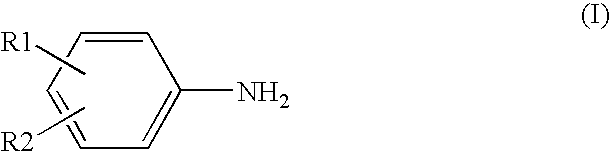
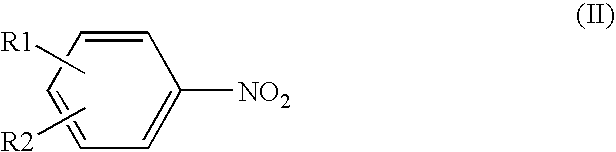
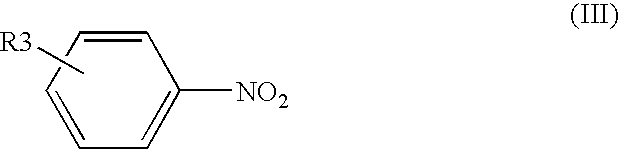
Examples
example 1
Comparative Example
With No Water in the Reactant Stream
[0086]In the plant described below, a catalyst containing palladium (18 g / lcatalyst; corresponds to approx. 1.8 mass % palladium), vanadium (18 g / lcatalyst) and lead (6 g / lcatalyst) on an α-Al2O3 support with an average particle diameter of 1.6 mm and a BET surface area of 5 m2 / g was used.
[0087]A mini-plant with three reactors connected in series was used as the test plant. The plant had no closed recycle gas system for hydrogen recycling. Nitrobenzene was pumped into the evaporators from above using metering pumps. In an analogous manner, recycled reaction water could be pumped into the evaporator using a metering pump. The hydrogen was fed into the evaporators which were heated with oil thermostats (approx. 250° C.), from below so that the nitrobenzene pumped in from above could evaporate countercurrently. The hydrogen supply was controlled ahead of the evaporators by means of mass flow controllers, the pressure in the plant w...
example 2
Example According to the Invention
[0092]The conditions recited in Example 1 were maintained and 2 moles of water per mole of nitrobenzene were additionally introduced into the first reactor. After 460 hours it could already be determined with certainty that the travel rate of the reaction zone through the first reactor was substantially slower than in Example 1. No signs of nitrobenzene leakage could be detected. The experiment was therefore interrupted in order to save time. By extrapolation it was determined that the addition of water more than doubled the cycle time to around 1100 hours.
example 3
Example According to the Invention
[0093]The experiment was performed in a mini-plant which was constructed in a manner analogous to that used in Example 1 and was additionally fitted with a recycle gas compressor to recycle the gas streams.
[0094]In this plant, a catalyst which contained palladium (9 g / lcatalyst; corresponds to approx. 0.9 mass % palladium), vanadium (9 g / lcatalyst) and lead (3 g / lcatalyst) on an α-Al2O3 support with an average particle diameter of 1.6 mm and a BET surface area of approx. 5 m2 / g was used. With an average total load of approx. 1.5 gnitroarene / [gcatalyst·h], an average molar hydrogen:nitrobenzene ratio of approx. 90:1, a molar water:nitrobenzene ratio ahead of the first reactor of approx. 4:1 and a pressure which was increased successively from 3 to 5 bar(abs), a cycle time of 1500 hours could be obtained (termination criterion: the position of the reaction zone in all reactors is just before the end of the bed (but there are still no signs of nitroben...
PUM
| Property | Measurement | Unit |
|---|---|---|
| inlet temperature | aaaaa | aaaaa |
| thickness | aaaaa | aaaaa |
| thickness | aaaaa | aaaaa |
Abstract
Description
Claims
Application Information
 Login to View More