

Cement material and cement
一种粘固粉、粉体的技术,应用在医药科学、假体等方向,达到良好生物体适合性的效果
- Summary
- Abstract
- Description
- Claims
- Application Information
AI Technical Summary
Problems solved by technology
Method used
Image

Examples
Embodiment 1
[0135]
[0136] As a study of synthesis conditions, the synthesis of HAp9 hydroxyapatite) was carried out under the experimental conditions shown in Table 1.
[0137] The experimental parameters are the following five types.
[0138] Synthesis temperature (37, 50, 70°C),
[0139] Stirring speed (200, 400, 800rpm),
[0140] Reagent concentration (0.1M calcium hydroxide and 0.06M phosphoric acid, 0.5M calcium hydroxide and 0.3M phosphoric acid, 1.0M calcium hydroxide and 0.6M phosphoric acid, 2.0M potassium hydroxide and 1.2M phosphoric acid),
[0141] pH regulator (25% NH 4 OH, 1.5M NaoH, 1.5M KOH),
[0142] Phosphoric acid dripping speed (17, 4.2ml / min)
[0143]
[0144] A specific synthesis method is shown below.
[0145] First, prepare calcium hydroxide suspension 500cm 3 , drop phosphoric acid aqueous solution 500cm into it 3. The concentrations of calcium hydroxide and phosphoric acid were adjusted to Ca / P=1.67 (molar ratio). In addition, it is adjusted so tha...
Embodiment 2
[0163] 6 Powder preparation>
[0164] Using the synthetic conditions obtained in Example 1, the "freeze-dried HAp / IP" 6 Powder".
[0165] Using the resulting lyophilized HAp / IP 6 As for the powder, cement was produced in the same manner as in Example 1, and the compressive strength of the cement was measured. The results are shown in Table 2.
[0166]
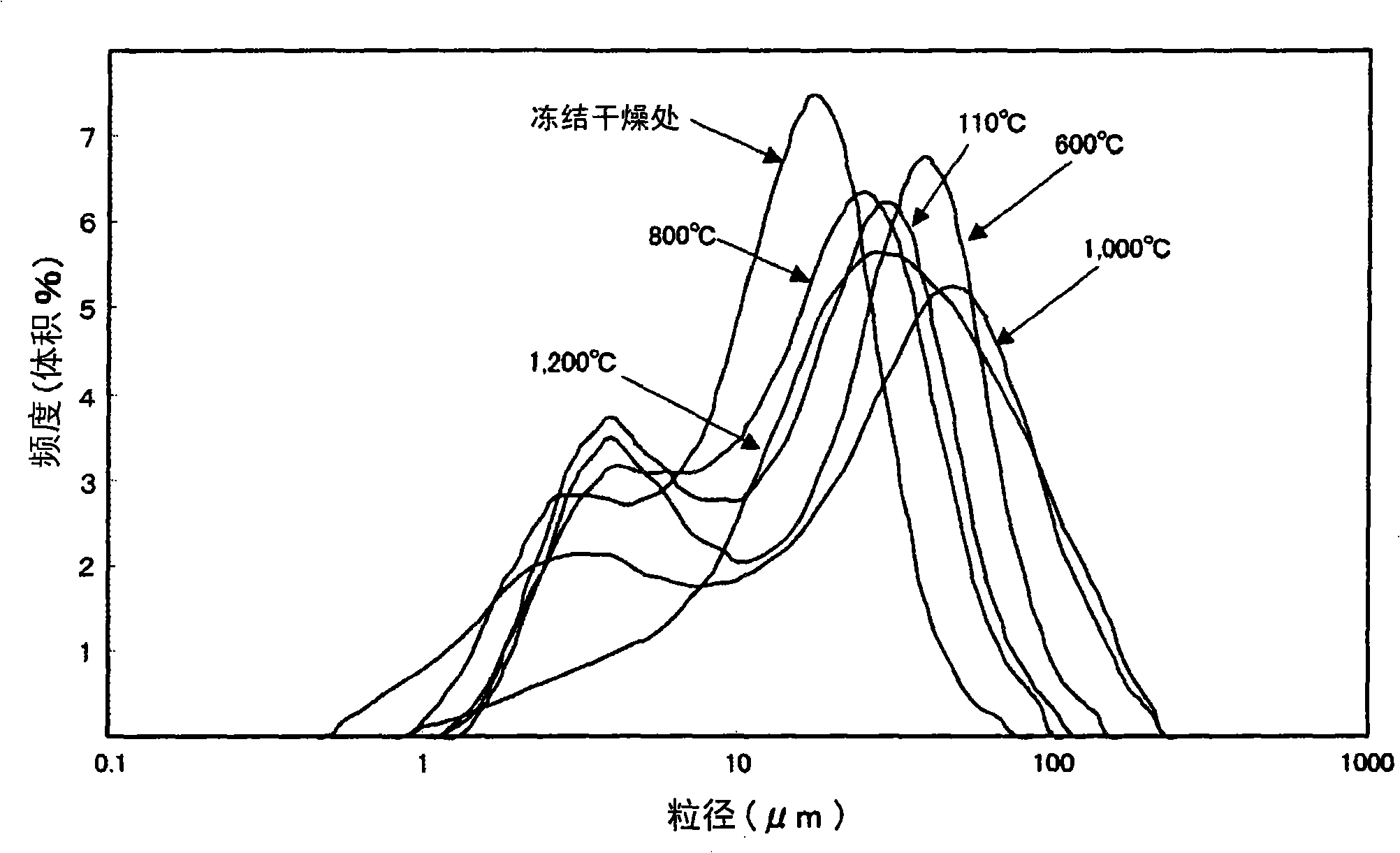
[0167] Freeze-dried HAp / IP was measured using a laser diffraction / scattering particle size distribution analyzer LA-300 (manufactured by Horiba, Ltd.) 6 The median diameter and particle size distribution of the powder. Disperse the reagent in purified water and measure it with a flow cell. Freeze-dried HAp / IP 6 The median diameter of the powder is shown in Table 2, and the results of the particle size distribution measurement are shown in figure 1 middle.
[0168]
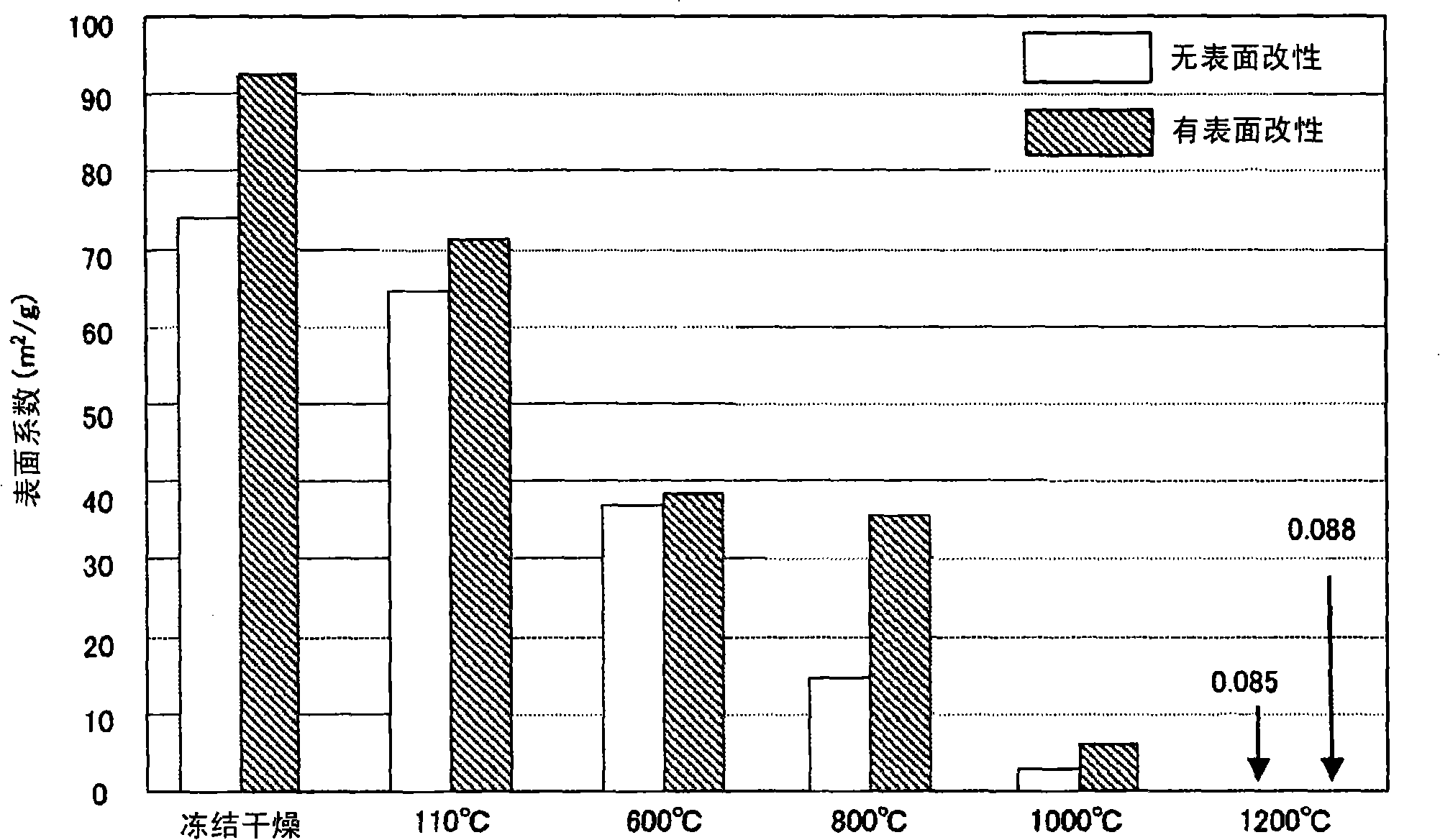
[0169] The surface coefficient (Specific surface area; SSA) of the freeze-dried HAp powder was measured by the BET method using a microparticle automati...
Embodiment 3
[0175] 6 Powder preparation>
[0176] Carry out wet synthesis identically with embodiment 2, after ripening, utilize suction filtration to reclaim HAp slurry, make slurry in 300cm 3 suspended in acetone, and then recovered by suction filtration again. The recovered HAp slurry was air-dried until the acetone disappeared, and then dried in a dryer set at 110 °C for two days. Except that, same as Example 2, 6 Powder>.
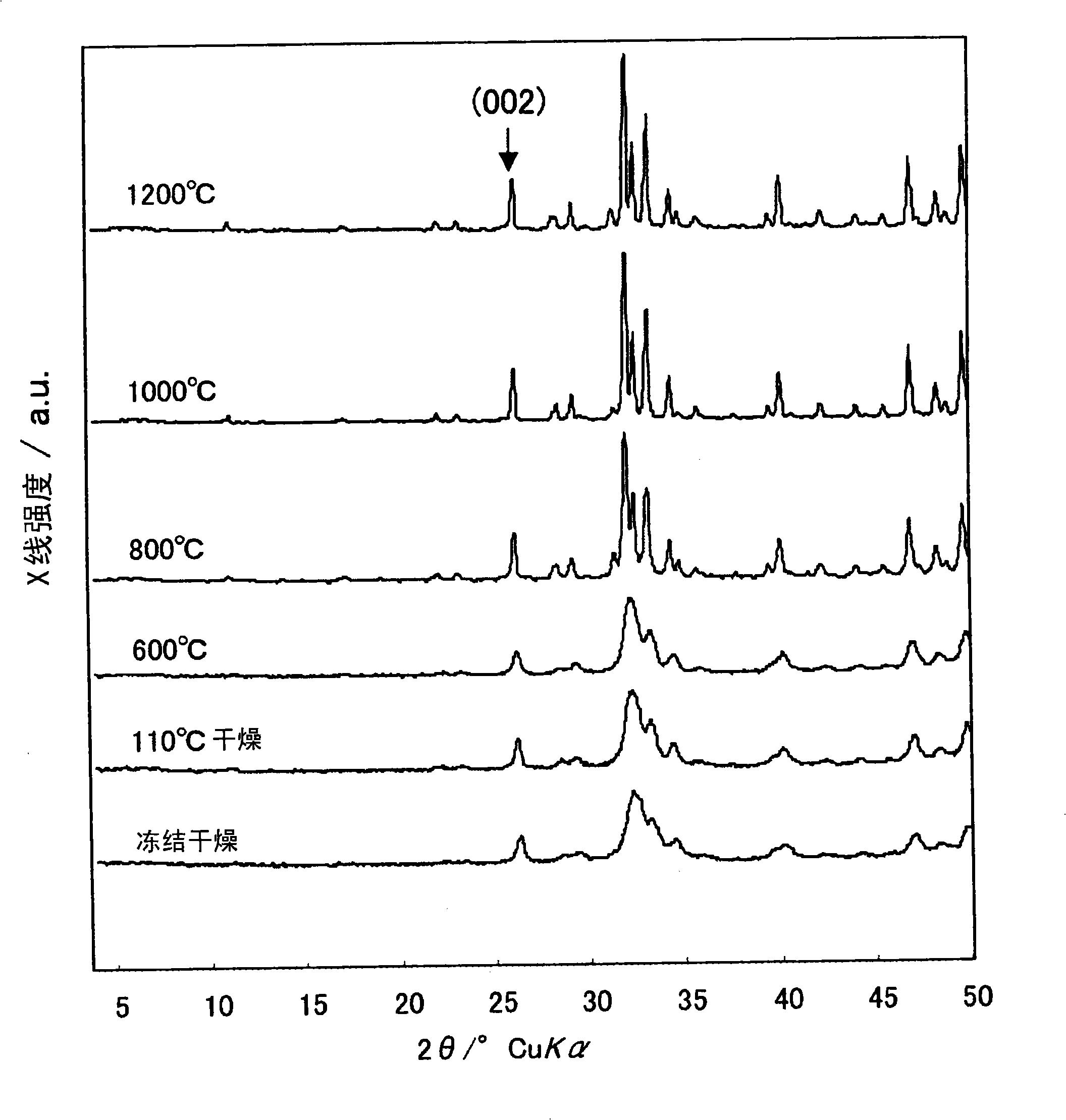
[0177] The resulting 110°C dried HAp / IP 6 The median diameter of the powder is shown in Table 2, and the results of the particle size distribution measurement are shown in figure 1 , the surface coefficient measurements are shown in the figure 2 , the X-ray diffraction pattern is shown in image 3 , half-value widths are shown in Table 2. Alternatively, use the resulting 110°C dried HAp / IP 6 As for the powder, cement was produced in the same manner as in Example 1, and the results of measuring the compressive strength of the cement are shown in Table 2.
PUM
 Login to View More
 Abstract
Description
Claims
Application Information
 Login to View More