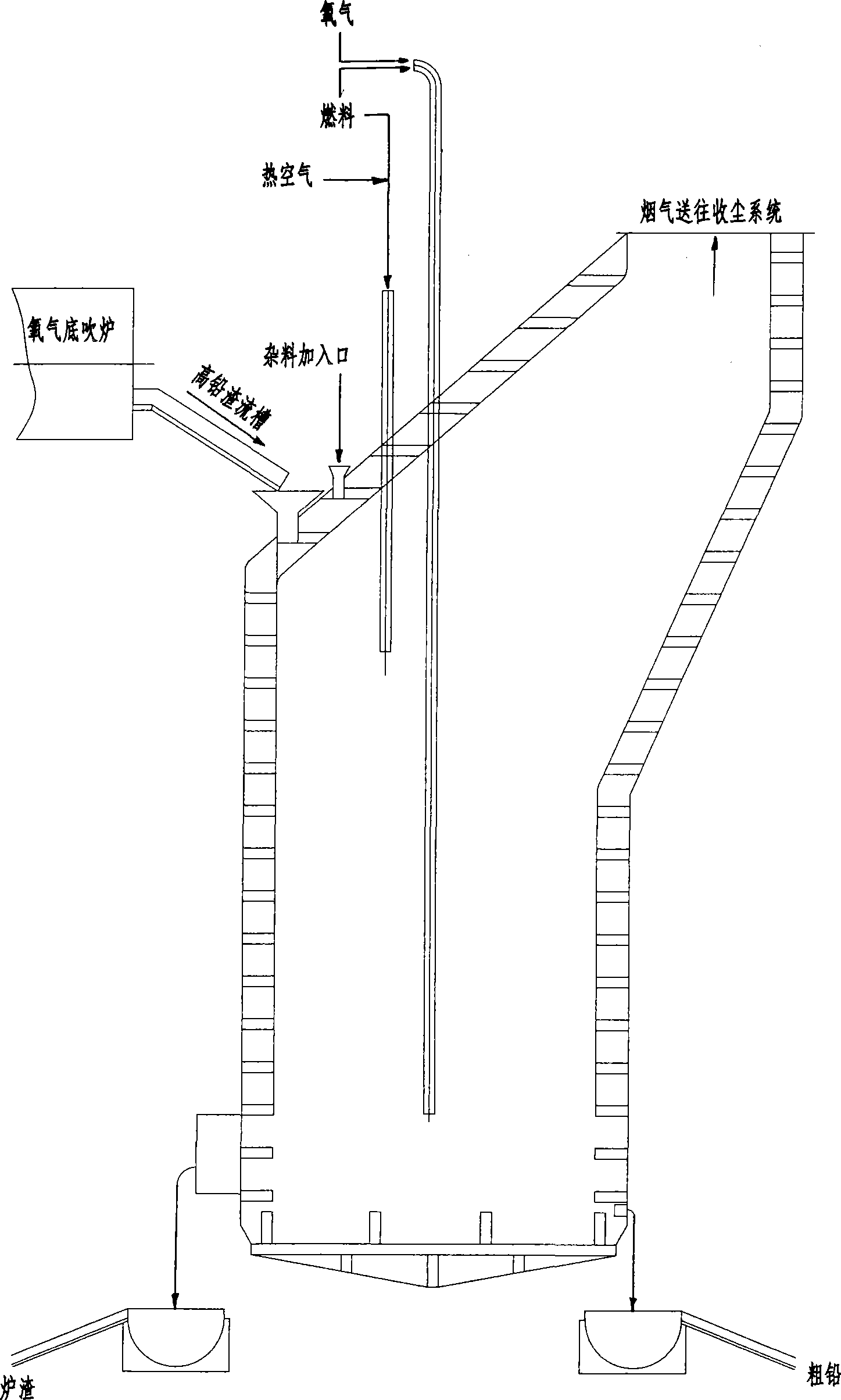
Process for direct reduction of liquid high-lead skim with reduction furnace

A reduction furnace and high lead slag technology, applied in the field of lead smelting, can solve the problems of difficult recovery of sulfur dioxide flue gas, unorganized emission and lead dust pollution cannot be effectively controlled, and achieve improved labor productivity, large production capacity, coke The effect of reducing consumption and flue gas volume

CN101509081AInactive Publication Date: 2009-08-19安徽铜冠有色金属(池州)有限责任公司
0 Cites 21 Cited by

Patent Information

Authority / Receiving Office
CN · China
Current Assignee / Owner
Publication Date
2009-08-19
Estimated Expiration
Not applicable · inactive patent

Smart Images

  • Figure 1
    Figure 1
Patent Text Reader

Abstract

The invention discloses a process of directly reducing liquid high lead slag in reducing furnace, secondary lead-containing materials such as the liquid high lead slag, lead concentrate, scrap leads, waste accumulators and the like generated from the oxygen bottom blowing smelting furnace or zinc leaching residues are used as raw materials and are added from the top end of the reducing furnace; coal powder and natural gas used as fuel and oxygen-enriched air used as combustion improver are continuously led in from the top of the reducing furnace to carry out combustion reaction; the temperature in the reducing furnace is kept at 1000-1500 DEG C; the coal powder and natural gas can be simultaneously used as reducing agents and fall into the reaction tank at the bottom of the reducing furnace after being fully mixed with the raw materials; the lead oxides in the raw materials are reduced to crude lead and the addition of the reducing agents is subject to full reduction of the lead oxides in the raw materials. The process of the invention directly reduces the liquid high lead slag, fully utilizes the thermal energy of the high lead slag and further reduces the coke consumption and flue gas volume, thereby dramatically reducing the smoke dust rate and the smelting cost.
Need to check novelty before this filing date? Find Prior Art

Description

technical field

[0001] The invention relates to a process method for smelting lead in the nonferrous metal smelting industry. Background technique

[0002] At present, the processes adopted in my country's crude lead production mainly include the traditional "sintering-blast furnace reduction" lead smelting process and direct lead smelting methods such as oxygen bottom blowing-blast furnace reduction lead smelting method, QSL method, ISA and Kaldo method. Due to the difficulty in recovering low-concentration sulfur dioxide flue gas produced in the traditional "sintering-blast furnace reduction" lead smelting process, limited by process conditions and equipment, SO 2 Unorganized emissions and lead dust pollution cannot be effectively controlled, and the country has banned the use of this process in 2000. In recent years, with the country's increasingly stringent environmental protection requirements, new lead smelting methods have been gradually popularized and applied in my...

Examples

Embodiment Construction

[0014] Referring to the accompanying drawings, a reduction furnace directly reduces liquid high-lead slag technology, using secondary lead-containing materials such as liquid high-lead slag, lead concentrate, waste miscellaneous lead, waste batteries, etc. The raw materials are added from the top of the reduction furnace, and the pulverized coal and natural gas as fuel and the oxygen-enriched air as a combustion accelerant are passed through the top of the reduction furnace continuously, and then the combustion reaction occurs, and the temperature in the reduction furnace is kept at 1000-1500 ° C; pulverized coal Natural gas is used as a reducing agent at the same time, and it is fully mixed with the raw material and then falls into the reaction pool at the bottom of the reduction furnace to reduce the lead oxide in the raw material to crude lead. The amount of reducing agent added is to fully reduce the lead oxide in the raw material The lead oxide shall prevail, and the zinc ...