
Method for immobilizing beta-glucosidase and hydrolyzing straw cellulose by cooperating beta-glucosidase with cellulase
A technology of glucosidase and straw cellulose, applied in the direction of immobilization on or in inorganic carriers, on/in organic carriers, fermentation, etc., can solve the problem of low recovery rate of enzyme activity and problems of nano-immobilized enzymes Problems such as complex process and difficult recovery of immobilized enzymes, to achieve the effect of improving the yield of hydrolyzed sugar, good reusability, and simple immobilization operation
Patent Information
- Authority / Receiving Office
- CN · China
- Patent Type
- Applications(China)
- Current Assignee / Owner
- Publication Date
- 2012-07-04
- Estimated Expiration
- Not applicable · inactive patent
Smart Images
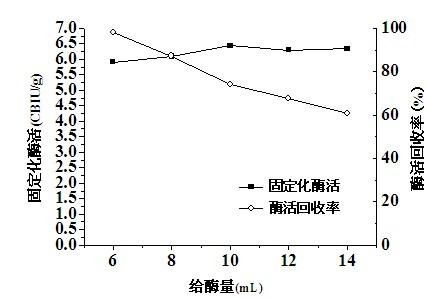
Figure 1 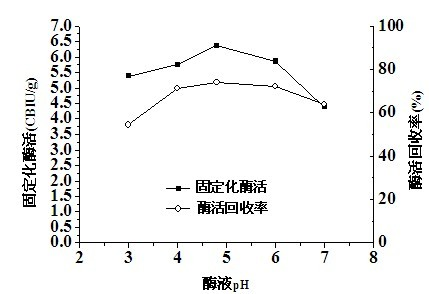
Figure 2 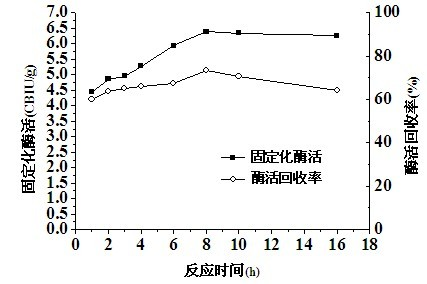
Figure 3
Abstract
Description
technical field
[0001] The invention discloses a method for immobilizing β-glucosidase and cooperating with cellulase to hydrolyze straw cellulose, in particular to a method for preparing magnetically immobilized β-glucosidase, and the immobilized enzyme in straw cellulose The application in hydrolysis belongs to the technical field of biocatalysis. Background technique
[0002] β-glucosidase (EC3.2.1.21), also known as cellobiase, is a hydrolase that can hydrolyze the non-reducing β-D-glucosidic bond bound to the terminal. It can act on cellobiose or cellooligosaccharide to hydrolyze it into glucose molecules, and it is also one of the components of cellulase, which can cooperate with cellulase to increase the speed and degree of lignocellulose hydrolysis. It has a wide range of applications in the fields of cellulose degradation and improvement of food flavor. It is generally believed that at least three enzymes are required to generate glucose from cellulose substances ...
Examples
Embodiment 1
[0033] Example 1 The effect of the amount of enzyme on the preparation of magnetic chitosan microspheres immobilized enzyme
[0034] Dissolve 0.5 g chitosan in 50 mL, 2% propionic acid solution, add 40 μL PEG400 to form a transparent and uniform liquid, then add 0.5 g Fe 3 o 4 Granules, stir well, remove air bubbles. Then it was dropped into 200 mL 2 M NaOH solution for 10 h to form chitosan magnetic microspheres, which were washed repeatedly with distilled water until neutral. Take 1 g of chitosan magnetic microspheres, add them to 20 mL, 2% glutaraldehyde solution, cross-link for 2 h at 25 °C, and wash them repeatedly with distilled water until neutral to obtain the immobilized carrier.
[0035] Take 5 copies of the same 0.5 g immobilized carrier and add them to 6 mL, 8 mL, 10 mL, 12 mL and 14 mL of β-glucosidase solution (pH 4.8, enzyme activity 0.93 CBIU / mL), Adsorption at 20°C, 200 r / min for 10 h. Determination of enzyme activity of immobilized enzymes, such as figu...
Embodiment 2
[0036] Example 2 The influence of pH on the preparation of magnetic chitosan microspheres immobilized enzyme
[0037] The immobilized carrier was prepared according to the method in Example 1, and 5 parts of the same 0.5 g immobilized carrier were added to 10 mL of β-glucosidase solutions with pHs of 3.0, 4.0, 4.8, 6.0 and 7.0 (enzyme activity is 0.93 CBIU / mL), and adsorbed at 20°C, 200 r / min for 10 h. Determination of enzyme activity of immobilized enzymes, such as figure 2 As shown, the highest was 6.36 CBIU / mL, and the recovery rate of enzyme activity was 74.0%.
Embodiment 3
[0038] Example 3 The influence of adsorption time on the preparation of magnetic chitosan microspheres immobilized enzyme
[0039] The immobilized carrier was prepared according to the method in Example 1, and 5 copies of the same 0.5 g immobilized carrier were added to 10 mL of β-glucosidase solution at pH 4.8 (enzyme activity was 0.93 CBIU / mL) , at 20 °C and 200 r / min for 1 h, 2 h, 3 h, 4 h, 6 h, 8 h, 10 h and 16 h, respectively. Determination of enzyme activity of immobilized enzymes, such as image 3As shown, the highest was 6.39 CBIU / mL, and the recovery rate of enzyme activity was 73.3%.