

Method for preparing medical titanium material with high anti-cancer and antibacterial properties
A kind of titanium material, good technology, applied in the field of preparation of functionalized titanium material, can solve the problems of inability to achieve antibacterial effect, looseness, etc., achieve good anticancer and antibacterial performance, low cost, and simple operation
Patent Information
- Authority / Receiving Office
- CN · China
- Current Assignee / Owner
- Publication Date
- 2012-07-11
- Estimated Expiration
- Not applicable · inactive patent
Smart Images
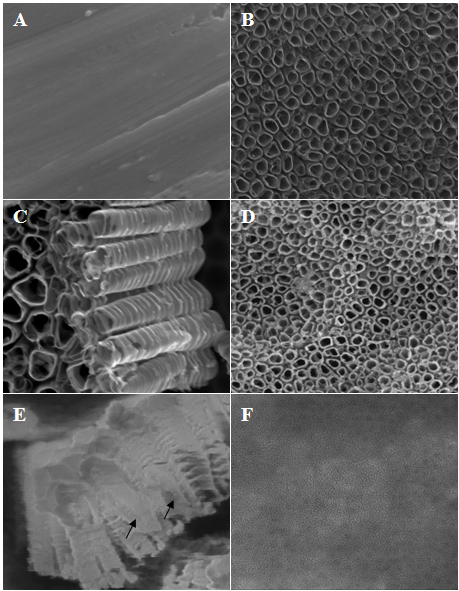
Figure 1 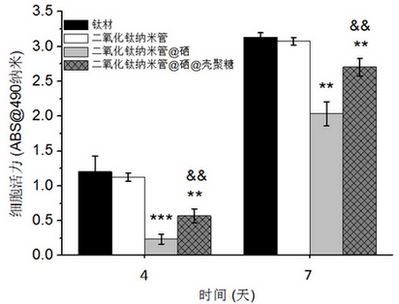
Figure 2 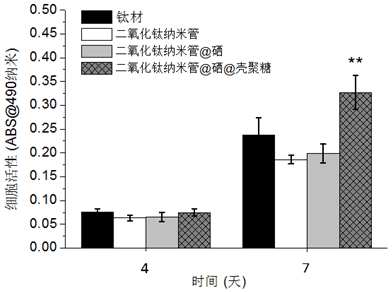
Figure 3
Abstract
Description
technical field
[0001] The invention belongs to the field of medical materials and relates to a preparation method of a functionalized titanium material. Background technique
[0002] Titanium and titanium alloys are commonly used medical metal materials. Because of their elastic modulus similar to that of human bone, excellent corrosion resistance, good biocompatibility and processing performance, they have been used in dental implants and teeth since the 1970s. It is widely used in stents, bone implants and artificial joints. The clinical treatment of bone cancer is usually to replace the cancerous bone with bone implants. Since there may still be cancer cells that have not been completely removed near the bone implant implanted after surgery, and the inflammatory response caused by bacteria can easily lead to loosening after implantation, therefore, it is desirable to develop a bone implant with good anticancer and antibacterial properties. Implant material is very impo...
Examples
Embodiment 1
[0026] Embodiment 1. Preparation of medical titanium material with good anticancer and antibacterial properties
[0027] a. Pretreatment of titanium materials: ultrasonically clean the titanium materials with acetone, isopropanol and methanol for 20 minutes, then wash with deionized water for 3 times, dry at 40°C, and set aside;
[0028] b. Construction of titanium dioxide nanotube arrays: dissolving ammonium fluoride with a glycerol-water mixture with a volume ratio of 1:1 to make a solution with a concentration of 0.27mol / L as the electrolyte; use the titanium material obtained in step a as The anode, platinum as the cathode, is placed in the above-mentioned ammonium fluoride electrolyte, and the anodic oxidation reaction is carried out at a constant voltage of 30V for 30 minutes; the treated titanium material is washed 5 times with deionized water, dried at 40°C, and used for later use; the obtained titanium material is referred to as is "titanium dioxide nanotubes";
...
Embodiment 2
[0032] Embodiment 2. Preparation of medical titanium material with good anticancer and antibacterial properties
[0033] a. Pretreatment of titanium materials: ultrasonically clean the titanium materials with acetone, isopropanol and methanol for 20 minutes, then wash with deionized water for 3 times, dry at 40°C, and set aside;
[0034] b. Construction of titanium dioxide nanotube arrays: dissolving ammonium fluoride with a glycerol-water mixture with a volume ratio of 1:1 to make a solution with a concentration of 0.25mol / L as the electrolyte; use the titanium material obtained in step a as Anode, platinum as cathode, placed in the above-mentioned ammonium fluoride electrolyte, anodic oxidation reaction at a constant voltage of 30V for 45 minutes; the treated titanium material was washed 5 times with deionized water, dried at 40°C, and used for later use; the obtained titanium material is referred to as is "titanium dioxide nanotubes";
[0035]c. Loading of selenium nan...
Embodiment 3
[0037] Embodiment 3. Preparation of medical titanium material with good anticancer and antibacterial properties
[0038] a. Pretreatment of titanium materials: ultrasonically clean the titanium materials with acetone, isopropanol and methanol for 20 minutes, then wash with deionized water for 3 times, dry at 40°C, and set aside;
[0039] b. Construction of titanium dioxide nanotube arrays: dissolving ammonium fluoride with a glycerol-water mixture with a volume ratio of 1:1 to make a solution with a concentration of 0.30 mol / L as the electrolyte; use the titanium material obtained in step a as Anode, platinum as cathode, placed in the above-mentioned ammonium fluoride electrolyte, anodic oxidation reaction at a constant voltage of 30V for 60 minutes; the treated titanium material was washed 5 times with deionized water, dried at 40°C, and used for later use; the obtained titanium material is referred to as is "titanium dioxide nanotubes";
[0040] c. Loading of selenium n...