Unlock instant, AI-driven research and patent intelligence for your innovation.

Multilayer film structure for improving conversion efficiency of crystalline silicon solar cell

A solar cell and conversion efficiency technology, applied in the direction of circuits, electrical components, semiconductor devices, etc., can solve problems such as inappropriate passivation of solar cells, and achieve the effect of excellent film uniformity and high deposition rate

Inactive Publication Date: 2013-05-15
SHENYANG SCI INSTR RES CENT CHINESE ACAD OF SCI
View PDF5 Cites 1 Cited by
  • Summary
  • Abstract
  • Description
  • Claims
  • Application Information

AI Technical Summary

Problems solved by technology

[0004] Microwave PECVD deposits SiN films for hydrogenation of large-area cells, not suitable for passivation of solar cells

Method used

the structure of the environmentally friendly knitted fabric provided by the present invention; figure 2 Flow chart of the yarn wrapping machine for environmentally friendly knitted fabrics and storage devices; image 3 Is the parameter map of the yarn covering machine
View more

Image

Smart Image Click on the blue labels to locate them in the text.
Viewing Examples
Smart Image
  • Multilayer film structure for improving conversion efficiency of crystalline silicon solar cell

Examples

Experimental program
Comparison scheme
Effect test

Embodiment 1

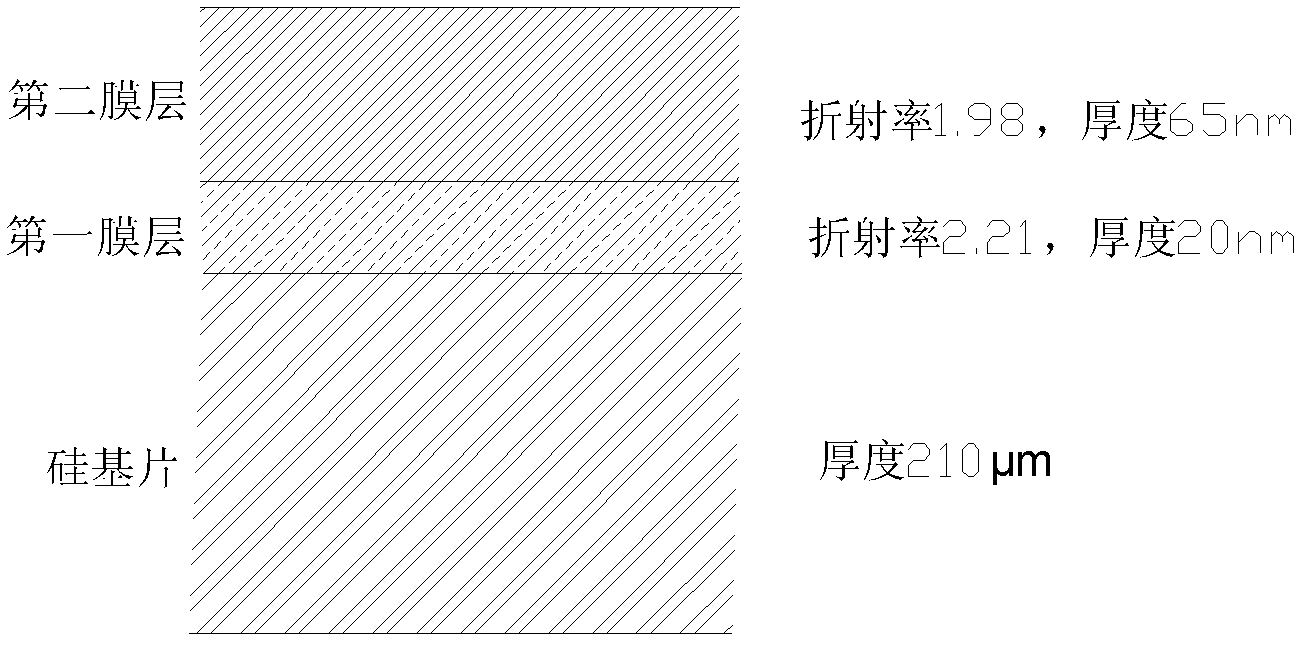
[0027] Forming a multilayer film structure to improve crystalline silicon solar cells Using microwave PECVD, a mixed gas of silane, ammonia and nitrogen is passed to deposit the first film layer on the cell substrate, and then the gas mixture is passed to deposit the second film on the first film layer layer; during the deposition process, the pressure is 40Pa; the gas flow rate is 440sccm for silane, 1850sccm for ammonia and 500sccm for nitrogen; and the microwave power density is 3000W.

Embodiment 2

[0029] Additionally, nitrogen will be removed from the conventional precursor gas so that the precursor gas includes silane and ammonia as source gases. The hydrogen concentration of the deposited SiN layer can have suitable film properties for passivation / anti-reflection.

[0030] Also, the mass density of SiN affects the hydrogen concentration during the sintering process. After sintering, for very low density SiN eg 2.2g / g / cm 3 , the hydrogen concentration can be reduced by 60%, and for higher density SiN layers, the hydrogen loss is negligible. It can be assured that the annealed layer has a mass density loss of less than 2.6 g / cm 3 , can allow excess hydrogen atoms to move during the sintering process, so that hydrogen molecules form and diffuse out of the SiN layer. Conversely, it is believed that having a higher than 2.8g / cm 3 With a mass density of , it does not allow sufficient hydrogen mobility during the sintering process, thus avoiding the migration of hydrogen...

the structure of the environmentally friendly knitted fabric provided by the present invention; figure 2 Flow chart of the yarn wrapping machine for environmentally friendly knitted fabrics and storage devices; image 3 Is the parameter map of the yarn covering machine
Login to View More

PUM

PropertyMeasurementUnit
Thicknessaaaaaaaaaa
Thicknessaaaaaaaaaa
Login to View More

Abstract

The invention relates to a multilayer film structure, in particular to a multilayer film structure for improving the conversion efficiency of a crystalline silicon solar cell. The multilayer film comprises at least two silicon system film layers; the multilayer film structure can be used as a passivation layer / antireflection layer on a solar cell sheet; and conventional precursor gas mixture is introduced during a deposition process to form the silicon system film layers on the solar cell sheet. Multiple SiN film layers are deposited by a microwave plasma enhanced chemical vapor deposition (PECVD) method and used as the passivation layer and the antireflection layer on the solar cell sheet. A system for processing the large-area cell sheet can be formed by the PECVD method so as to perform the deposit on the SiN passivation layer on the solar cell sheet, and therefore high deposition rate and good film uniformity of the system are utilized.

Description

technical field [0001] The invention relates to a multilayer film structure, in particular to a multilayer film structure capable of improving conversion efficiency of crystalline silicon solar cells. Background technique [0002] With the rapid development of economic construction, microelectronics technology has developed rapidly, and the development and use of PECVD plasma processing equipment has become increasingly widespread. [0003] PECVD is the plasma enhanced chemical vapor deposition method. During chemical vapor deposition, in order to make the chemical reaction proceed at a lower temperature, the activity of the plasma can be used to promote the reaction. This chemical vapor deposition method is called plasma Volume-enhanced chemical vapor deposition method, the equipment for implementing this processing method is PECVD equipment. [0004] Microwave PECVD deposits SiN films for hydrogenation of large-area cells, which is not suitable for passivation of solar ce...

Claims

the structure of the environmentally friendly knitted fabric provided by the present invention; figure 2 Flow chart of the yarn wrapping machine for environmentally friendly knitted fabrics and storage devices; image 3 Is the parameter map of the yarn covering machine
Login to View More

Application Information

Patent Timeline
no application Login to View More
IPC IPC(8): H01L31/0216
Inventor 雷震霖赵崇凌李士军张健张东洪克超徐宝利钟富强陆涛许新王刚刘兴郭玉飞王学敏李松
Owner SHENYANG SCI INSTR RES CENT CHINESE ACAD OF SCI
Features
  • R&D
  • Intellectual Property
  • Life Sciences
  • Materials
  • Tech Scout
Why Patsnap Eureka
  • Unparalleled Data Quality
  • Higher Quality Content
  • 60% Fewer Hallucinations
Social media
Patsnap Eureka Blog
Learn More