

Pantoea for degrading organic phosphorus and inorganic phosphorus and application of pantoea
A technology of inorganic phosphorus and organic phosphorus, applied in the biological field, can solve the problems of soil phosphorus enrichment, and it is difficult for plants to directly absorb and utilize it.
- Summary
- Abstract
- Description
- Claims
- Application Information
AI Technical Summary
Problems solved by technology
Method used
Image


Examples
Embodiment 1
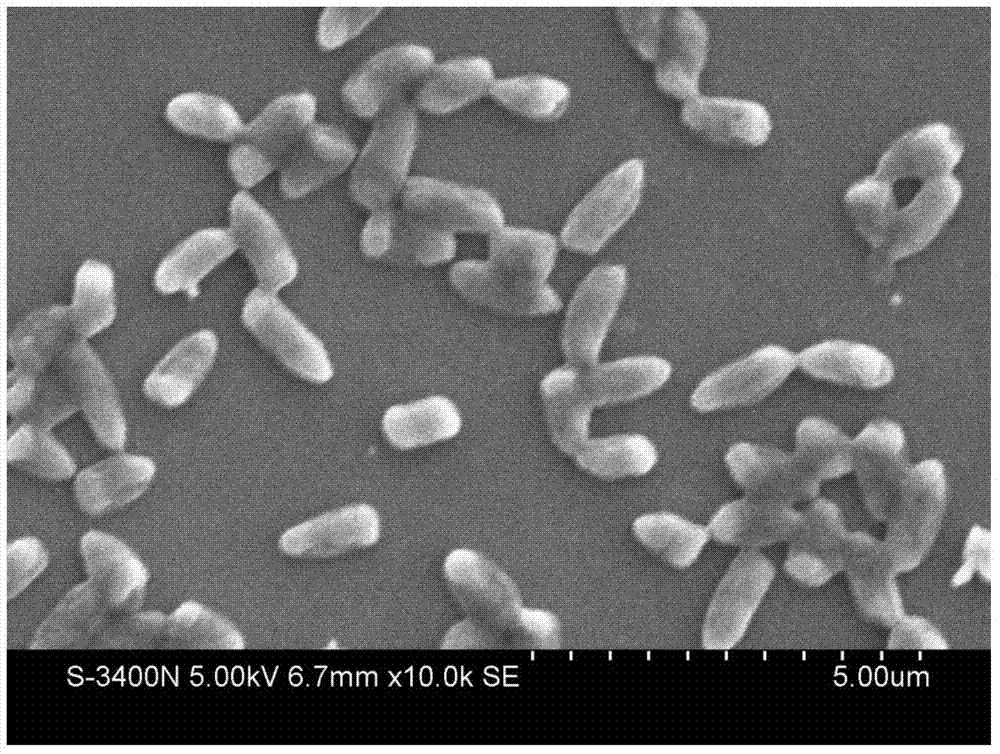
[0071] Example 1. Isolation and identification of Pantoea sp. S-32CGMCC No.10017
[0072] 1. Isolation of Phosphorus Solubilizing Bacteria
[0073] 1. Soil sample collection
[0074] The reclaimed soil was collected from the Xiaoyi open-pit mining area in Shanxi Province (collection time: June 2012, collector: Li Jianhua, contact information: 0351-7639390).
[0075] 2. Primary screening
[0076] Add 10 g of the above-mentioned soil sample to a Erlenmeyer flask filled with 100 ml of sterile water, shake and incubate for 10 minutes to make a cloudy solution. Take 1ml of the above cloudy solution and add it to a test tube filled with 9ml sterile water and mix well (at this time, the dilution is recorded as 10 -1 ), then draw 1ml from this test tube and add it to another test tube filled with 9ml sterile water and mix evenly, and so on to make 10 -2 、10 -3 、10 -4 、10 -5 、10 -6 Soil suspensions at different dilutions. will be 10 -4 、10 -5 、10 -6 1.0ml of each dilution o...
Embodiment 2
[0116] Example 2, Phosphatase activity secreted by Pantoea sp. S-32CGMCC No.10017
[0117]Get and measure the phosphatase activity of the supernatant after the pantoea (Pantoea sp.) S-32CGMCC No.100175d of embodiment 1 is cultivated with organophosphorus liquid medium, respectively adopt alkaline phosphatase kit (Nanjing Jiancheng Institute of Bioengineering , Cat. No. A059-1) and acid phosphatase kit (Nanjing Jiancheng Institute of Bioengineering, Cat. No. A060-1) were used to measure acid phosphatase activity and alkaline phosphatase activity according to the instructions. 100mL of fermentation broth was reacted with substrate (disodium phenyl phosphate) for 15min at 37°C to produce 1mg of phenol, which was defined as 1 Guinea unit (U). Bacillus megaterium As1.223 was used as the control, and the organophosphate liquid medium without adding any strain was used as the blank control.
[0118] The results showed that the acid phosphatase and alkaline phosphatase enzyme activit...
Embodiment 3
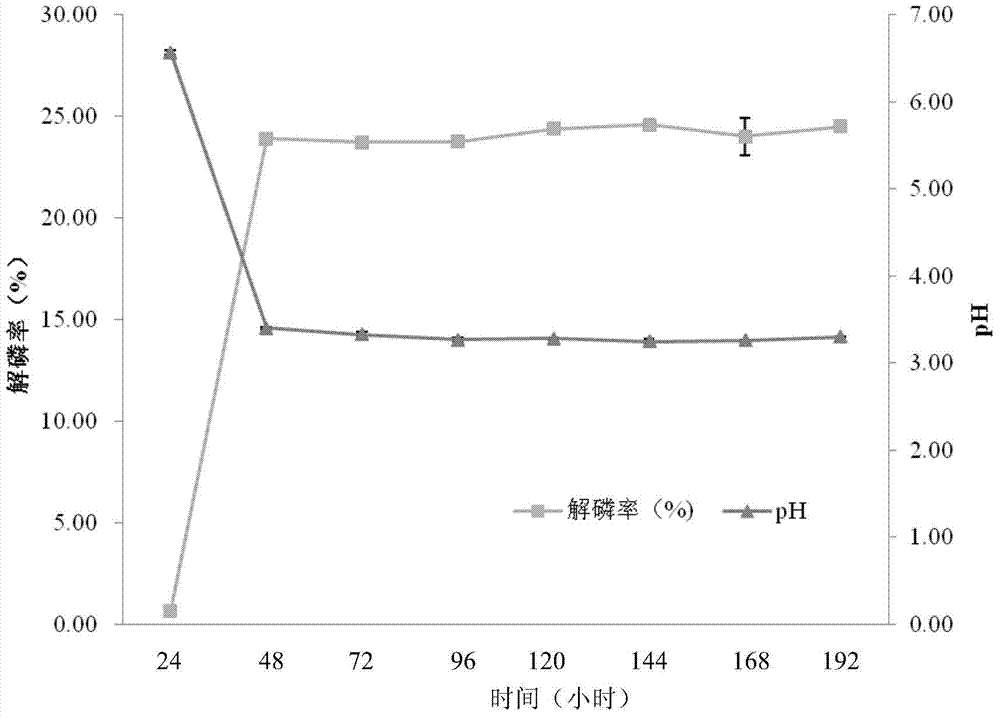
[0119] Example 3, Pantoea sp. (Pantoea sp.) S-32CGMCC No.10017 Environmental Adaptation and Determination of Phosphorus Solubilizing Ability
[0120] The phosphorus dissolving rate measuring method in the present embodiment is all the same as embodiment 1.
[0121] 1. Environmental adaptability of Pantoea sp. S-32CGMCC No.10017
[0122] The experiment was repeated three times, and the specific steps of each repeated experiment were as follows:
[0123] Cultivate, observe, and record the temperature adaptability of Pantoea sp. S-32CGMCC No.10017 at 4°C, 20°C, 28°C, 37°C, and 60°C respectively, using nutrient agar medium, and each treatment is performed 3 times Repeat; adjust the NaCl concentration of the nutrient agar medium to be 2%, 5%, 7%, 10%, 12%, 15% respectively, each treatment is repeated 3 times, cultivate, observe, and record the salt tolerance of the bacterial strain; adjust the nutrient agar The acidity of the culture medium was pH3, pH4, pH5, pH6, pH7, pH8, pH9, ...
PUM
 Login to View More
 Abstract
Description
Claims
Application Information
 Login to View More