Unlock instant, AI-driven research and patent intelligence for your innovation.

Preparation method of nanometer composite photocatalyst TiO2/Fe-TiO2 with P-N junction structure

A nanocomposite and photocatalyst technology, applied in the field of nanocomposite photocatalyst and photocatalyst material preparation, can solve the problems of high photogenerated electron-hole recombination rate and poor visible light absorption rate, etc., and achieve good stability and catalytic activity. Conducive to environmental protection, easy to achieve effect

Inactive Publication Date: 2015-12-09
TIANJIN CHENGJIAN UNIV
View PDF2 Cites 0 Cited by
  • Summary
  • Abstract
  • Description
  • Claims
  • Application Information

AI Technical Summary

Problems solved by technology

But a single TiO 2 The existence of practical problems such as semiconductor photogenerated electron-hole recombination rate and poor visible light absorption rate has limited the use scale, so as to further improve the TiO 2 The photocatalytic efficiency of photocatalysts and the expansion of their response range under visible light are the key to expanding their application range

Method used

the structure of the environmentally friendly knitted fabric provided by the present invention; figure 2 Flow chart of the yarn wrapping machine for environmentally friendly knitted fabrics and storage devices; image 3 Is the parameter map of the yarn covering machine
View more

Image

Smart Image Click on the blue labels to locate them in the text.
Viewing Examples
Smart Image
  • Preparation method of nanometer composite photocatalyst TiO2/Fe-TiO2 with P-N junction structure
  • Preparation method of nanometer composite photocatalyst TiO2/Fe-TiO2 with P-N junction structure
  • Preparation method of nanometer composite photocatalyst TiO2/Fe-TiO2 with P-N junction structure

Examples

Experimental program
Comparison scheme
Effect test

Embodiment 1

[0037] (1) Mix butyl titanate solution and absolute ethanol solution at a molar ratio of 1:35, adjust the pH of the mixed solution to 3 with nitric acid, transfer the mixed solution to a hydrothermal kettle, the hydrothermal reaction temperature is 200°C, water TiO was prepared by thermal reaction for 24h 2 Nano powder; the above reaction parameters remain unchanged, and Fe-TiO is prepared from ferric nitrate according to the molar percentage of 0.2% Fe / Ti 2 Nano powder.

[0038] (2) The two kinds of nano photocatalytic powders were washed with absolute ethanol and water three times respectively, dried at 70°C for 12h, ground, and the powders were heat-treated at 450°C in a muffle furnace for 2h.

[0039] (3) Fe-TiO 2 with TiO 2 Two kinds of nano-powders were mixed at a ratio of 8:100 by weight, and ultrasonically dispersed in distilled water for 30 minutes at room temperature. Among them, TiO 2 The mass volume ratio with distilled water is 1:10. After ultrasonication, the...

Embodiment 2

[0041] (1) Mix butyl titanate solution and absolute ethanol solution at a molar ratio of 1:35, adjust the pH of the mixed solution to 3 with nitric acid, transfer the mixed solution to a hydrothermal kettle, the hydrothermal reaction temperature is 200°C, water TiO was prepared by thermal reaction for 16h 2 Nano powder; the above reaction parameters remain unchanged, and Fe-TiO is prepared from ferric nitrate according to 0.5% Fe / Ti molar percentage 2 Nano powder.

[0042] (2) The two kinds of nano photocatalytic powders were washed with absolute ethanol and water three times respectively, dried at 70°C for 12h, ground, and the powders were heat-treated at 450°C in a muffle furnace for 2h.

[0043] (3) Fe-TiO 2 with TiO 2 Two kinds of nano-powders were mixed at 7.7:100 by weight percentage, and ultrasonically dispersed in distilled water for 30 minutes at room temperature, wherein TiO 2 The mass volume ratio with distilled water is 1.2:10. After ultrasonication, the powder...

Embodiment 3

[0045] (1) Mix butyl titanate solution and absolute ethanol solution at a molar ratio of 1:35, adjust the pH of the mixed solution to 3 with hydrochloric acid, transfer the mixed solution to a hydrothermal kettle, the hydrothermal reaction temperature is 160°C, and water TiO was prepared by thermal reaction for 16h 2 Nano powder; the above reaction parameters remain unchanged, and Fe-TiO is prepared from ferric nitrate according to the molar percentage of 0.2% Fe / Ti 2 Nano powder.

[0046] (2) The two kinds of nano photocatalytic powders were washed with absolute ethanol and water three times respectively, dried at 70°C for 12h, ground, and the powders were heat-treated at 450°C in a muffle furnace for 2h.

[0047] (3) Fe-TiO 2 with TiO 2 Two kinds of nano-powders were mixed at 7.7:100 by weight percentage, and ultrasonically dispersed in distilled water for 30 minutes at room temperature, wherein TiO 2 The mass volume ratio with distilled water is 1.5:10. After ultrasonic...

the structure of the environmentally friendly knitted fabric provided by the present invention; figure 2 Flow chart of the yarn wrapping machine for environmentally friendly knitted fabrics and storage devices; image 3 Is the parameter map of the yarn covering machine
Login to View More

PUM

No PUM Login to View More

Abstract

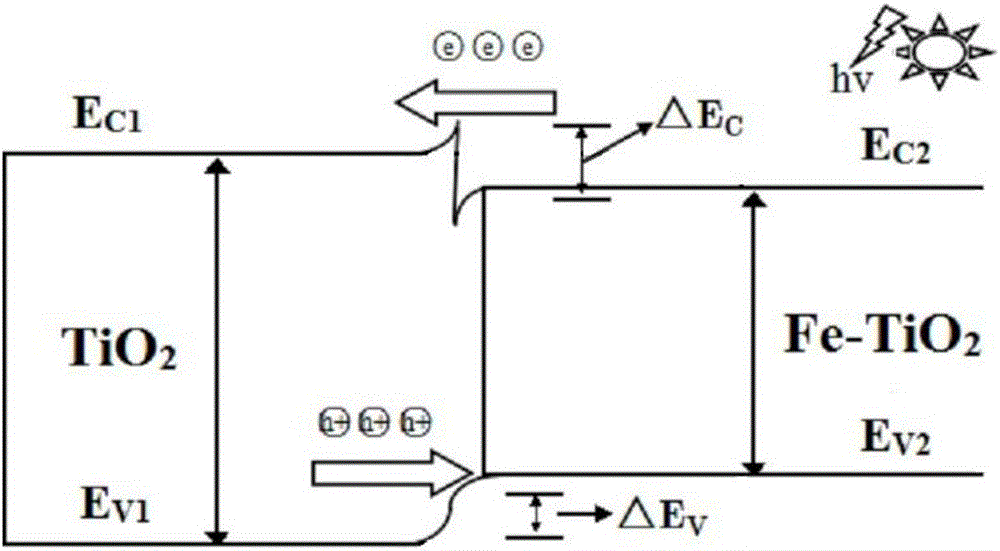
The invention belongs to the field of photocatalyst material preparation and relates to the field of nanometer composite photocatalysts. The invention discloses a preparation method and use of a nanometer composite photocatalyst TiO2 / Fe-TiO2 with a P-N junction structure. The preparation method comprises adding Fe-TiO2 materials with different Fe / Ti mole percents and TiO2 nanometer powder into oleic acid or an aqueous solution according to different mass percents, wherein the Fe-TiO2 materials are prepared by a hydrothermal method, carrying out ultrasonic dispersion at a normal temperature, drying the mixed powder subjected to ultrasonic dispersion and carrying out grinding to obtain the composite photocatalyst TiO2 / Fe-TiO2 with a P-N junction structure. The nanometer composite photocatalyst TiO2 / Fe-TiO2 has the characteristics of small electron-hole pair recombination rate, large visible light response scope and high photocatalysis efficiency. The nanometer composite photocatalyst TiO2 / Fe-TiO2 with a P-N junction structure has methylene blue degradation efficiency of 90% or more under visible light action for 3h. The preparation method has simple processes and a low comprehensive cost and does not produce secondary damage.

Description

technical field [0001] The invention belongs to the field of preparation of photocatalyst materials, in particular to the field of nanocomposite photocatalysts. Background technique [0002] At present, formaldehyde is widely used as a binder in various decorative materials and furniture used indoors by urban and rural residents in my country. Excessive use of decorative materials or furniture containing formaldehyde binders in the room will produce excessive formaldehyde harmful gas for a long time , and it takes 3 to 15 years for these formaldehyde gases to volatilize. Staying in a closed room filled with formaldehyde gas for a long time will cause symptoms such as headache, weakness, and memory loss. Among all contacts, because most of the elderly, children and pregnant women are weak, the harm of formaldehyde to these groups of people is also more obvious. Therefore, strengthening the control of indoor formaldehyde and other polluting gases is conducive to creating a co...

Claims

the structure of the environmentally friendly knitted fabric provided by the present invention; figure 2 Flow chart of the yarn wrapping machine for environmentally friendly knitted fabrics and storage devices; image 3 Is the parameter map of the yarn covering machine
Login to View More

Application Information

Patent Timeline
no application Login to View More
IPC IPC(8): B01J23/745
Inventor 雅菁杨宁宁鄂磊刘志锋
Owner TIANJIN CHENGJIAN UNIV
Features
  • R&D
  • Intellectual Property
  • Life Sciences
  • Materials
  • Tech Scout
Why Patsnap Eureka
  • Unparalleled Data Quality
  • Higher Quality Content
  • 60% Fewer Hallucinations
Social media
Patsnap Eureka Blog
Learn More