In-situ combined remediation method for petroleum contaminated site soil

A technology for joint remediation and contaminated soil, applied in the field of soil remediation, can solve the problems of only remediating specific pollutants, secondary sulfate pollution, long phytoremediation time, etc. Effect

A technology for joint remediation and contaminated soil, applied in the field of soil remediation, can solve the problems of only remediating specific pollutants, secondary sulfate pollution, long phytoremediation time, etc. Effect

CN105772499AActive Publication Date: 2016-07-20丹东市金山投资建设发展有限公司

Image

Smart Image Click on the blue labels to locate them in the text.
Viewing Examples
Smart Image
  • In-situ combined remediation method for petroleum contaminated site soil
  • In-situ combined remediation method for petroleum contaminated site soil

Examples

Experimental program
Comparison scheme
Effect test

Embodiment 1

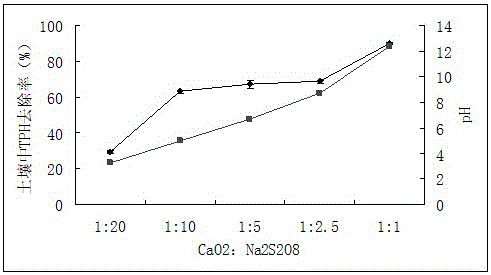
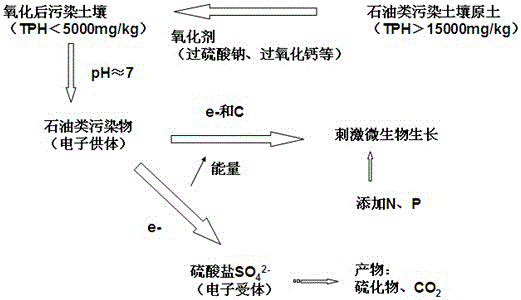
[0027] Take 10g of actual polluted soil (petroleum concentration 15000mg / kg), add 5g of sodium persulfate, 0.25~2g of calcium peroxide, 0.1g of sodium thiosulfate, and react for 24 hours. Take 10g of polluted soil after oxidation (calcium peroxide: sodium persulfate = 1:5), the concentration of petroleum after reaction is about 5000mg / kg, the pH is about 6.67, add 0.018g of ammonium sulfate and 0.011g of sodium phosphate, and cultivate for 30 days .

Embodiment 2

[0029] Take 10g of actual polluted soil (petroleum concentration 15000mg / kg), add 5g of sodium persulfate, 0.25~2g of calcium peroxide, 0.1g of sodium thiosulfate, and react for 24 hours. Take 10g of contaminated soil after oxidation (calcium peroxide: sodium persulfate = 1:5), the concentration of petroleum after reaction is about 5000mg / kg, the pH is about 6.67, add 0.018g of ammonium sulfate, 0.011g of sodium phosphate, and add exogenous Sulfate-reducing bacteria, cultivated for 30 days.

the structure of the environmentally friendly knitted fabric provided by the present invention; figure 2 Flow chart of the yarn wrapping machine for environmentally friendly knitted fabrics and storage devices; image 3 Is the parameter map of the yarn covering machine
Login to View More

PUM

No PUM Login to View More

Abstract

The invention discloses an in-situ combined remediation method for petroleum contaminated site soil and relates to a soil remediation method. According to the in-situ combined remediation method, a chemical oxidation reagent is prepared from the following components including sodium persulfate as an oxidant, sodium hydroxide or calcium peroxide as an activator and sodium thiosulfate as a sustained-release agent; a microorganism simulation nutrient is prepared from the following components including sodium phosphate and ammonium sulfate; the molar ratio of the sodium persulfate and the activator is 5:1; the quantity of the sustained-release agent is 1-5 percent of the quantity of the oxidant and the activator; the molar ratio of C, N and P as the nutrients for promoting growth of microorganisms is 120: 10: 1; a phosphorus source is the sodium phosphate (Na3PO4.12H2O); a nitrogen source is the ammonium sulfate ((NH4)2SO4); and a carbon source is petroleum pollutants and is estimated according to the actual pollutant degree. The in-situ combined remediation method for the petroleum contaminated site soil can reach the purpose of completely remediating the long-term petroleum contaminated site soil, and thus solving the problems of difficulty in remediating aged contaminated soil microorganisms, higher chemical oxidation cost and larger environmental influence and lowering the remediation cost.

Description

technical field [0001] The invention relates to a soil restoration method, in particular to an in-situ joint restoration method for oil-contaminated soil. Background technique [0002] Petroleum pollutants (TPH, Totalpetroleumhydrocarbons) refers to the 4 dissolved, and at wave number 3030cm -1 (≡CH1 aromatic ring), 2960cm -1 (-CH3 methyl) and 2930cm -1 (=CH2 methylene) Any substance with characteristic absorption. Mainly hydrocarbons (according to the structure can be divided into alkanes, cycloalkanes, aromatic hydrocarbons, olefins), followed by a small number of non-hydrocarbon components (containing O, S, N compounds, colloids and asphaltenes). Different components migrate and transform in soil through dispersion, molecular diffusion, volatilization, adsorption, chemical reaction and degradation, and exist in the underground environment in free state (NAPL), volatile state, dissolved state and adsorbed state. Due to the toxicity of petroleum pollutants and their mi...

Claims

the structure of the environmentally friendly knitted fabric provided by the present invention; figure 2 Flow chart of the yarn wrapping machine for environmentally friendly knitted fabrics and storage devices; image 3 Is the parameter map of the yarn covering machine
Login to View More

Application Information

Patent Timeline
20 Jul 2016
Publication
CN105772499A
IPC
B09C1/08; B09C1/10
CPC
B09C1/08; B09C1/10; B09C2101/00
Inventors
孙丽娜; 吴昊