
Process for processing microlite slabs
A processing technology and technology of microcrystalline stone, applied in the field of processing technology of microcrystalline stone plate, can solve the problems of unstable color of microcrystalline stone, short service life, low production efficiency, etc., and achieve stable color, long service life, mechanical strong effect
Patent Information
- Authority / Receiving Office
- CN · China
- Patent Type
- Applications(China)
- Current Assignee / Owner
- Publication Date
- 2017-01-04
- Estimated Expiration
- Not applicable · inactive patent
Smart Images
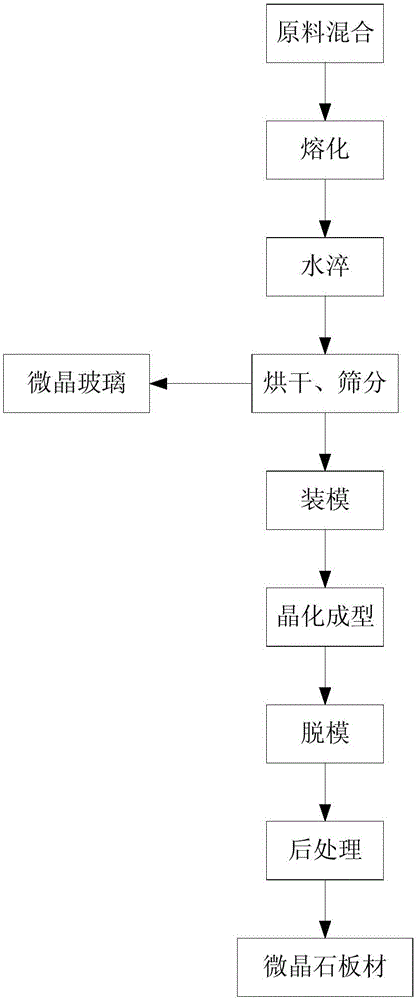
Figure 1
Abstract
Description
technical field
[0001] The invention relates to the technical field of microcrystalline stone plates, in particular to a processing technology for microcrystalline stone plates. Background technique
[0002] Microcrystalline stone, also known as microcrystalline glass-ceramic composite board, is a high-tech product in the field of architectural ceramics. Excellent appearance decoration effect, free from pollution, easy to clean, and excellent internal physical and chemical properties. In addition, it has stronger weather resistance and weather resistance than stone, so it is favored by high-end building materials markets at home and abroad. With the advent and expansion of glass-ceramic building materials, glass-ceramic composite panels came into being. It is a planar composite material of glass-ceramics and ceramic plates, showing comprehensive advantages in many aspects. The existing microcrystalline stone plate has complex operation and low production efficiency in the ...
Examples
Embodiment 1
[0019] A processing technology of microcrystalline stone plate, comprising the following steps:
[0020] 1) Mixing of raw materials: tailings slag is transported to the storage tank through the slurry pump, calcium carbonate, quartz sand, borax, zinc oxide, barium carbonate and soda ash enter their respective silos from the raw material warehouse, and the proportion of each material enters through the automatic batching production line. Mix in a mixer, wherein the mass parts of raw materials are 630kg of tailings slag, 30kg of barium carbonate, 210kg of calcium carbonate, 45kg of quartz sand, 35kg of borax, 20kg of soda ash, and 30kg of zinc oxide;
[0021] 2) Melting: After the raw materials are mixed evenly in a certain proportion, they enter the glass melting furnace and are melted at a high temperature of 1500°C to form a liquid substance;
[0022] 3) Water quenching: the liquid substance from the melting furnace enters the water quencher, and is water quenched through wat...
Embodiment 2
[0027] A processing technology of microcrystalline stone plate, comprising the following steps:
[0028] 1) Mixing of raw materials: tailings slag is transported to the storage tank through the slurry pump, calcium carbonate, quartz sand, borax, zinc oxide, barium carbonate and soda ash enter their respective silos from the raw material warehouse, and the proportion of each material enters through the automatic batching production line. Mix in a mixer, wherein the mass parts of raw materials are 600kg of tailings slag, 30kg of barium carbonate, 220kg of calcium carbonate, 40kg of quartz sand, 40kg of borax, 30kg of soda ash, and 40kg of zinc oxide;
[0029] 2) Melting: After the raw materials are mixed evenly in a certain proportion, they enter the glass melting furnace and are melted at a high temperature of 1600°C to form a liquid substance;
[0030] 3) Water quenching: the liquid substance from the melting furnace enters the water quencher, and is water quenched through wat...
Embodiment 3
[0035] A processing technology of microcrystalline stone plate, comprising the following steps:
[0036] 1) Mixing of raw materials: tailings slag is transported to the storage tank through the slurry pump, calcium carbonate, quartz sand, borax, zinc oxide, barium carbonate and soda ash enter their respective silos from the raw material warehouse, and the proportion of each material enters through the automatic batching production line. Mix in a mixer, wherein the mass parts of raw materials are 650kg of tailings slag, 20kg of barium carbonate, 200kg of calcium carbonate, 50kg of quartz sand, 30kg of borax, 20kg of soda ash, and 30kg of zinc oxide;
[0037] 2) Melting: After the raw materials are mixed evenly in a certain proportion, they enter the glass melting furnace and are melted at a high temperature of 1550°C to form a liquid substance;
[0038] 3) Water quenching: the liquid substance from the melting furnace enters the water quencher, and is water quenched through wat...