A method for efficiently retarding migration and degrading organic pollutants in leachate in situ
A technology of organic pollutants and leachate, applied in water pollutants, chemical instruments and methods, reduced water/sewage treatment, etc., can solve problems such as limited adsorption capacity, low anti-seepage coefficient, aging, etc., and achieve simple preparation and high effect Significantly, the effect of improving the blocking ability
- Summary
- Abstract
- Description
- Claims
- Application Information
AI Technical Summary
Problems solved by technology
Method used
Image

Examples
Embodiment 1
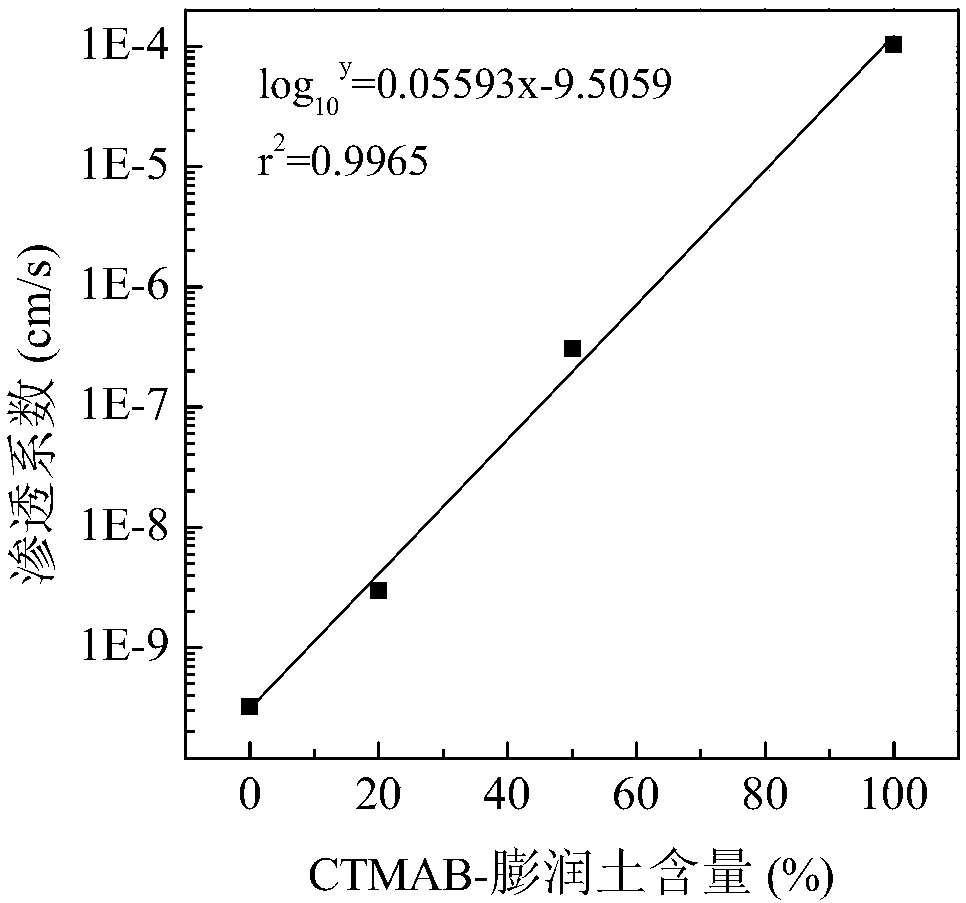
[0040] Several bentonite materials with a water content of 30% and different amounts of CTMAB-bentonite were put into the ring cutter, and after being compacted with a hammer, the permeability coefficient of the material was measured by the method of variable water head permeability coefficient measurement.
[0041] Such as figure 1 As shown, the logarithmic value of the material permeability coefficient has a linear relationship with the content of organic bentonite, and the correlation coefficient r 2 is 0.9965. The total content of CTMAB-bentonite in the material is 10%, and the permeability coefficient is 1.13×10 -9 cm / s; the total content of CTMAB-bentonite in the material is 20%, and the permeability coefficient is 2.97×10 -9 cm / s, which are far lower than the national standard of 1×10 -7 cm / s.
Embodiment 2
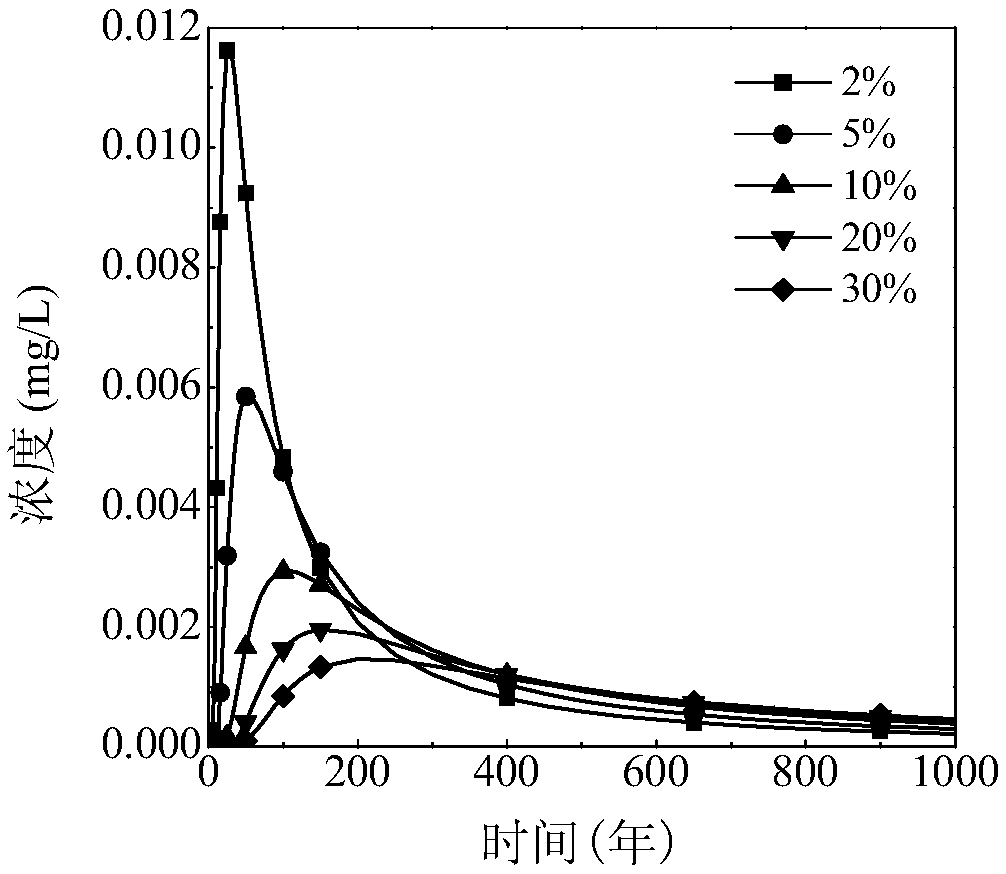
[0043] A one-dimensional transport model including convection, advection and laminar flow was used to simulate the migration of phenanthrene in a 5cm liner containing different ratios of CTMAB-bentonite, and the initial concentration was set to 1mg / L.
[0044] Such as figure 2As shown, after 30 years, phenanthrene penetrated the liner containing 5% CTMAB-bentonite, and the peak concentration was 0.0116mg / L; its penetration time in the liner containing 10% CTMAB-bentonite was extended to 50 years, and the peak value The concentration is reduced to 0.0058mg / L; further, its penetration time in the liner containing 20% CTMAB-bentonite is extended to 100 years, and the peak concentration is reduced to 0.0029mg / L; further, it is contained in 30% CTMAB -The penetration time in the bentonite liner is extended to 120 years, and the peak concentration is reduced to 0.0017mg / L; further, the penetration time in the liner containing 40% CTMAB-bentonite is extended to 160 years, and the ...
Embodiment 3
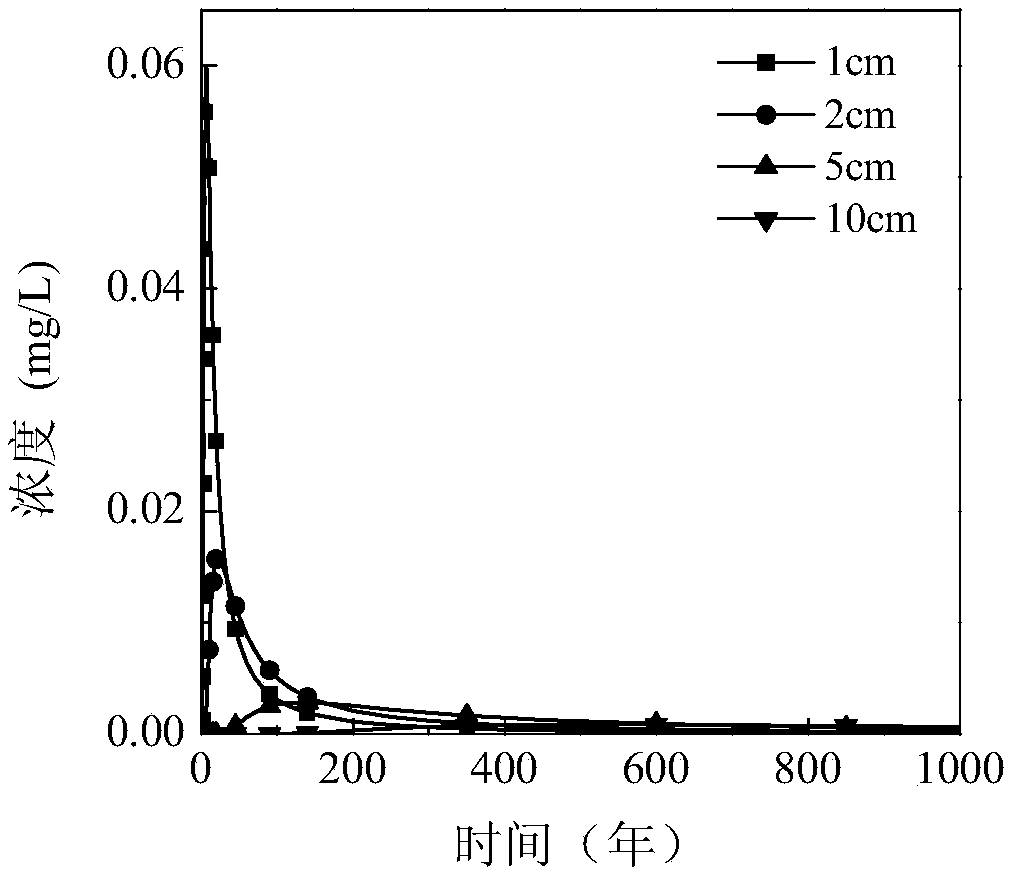
[0046] A one-dimensional transport model including convection, advection and laminar flow was used to simulate the migration of phenanthrene in liners containing 20% CTMAB-bentonite with different thicknesses, and the initial concentration was set to 1mg / L.
[0047] Such as image 3 As shown, after 6 years, phenanthrene penetrated the 1cm thick pad, and the peak concentration was 0.0601mg / L; further, the time for penetrating the 2cm thick pad was extended to 20 years, and the peak concentration decreased to 0.0151mg / L ; Further, the time it penetrates 5cm thick this liner prolongs to be 100 years, and peak concentration reduces to 0.0029mg / L; Further, the time that it penetrates 10cm thick this liner prolongs to 500 years, and peak concentration reduces to 0.0008mg / L. Considering that the service life of the landfill can generally reach 60-80 years, the thickness of the liner should be greater than 5cm.
PUM
| Property | Measurement | Unit |
|---|---|---|
| thickness | aaaaa | aaaaa |
| osmotic coefficient | aaaaa | aaaaa |
| osmotic coefficient | aaaaa | aaaaa |
Abstract
Description
Claims
Application Information
 Login to View More
 - R&D
- Intellectual Property
- Life Sciences
- Materials
- Tech Scout
- Unparalleled Data Quality
- Higher Quality Content
- 60% Fewer Hallucinations
Browse by: Latest US Patents, China's latest patents, Technical Efficacy Thesaurus, Application Domain, Technology Topic, Popular Technical Reports.
© 2025 PatSnap. All rights reserved.Legal|Privacy policy|Modern Slavery Act Transparency Statement|Sitemap|About US| Contact US: help@patsnap.com