

Fluorescence probe based on BODIPY type singlet oxygen
A fluorescent probe, singlet oxygen technology, applied in the field of fluorescent probes, to achieve the effects of high fluorescence quantum yield, low cytotoxicity, and high molar extinction coefficient
- Summary
- Abstract
- Description
- Claims
- Application Information
AI Technical Summary
Problems solved by technology
Method used
Image

Examples
Embodiment Construction
[0027] The following examples are only used to illustrate the present invention in detail and do not limit the scope of the invention in any way.
[0028] The synthesis of embodiment probe:
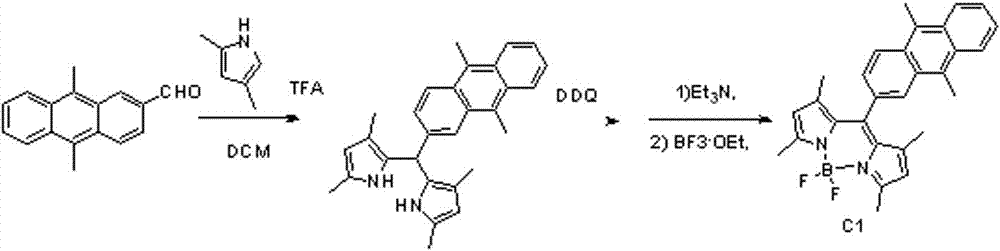
[0029] Accurately weigh 9,10-2-methyl-2-aldoanthracene (1.17 g, 5.0 mmol) dissolved in dry CH 2 Cl 2 (500 mL), under a nitrogen atmosphere, slowly drop into freshly distilled 2,4-dimethylpyrrole (1.1 mL, 12.5 mmol), and then add 0.1 mL of trifluoroacetic acid as a catalyst, the reaction solution gradually changed from clear to Turn into blood red, and react for 10 hours under stirring at room temperature. Then dichlorodicyanobenzoquinone (DDQ) (1.13 g, 5.0 mmol) dissolved in dry tetrahydrofuran was injected with a syringe, and the reaction was continued for 0.5 h under stirring at room temperature. Under the condition of ice-water bath, slowly add triethylamine (10.0 mL, 71.9 mmol), continue to stir for 15 min after the addition, then slowly add boron trifluoride diethyl ether (10.0 mL...
PUM
 Login to View More
 Abstract
Description
Claims
Application Information
 Login to View More