
A kind of preparation method of perovskite micro ring array
A technology of perovskite and perovskite precursors, applied in lead halide and other directions, can solve the problems of high cost, high difficulty in operation process, complicated equipment, etc., and achieve the effect of fast reaction speed, low difficulty in operation process and simple equipment
- Summary
- Abstract
- Description
- Claims
- Application Information
AI Technical Summary
Problems solved by technology
Method used
Image

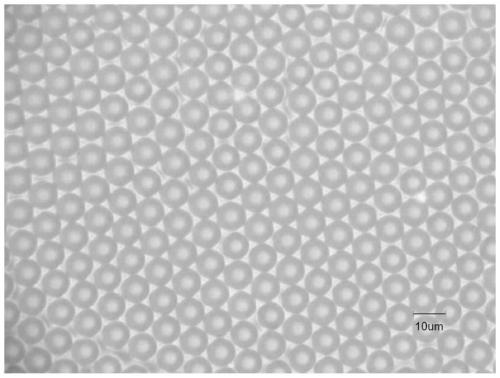
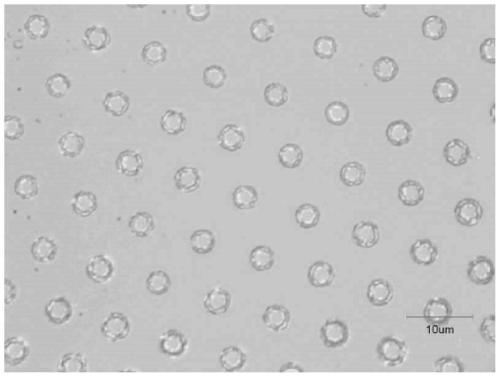
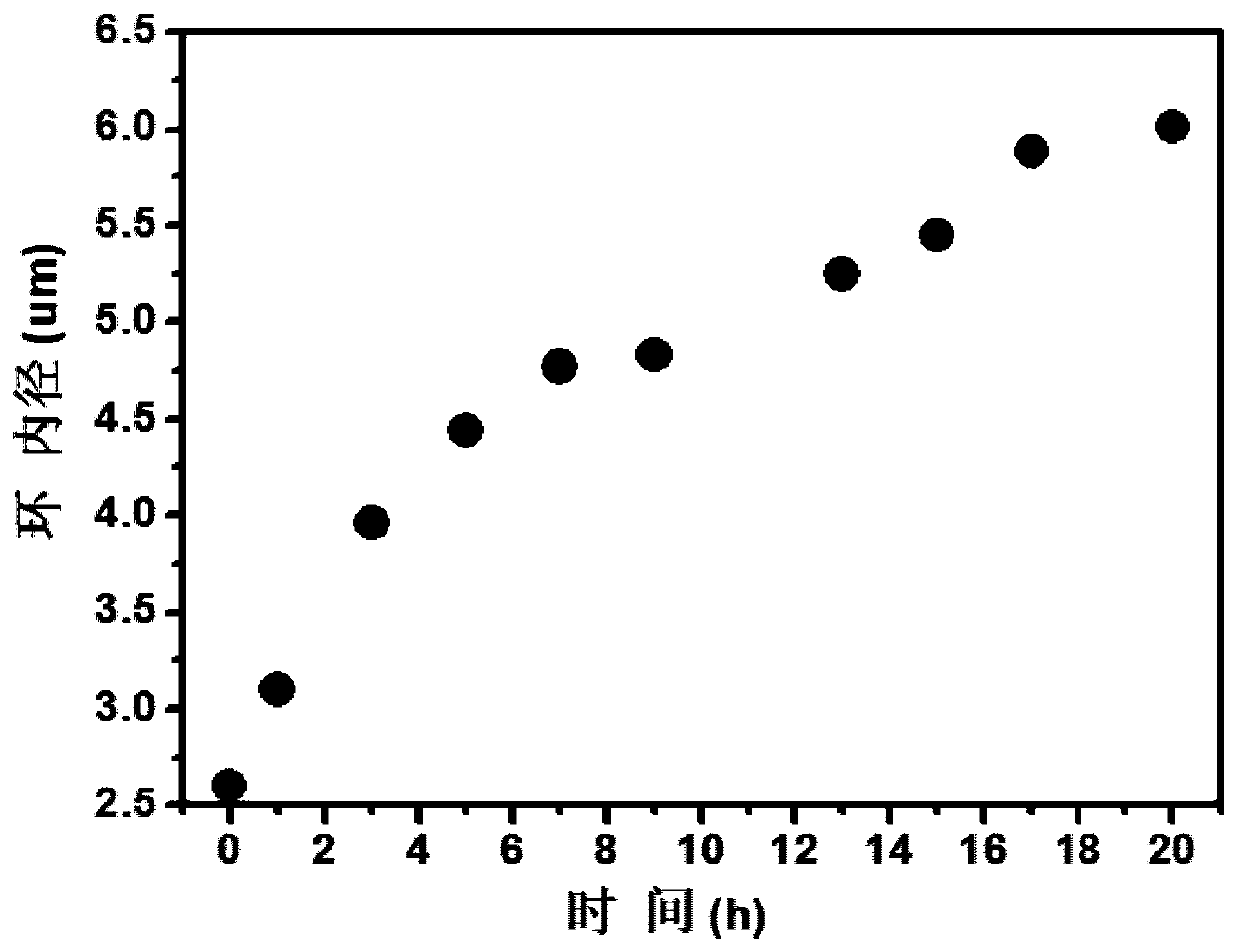
Examples
Embodiment 1
[0028] All-inorganic CsPbBr with an inner diameter of 2.5um 3 Fabrication of perovskite micro-ring arrays
[0029] 1) The glass substrate was sequentially filled with H at a volume ratio of 3:1 2 SO 4 / H 2 o 2 The mixed solution, acetone, isopropanol, ethanol and deionized water were ultrasonically cleaned; then dried with nitrogen and placed in an oven for later use, the suspension of polystyrene microspheres was dropped on the cleaned glass substrate, at 80rpm Spin-coat at a speed of 100°C, and after the water evaporates, a colloidal monolayer template is obtained, wherein the particle size of the polystyrene microspheres is 8um, and the solid content of the emulsion of the polystyrene particles in the polystyrene microsphere suspension is 5.0wt%;
[0030] 2) Mix 1mmolCsBr and 1mmolPbBr 2 Dissolve in 10mL dimethyl sulfoxide to obtain a precursor solution of perovskite;
[0031] 3) Spin-coat the perovskite precursor solution on the colloidal single-layer template at a s...
Embodiment 2
[0035] All-inorganic CsPbBr with an inner diameter of 6um 3 A method for preparing a perovskite micro-ring array, comprising the steps of:
[0036] 1) The glass substrate is sequentially filled with H at a volume ratio of 7:32 SO 4 / H 2 o 2 The mixed solution, acetone, isopropanol, ethanol and deionized water were ultrasonically cleaned; then dried with nitrogen and placed in an oven for later use. Drop the suspension of polystyrene microspheres on the cleaned glass substrate and spin-coat at a speed of 60 rpm. After the water evaporates, place it on a heating platform and heat it at 100°C for 20h or 110°C for 1h, then cool it down to room temperature naturally to obtain A colloidal monolayer template, wherein the particle size of the polystyrene microspheres is 10um, and the solid content of the polystyrene microparticle emulsion in the polystyrene microsphere suspension is 2.5wt%;
[0037] 2) Mix 0.8mmolCsBr and 1mmolPbBr 2 Dissolve in 10mL dimethyl sulfoxide to obtain ...
Embodiment 3
[0041] All-inorganic CsPb(Cl) with an inner diameter of 2.5um 0.3 Br 0.7 ) 3 Fabrication of perovskite micro-ring arrays
[0042] 1) The glass substrate was sequentially filled with H at a volume ratio of 8:3 2 SO 4 / H 2 o 2 The mixed solution, acetone, isopropanol, ethanol and deionized water were ultrasonically cleaned; then dried with nitrogen and placed in an oven for later use. Drop the suspension of polystyrene microspheres on the cleaned glass substrate and spin-coat at a speed of 80 rpm. After the water evaporates, place it on a heating table and heat it at 110°C for 1 hour, then cool it down to room temperature naturally to obtain a colloidal single-layer template; Wherein the particle size of the polystyrene microsphere is 9um, and the solid content of the emulsion of the polystyrene microsphere in the polystyrene microsphere suspension is 3.5wt%;
[0043] 2) 1mmolCsBr, 0.7mmolPbBr 2 and 0.3mmolPbCl 2 Dissolve in 10mL dimethyl sulfoxide after mixing to obtai...
PUM
| Property | Measurement | Unit |
|---|---|---|
| emission peak | aaaaa | aaaaa |
| emission peak | aaaaa | aaaaa |
Abstract
Description
Claims
Application Information
 Login to View More